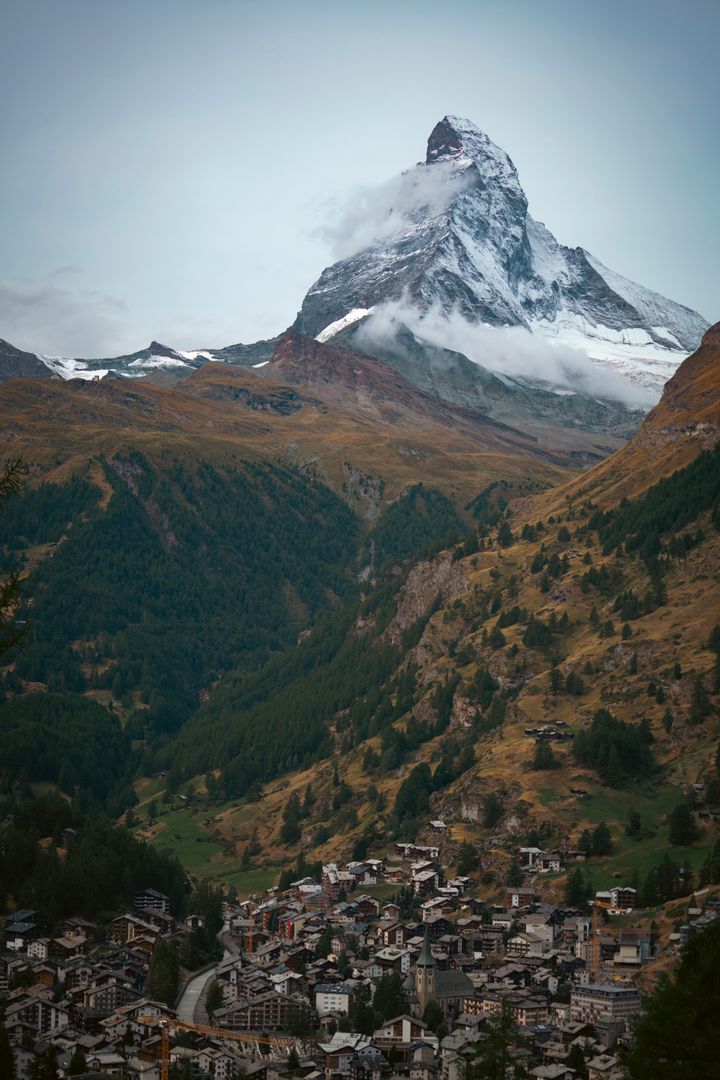

Switzerland charges what it charges. A coffee is CHF 4.50–5.50, a supermarket sandwich costs CHF 8–12, and a mid-range hotel room in the Alps runs CHF 150–250. These are not tourist prices — they're what Swiss residents pay too, because the cost of living is among the highest in the world. The mountains compensate: the Eiger north face above Grindelwald, the Matterhorn above Zermatt, and the Jungfrau glaciers are all genuine. The question is how to structure a trip so you see them without the bill spiralling past what you budgeted.
Interlaken and the Bernese Oberland
Interlaken sits between two lakes at the foot of the Jungfrau mountain group and is the main gateway to the Bernese Oberland. The town itself is functional rather than atmospheric — a transit hub with good transport connections rather than a destination in its own right. The surrounding area is the reason to come.
Grindelwald, 20 minutes by train from Interlaken, sits directly below the Eiger and has better mountain views than Interlaken itself. The Männlichen ridge walk from Wengen (4km, mostly flat, spectacular views of the Eiger, Mönch, and Jungfrau) is one of the best free Alpine walks in the region — take the cable car up (CHF 36 return) and walk across. The Jungfraujoch ("Top of Europe" at 3,454m, accessed by cogwheel railway) costs CHF 145–200 return and is simultaneously very impressive and very crowded. Clear skies are essential; check the webcam before booking.
Lauterbrunnen valley, 20 minutes from Interlaken by train, has 72 waterfalls and two cliff-top villages (Wengen and Mürren) accessible only by cable car or train. Mürren is car-free and has a scale that Grindelwald, which has grown with tourism, has partly lost. Staubbach Falls, dropping 297m directly behind the village, is free to walk to.
Zermatt and the Matterhorn
Zermatt is a car-free village at 1,600m with the Matterhorn (4,478m) rising directly above it. The mountain is photographed so often that seeing it in person carries a slight surreality — it looks exactly like the image, which is either satisfying or anticlimactic depending on your disposition.
The Gornergrat cogwheel train (CHF 99 return, Swiss Travel Pass gives 50% discount) climbs to 3,089m with direct views of the Matterhorn and Monte Rosa massif. Sunrise from the top is worth the early start. The Klein Matterhorn cable car (Matterhorn Glacier Paradise, CHF 105 return, highest cable car in Europe at 3,883m) reaches year-round snow and a ski area that operates in summer. Both are excellent on clear days, pointless in cloud.
Zermatt is more expensive even than the Swiss average. A hotel room runs CHF 200–400 in season; restaurant main courses run CHF 30–60. The supermarket (Coop or Migros) is the practical solution for lunch. Cars are not permitted in Zermatt — arrive via Täsch and take the 12-minute shuttle train (CHF 18 return).
The Swiss Travel Pass: When It's Worth It

The Swiss Travel Pass gives unlimited travel on trains, buses, boats, and most urban transit for a fixed number of days (3, 4, 6, 8, or 15 consecutive days). The 8-day pass costs CHF 544 for second class. It also gives free entry to 500 museums and 50% discounts on mountain railways and cable cars.
Whether it pays off depends entirely on your itinerary. If you're moving between cities and doing two or three major mountain excursions, it typically covers its cost. If you're staying in one region for a week and taking trains occasionally, point-to-point tickets are cheaper. Run your planned journeys through the SBB fare calculator before committing. The pass is sold outside Switzerland at a slight discount.
Best Time to Visit the Swiss Alps
July and August are the peak months with the best guaranteed weather and the highest prices. Accommodation books out months ahead in Zermatt and Grindelwald. June and September are the shoulder months: weather slightly less certain but often excellent, prices 20–30% lower, and trails quieter. The Alpine wildflower season peaks in late June and early July.
Winter (December–March) transforms the region into a ski destination. Lift passes run CHF 70–100 per day. The Jungfraujoch and Zermatt glacier areas are open year-round for non-skiers.
Getting Around Switzerland
Swiss trains are famously punctual and cover almost every town of any size. The Interlaken–Zermatt connection requires a change (typically via Bern and Visp) and takes about 2h30. Lucerne is 2 hours from Interlaken and 3h30 from Zermatt. Geneva and Zurich are the main international entry points, both connecting to the Alpine regions in 2–3 hours by train.
Car rental is possible but less necessary than in most countries. Summer roads are fine; winter requires winter tyres and snow chains for mountain passes, several of which close seasonally.
Practical Costs

Budget CHF 80–130 (around €85–140) per person per day for food, transport, and two to three activities, excluding accommodation. A hostel dorm runs CHF 40–55; a mid-range hotel room CHF 150–250. The Migros and Coop supermarkets are the practical solution for breakfast and lunch — a filled roll and coffee costs CHF 7–9. Restaurant dinners run CHF 25–45 for a main course. The cost is real but the density of free hiking and viewpoints means you can control the daily total more than the accommodation price alone suggests.