
Getting There from Cebu
Bohol is most commonly reached from Cebu City. OceanJet and SuperCat operate fast ferries between Cebu City's Pier 1 and Tagbilaran, Bohol's capital, in roughly two hours. Ferries run multiple times daily; fares are 500–700 PHP each way depending on the operator and seat class.
Slower RoRo (roll-on, roll-off) ferries make the same crossing in four hours at lower cost — practical if you're bringing a motorbike. Direct flights connect Manila and Tagbilaran (1.5 hours) and Cebu and Tagbilaran (25 minutes) via Cebu Pacific and Philippine Airlines. Most international visitors fly direct to Tagbilaran from Manila rather than connecting through Cebu.
The Chocolate Hills
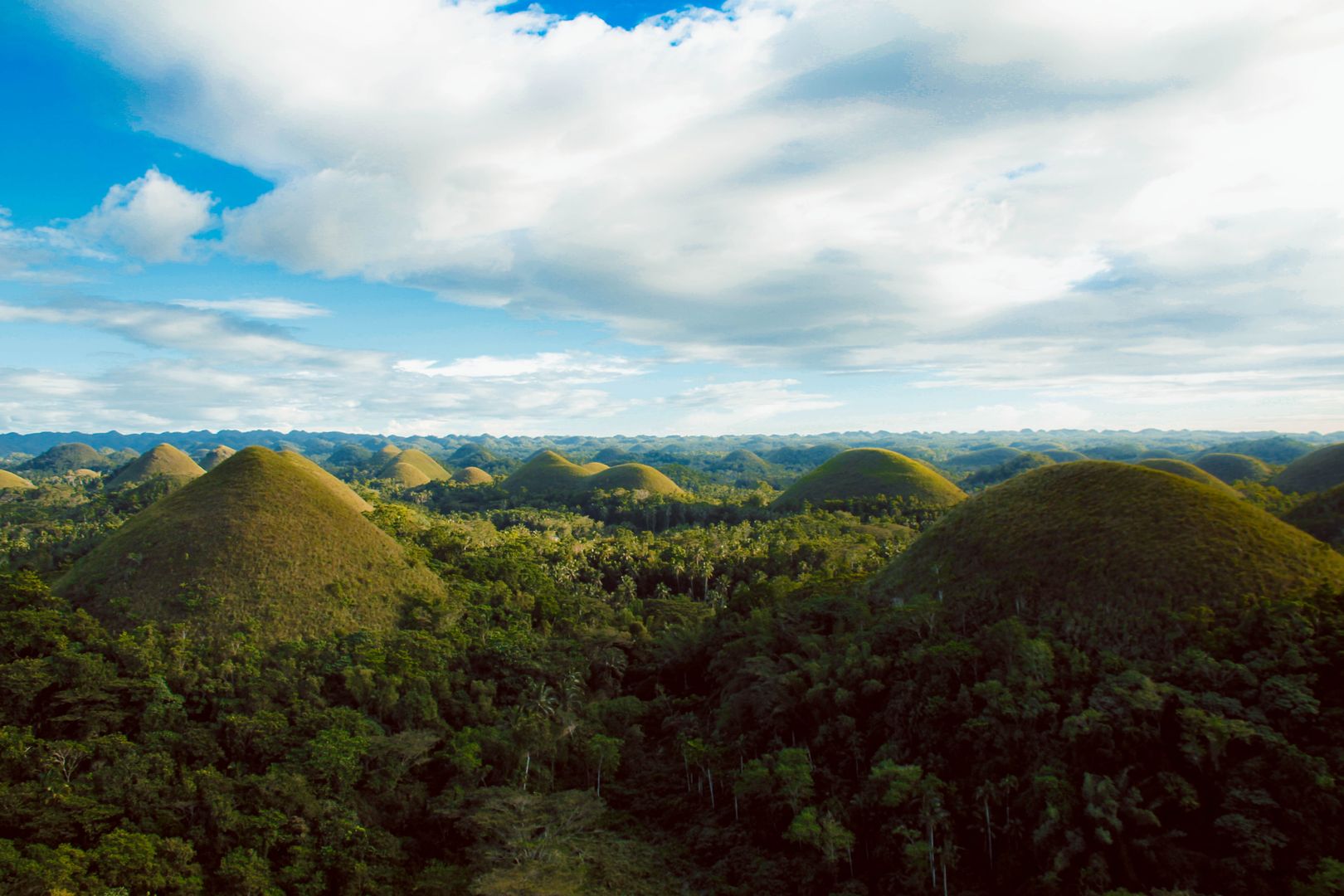
The Chocolate Hills are a geological anomaly: 1,268 near-identical conical limestone hills spread across 50 square kilometres of the Bohol interior. They rise 30–120 metres, separated by flat agricultural land. During the dry season (March–May), the grass covering them dries to a chocolate-brown — the name is literal. In the wet season they're uniformly green.
The main viewing complex is in the municipality of Carmen, 55 km from Tagbilaran. Stairs lead to an observation deck where 1–2 km of the formation stretches in front of you. On a clear day the visual effect — dozens of smooth, identically-shaped cones extending to the horizon — is genuinely unusual. It looks less like a natural landscape than a constructed one. Entrance is around 100 PHP.
A more immersive option for those with a full day: rent a motorbike and ride through the formations rather than viewing from the deck. Roads thread between the hills at ground level, and several informal viewpoints off the main complex have fewer visitors and a different sense of scale. The hills are a National Geological Monument and a UNESCO-recognised site.
Philippine Tarsier Sanctuary
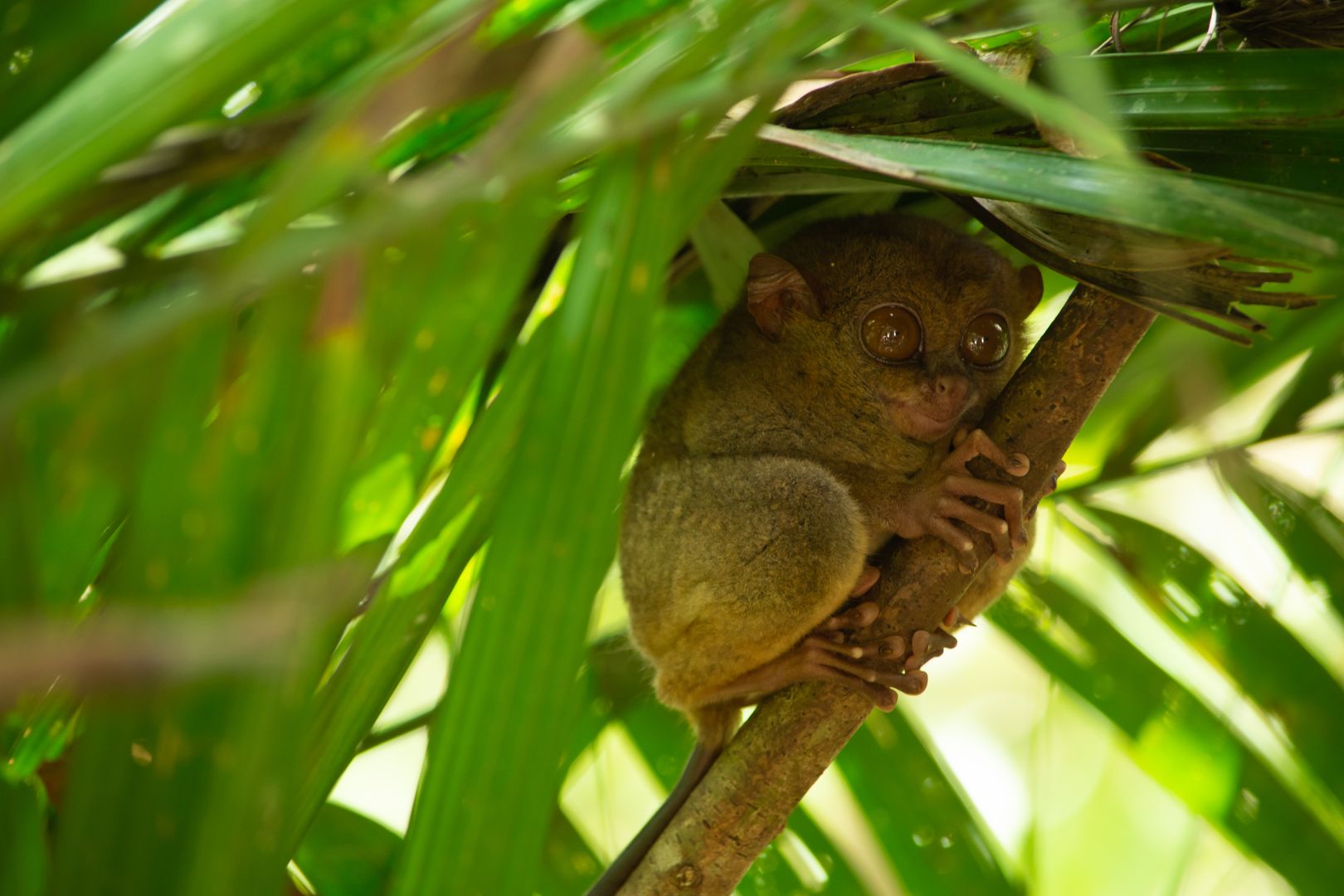
The tarsier is one of the world's smallest primates — body length 10–15 cm, with fixed eyes proportionally larger relative to skull size than any other mammal, and the ability to rotate its head 180 degrees. The Philippine tarsier (Carlito syrichta) exists only in the southern Philippines and is threatened by habitat loss and the illegal pet trade.
The Philippine Tarsier Foundation sanctuary in Corella, 14 km from Tagbilaran, is the welfare-focused option. Animals live in a forested enclosure in semi-wild conditions. Viewing is in small guided groups with no touching and no flash photography — the tarsier's stress response to handling can include self-harm and death. Guides locate the animals in the undergrowth; most are resting during daytime hours. You observe from close range, typically at eye level with a small primate on a low branch staring back at you with eyes that appear too large for its face.
Tours last 30–40 minutes. Entrance around 80 PHP. The Tarsier Research and Development Center in Loboc is an alternative with more animals and more commercial infrastructure; the Corella sanctuary prioritises research and has lower visitor density.
Loboc River
The Loboc River flows through Bohol's forested interior before reaching the sea near Loay. Floating restaurant boats run lunch cruises from Loboc town upstream through the forest canopy. Buffet lunch is included in the fare (around 400–600 PHP per person). The experience is touristic — slow boat, riverside communities, cultural performances staged for passing boats — but comfortable and practically the only way to see this part of the river properly.
Most Bohol countryside tours combine the Chocolate Hills, tarsier sanctuary, and Loboc River into a single day from Tagbilaran. Organised van tours run 1,200–2,500 PHP per person depending on group size, or you can cover the circuit independently by motorbike. The distances are manageable: Tagbilaran to Corella (14 km), Corella to Loboc (24 km), Loboc to Carmen (55 km), and back to Tagbilaran via an alternative route (around 60 km).
Panglao Island and Alona Beach
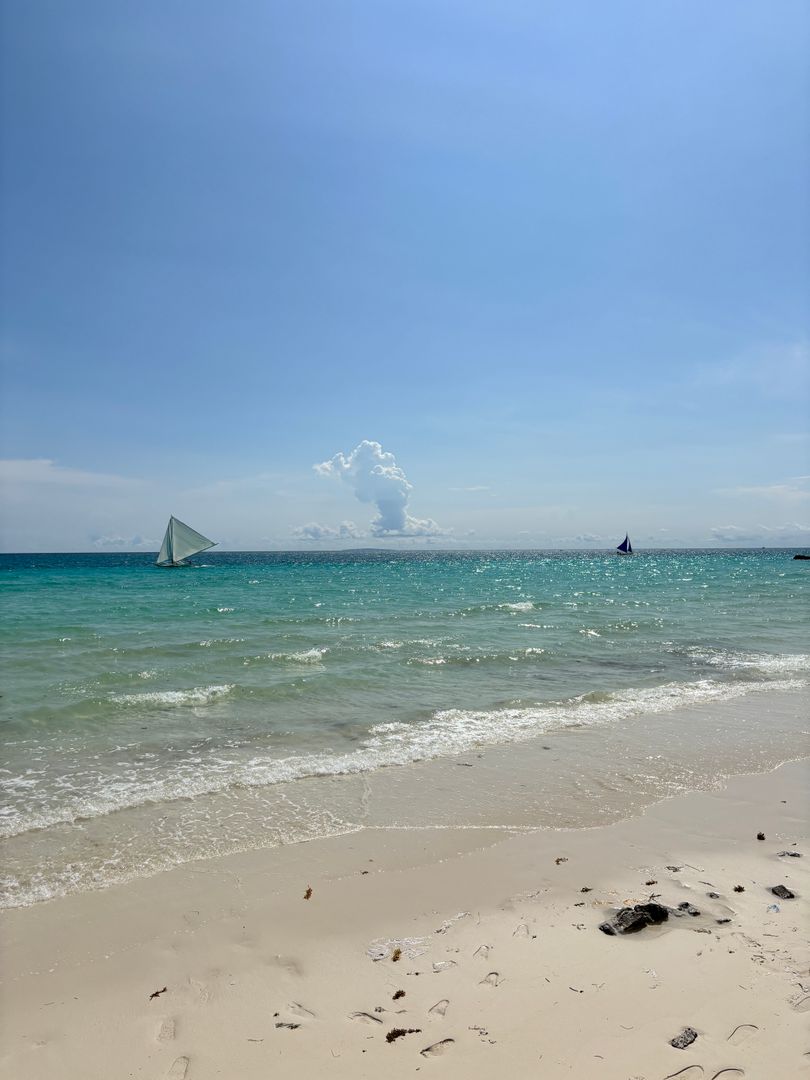
Panglao Island sits 2 km off Bohol's western coast, connected by two road bridges. It's where most beach accommodation is concentrated and the base for diving in the area. The Bohol Sea has good marine biodiversity, and Balicasag Island — 30 minutes by boat from Panglao — is one of the better dive sites in the Philippines: sea turtles, wall dives to 40 metres, and dense fish schools at a relatively uncrowded site.
Alona Beach on Panglao's southern coast is the dive and beach hub — a 600-metre stretch of sand with guesthouses, dive shops, and restaurants behind it. The beach shows wear: boats moor directly on the sand, and the space is tight at peak season. The diving access compensates if that's the priority.
Budget guesthouses at Alona run 500–700 PHP per night; small beachfront cottages are 2,000–4,000 PHP. Dive packages typically include two dives with equipment for 1,500–2,500 PHP.
When to Go

December through May is the dry season and the main tourist window. March–April gives the most photogenic Chocolate Hills (fully brown) but inland touring can be hot. November through January is cooler and drier.
June through October is rainy season. Diving visibility can drop and some operators reduce schedules. Typhoons occasionally affect the region. Basic touring continues.
Frequently Asked Questions
How many days do you need in Bohol?
Two full days covers the countryside tour (Chocolate Hills, tarsiers, Loboc River) and a day at Panglao with diving or snorkelling. Three days allows both at a relaxed pace with time for a trip to Balicasag Island.
Can you combine Bohol and Cebu in one trip?
Yes — most travellers pass through Cebu and take the fast ferry to Bohol as part of the same trip. A combined itinerary of 7–10 days covers both islands without rushing.
Is it better to stay in Tagbilaran or Panglao?
Tagbilaran is more convenient for transport and the countryside circuit. Panglao is better if diving and beach time are the priority. Many visitors split nights between both. The drive between them takes about 20 minutes.
Are the Chocolate Hills worth the trip?
Yes. They're genuinely unusual — nothing else looks quite like them in the region. The full countryside circuit can be done in a long day from Tagbilaran without staying overnight if time is limited.