Cebu is the Philippines' second city by population and its most connected island beyond Luzon and Palawan. Mactan–Cebu International Airport receives direct flights from Seoul, Tokyo, Singapore, Hong Kong, and Kuala Lumpur, making it the most practical entry point to the Visayas region for travellers coming from Asia. The island itself is long and narrow — 225km from tip to tip — and the tourist activity concentrates in three areas: Cebu City in the north, the dive sites around Moalboal on the west coast, and Oslob in the south where whale sharks are fed for tourists. The surrounding islands — Bohol, Malapascua, Bantayan — are all within a few hours by ferry.
Cebu City: How Long and What to See
Cebu City is a functioning Philippine city of 1 million people, not a beach resort. One full day is enough to cover what matters: the Basilica Minore del Santo Niño (the oldest Roman Catholic church in the Philippines, built 1565, still holding multiple daily masses with genuine congregations), Magellan's Cross (planted by the Portuguese explorer in 1521 on his arrival and now housed in a small chapel on the same site), and the Yap-San Diego Ancestral House (a Chinese-Filipino merchant house from the 17th century, one of the oldest surviving houses in the country). Fort San Pedro, a triangular Spanish fortification from 1565, gives context for the colonial period and charges ₱30 entry.
The Carbon Market, running 24 hours, is the oldest public market in Cebu and the practical heart of the city — produce, dried fish, street food, and the chaotic efficiency of a market that serves a million people. The Lahug and Ayala districts to the north have the best concentration of restaurants; IT Park is the late-night food strip.
Oslob Whale Sharks: The Reality
The whale shark interaction at Oslob, 3 hours south of Cebu City, is one of the most-visited wildlife experiences in Southeast Asia and one of the most debated. Local fishermen started feeding whale sharks to attract them in 2011; the programme grew rapidly and now receives roughly 600,000 visitors per year. The sharks are present year-round because they are fed daily — this is not a natural aggregation. Research published in biological journals has documented behavioural changes in the Oslob sharks consistent with conditioning and possible nutritional deficiency from the shrimp-based feeding diet.
The experience itself is close: you snorkel alongside sharks 6–8 metres long, sometimes more than a dozen at once. The entry fee is ₱1,500 (€27) for snorkelling, more for diving. Conservation organisations recommend against it. The local fishing community depends on it economically. If you go, the official briefing rules (no touching, 4-metre distance, no sunscreen) are regularly ignored by both operators and other tourists; budget 30 minutes of actual water time.
The alternative: Donsol in Sorsogon province (6 hours from Manila) has seasonal but genuinely wild whale shark aggregations from November through June, with strict no-feeding regulations and a well-managed interaction programme.
Moalboal and Sardine Run
Moalboal, on Cebu's west coast 90km south of the city, has the best diving on the island. The Pescador Island dive site offshore has walls and overhangs with good visibility and pelagic fish. The sardine run — a bait ball of millions of sardines that congregates offshore year-round, unusual for being a permanent rather than seasonal phenomenon — is accessible by snorkelling 50m from the beach. No boat needed; the sardines are there at 5–10m depth most mornings. Entry to the beach is ₱50.
Accommodation in Moalboal runs ₱800–2,000 per night for a basic guesthouse or dive resort. The vibe is quiet dive-and-snorkel focused rather than beach party. The buses from Cebu City South Bus Terminal take 2–2.5 hours and cost ₱80.
Nearby Islands: Bohol and Malapascua
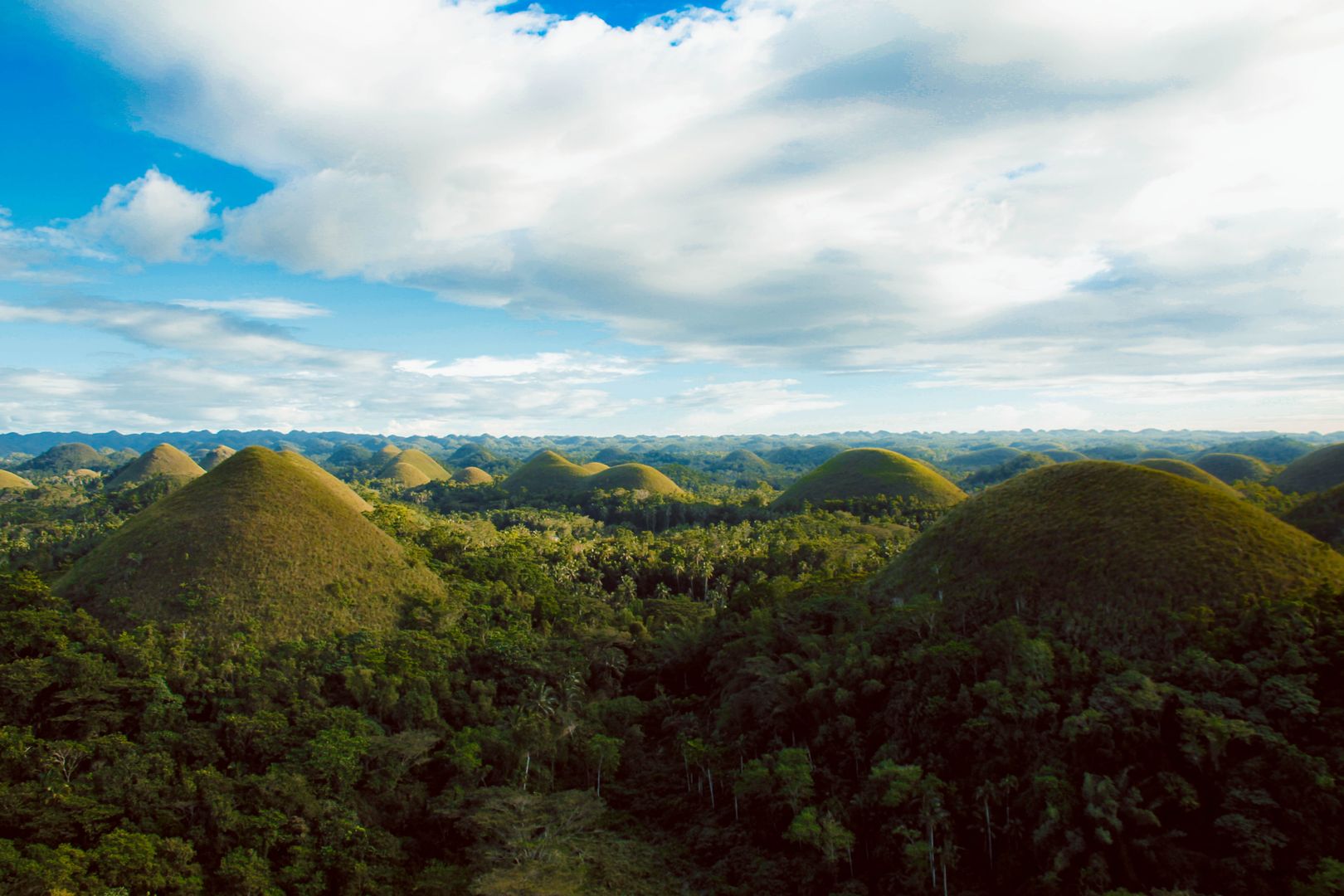
Bohol, 2 hours by fast ferry from Cebu City (₱350–600), has two things not found elsewhere: the Chocolate Hills (1,260 roughly symmetrical geological mounds that turn brown in the dry season, genuinely strange looking) and the tarsier, the world's smallest primate. The Philippine Tarsier Sanctuary near Corella is the ethical viewing option — the animals are wild and nocturnal, visible during daytime torpor on branches at eye level; the staff enforce no-flash photography and limited visit times. Panglao Island, connected to Bohol by bridge, has the most popular beach (Alona Beach) and accessible diving, though the beach has become very crowded.
Malapascua, a small island 45 minutes by outrigger from the northern tip of Cebu, is one of the few places in the world to reliably dive with thresher sharks. They visit a cleaning station at 25–30m depth from around 6am; the dive briefing happens at 4:30am. Aside from shark diving, the island has two beaches and a handful of guesthouses; there is very little to do in the evenings, which suits some travellers and frustrates others.
Practical Information
Cebu City South Bus Terminal serves Moalboal, Oslob, and the southern half of the island. North Bus Terminal serves Bantayan and connections to Malapascua. Jeepneys and V-hire (shared minivans) are the local transport; both are cheap (₱10–50) and frequent. Grab operates in Cebu City. Renting a motorbike runs ₱400–600 per day and is the most practical way to explore the coast independently.
The Philippine peso sits around ₱57 per euro and ₱56 per US dollar. A guesthouse room runs ₱800–1,500 per night outside tourist centres; a meal at a local carinderia (cafeteria) costs ₱100–200; a restaurant meal ₱300–600. Daily costs of €25–45 are realistic for budget to mid-range travel outside Cebu City.