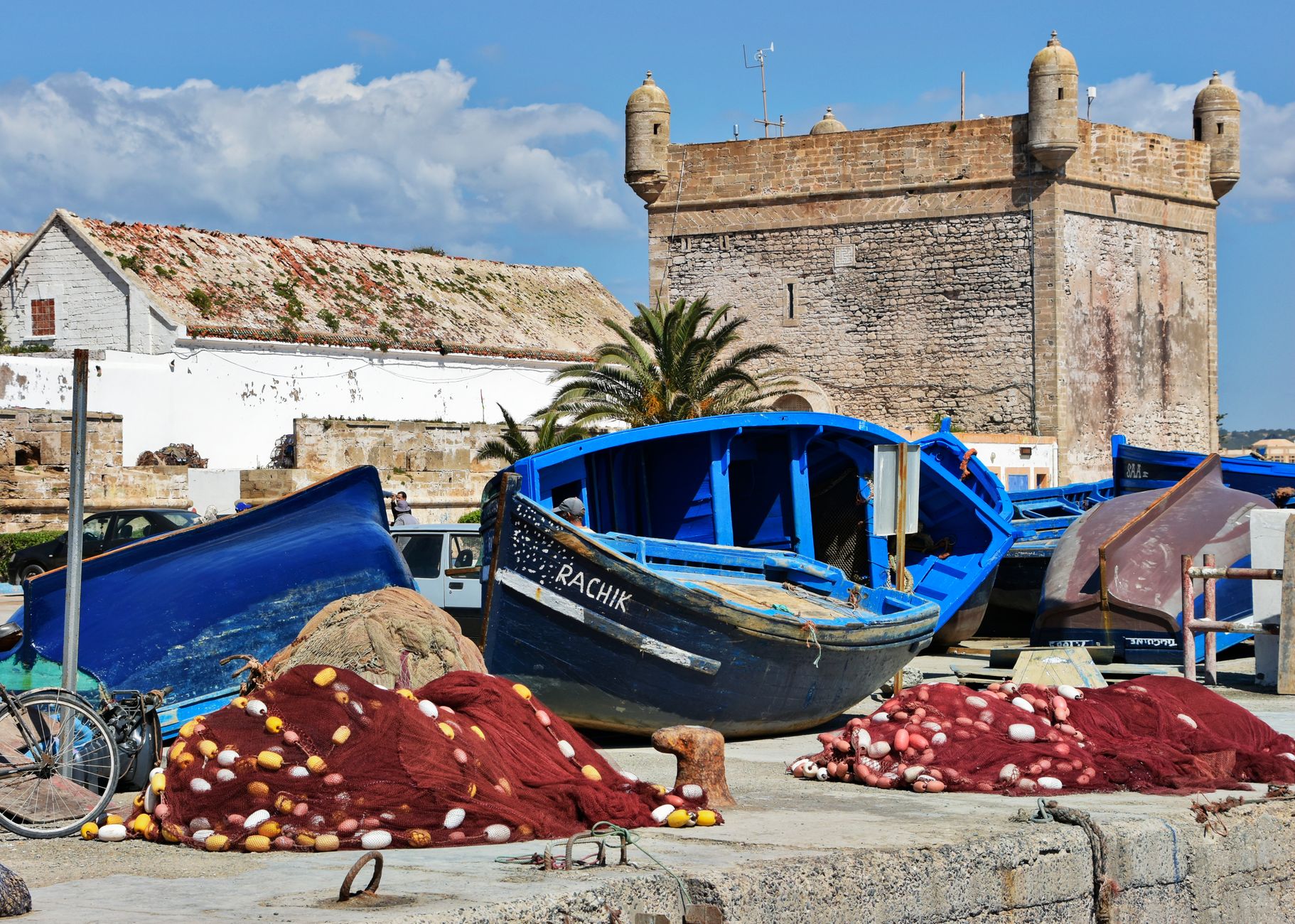

Essaouira is a walled Atlantic port 175km southwest of Marrakech, enclosed by 18th-century fortifications designed by a French military architect (Théodore Cornut, under the Alaouite Sultan Sidi Mohammed ben Abdallah). The medina is UNESCO World Heritage. The consistent trade winds off the Atlantic from May to September have made the coast south of the walls one of the better kitesurfing destinations in the world. And the town has the most concentrated gnawa music community in Morocco. These are its three distinct features; everything else follows from them.
Getting There from Marrakech
CTM bus: the most reliable option. Approximately 4 departures daily from Marrakech's CTM terminal (near Bab Doukkala). Journey time 3–3.5 hours, around 70 MAD (€7). Arrives at Essaouira's bus station near Bab Marrakech, 15 minutes' walk from the medina entrance.
Grand taxi: shared long-distance taxi from the Bab Doukkala taxi rank in Marrakech. Departs when the taxi has 6 passengers. Around 80–90 MAD per person, 2.5 hours. Faster but less predictable for timing.
Organised day trips from Marrakech (€30–50/person) give around 5 hours in town — manageable for the ramparts and port, not for eating well and walking at leisure. An overnight stay is a better investment.
The Medina
The Essaouira medina is more legible than Marrakech's — the main commercial streets run identifiably north-south, the grid is more rectangular, and the scale is smaller. The blue-and-white colour scheme is genuine rather than styled for visitors.
Skala de la Ville: the sea-facing rampart walk along the western edge of the medina. Restored bronze cannons (Portuguese and Spanish, 16th–18th century) point west toward the Atlantic. The best sunset position in town. Free to walk.
Skala du Port: the harbour fortification at the southern edge, overlooking the working fishing harbour. Entry approximately 10 MAD. From the top: the blue boats, the seagulls, the fish boxes on the quay.
The main souks: concentrated along Rue Sidi Mohammed Ben Abdallah and Rue Mohammed El Qorri. Essaouira's souk is more relaxed than Marrakech — less pressure, more browsing. The local specialty craft is thuya wood inlay work, using burl wood from the Tetraclinis articulata (a cypress relative local to the region). Argan oil cooperatives along the main streets sell genuine pressed oil (culinary and cosmetic) at fixed prices.
Mellah: the former Jewish quarter in the northern medina. Essaouira had a significant Sephardic community through the 19th century — most emigrated after 1948. Several historic synagogues remain, some accessible by arrangement.
The Port and Fish

The fishing harbour south of the walls is active and functional. The quayside fish stalls let you choose a fish by weight (sea bream, sardines, swordfish, monkfish, depending on what's been landed) and have it grilled on outdoor charcoal immediately — 50–80 MAD for a full plate. This is not a tourist reconstruction. The turnover is fast and the freshness is evident.
Chez Sam is a longstanding restaurant inside a converted boat hull at the port entrance. Mid-range prices, unusual setting, reliable fish.
Wind and Water Sports
The alizé trade winds produce consistent 20–30 knot conditions along the coast from May to September, making the beach south of the medina walls one of the better kitesurfing and windsurfing locations in the world. Several established schools operate on the Plage d'Essaouira. The same winds keep air temperatures at 22–26°C through summer — significantly cooler than Marrakech's 38°C in July and August — while the rest of Morocco bakes. This makes Essaouira the rational summer choice among Moroccan coastal towns.
Gnawa Music
Gnawa is a spiritual trance-music tradition originating in sub-Saharan Africa, brought to Morocco through the trans-Saharan trade routes. The music uses the guembri (three-stringed bass lute) and qaraqeb (iron castanets), with call-and-response vocal structures. It combines Islamic elements with older African spiritual practices and is associated with healing ceremonies (lila).
Essaouira has the most concentrated gnawa community in Morocco. The Gnaoua and World Music Festival (held in late June, four days) has run since 1998 and is one of the larger music events in Africa, drawing 400,000–500,000 attendees. Outside festival season, gnawa performances happen in the evenings around Place Moulay Hassan and in small venues in the medina — ask at accommodation for current locations.
When to Go

October–April: lowest visitor numbers, pleasant temperatures (14–20°C), the wind lighter and more variable. The most comfortable time for unhurried medina exploration.
June (pre-festival) and September: warm, manageable crowds, the wind starting or tapering. Reasonable prices.
July–August: the peak wind season, still moderate in temperature (23–27°C due to the Atlantic influence), and the busiest months. The town functions well under the pressure.
Late June (Gnawa Festival): hotels book out months in advance. Go specifically for the music; a casual visit during this period is impractical.
Accommodation
Riads inside the medina (€40–100/night) are the most atmospheric option — the house-with-courtyard format works well in the Atlantic climate, which is cooler and less oppressive than a Marrakech riad in summer. Hotels outside the walls are cheaper. Book ahead for July–August and the festival period.
Frequently Asked Questions
How does Essaouira compare to Marrakech?
Essaouira has a fraction of Marrakech's visitor numbers, a more navigable medina, Atlantic air that keeps temperatures down in summer, and a slower pace. It lacks Marrakech's historic palace architecture and concentrated craft production. As a complement (2–3 days in each), they cover both Atlantic and interior Morocco. As a standalone destination, Essaouira works for visitors who prioritise atmosphere over monuments.
Is the wind always this strong?
May to September: persistent. It's the defining feature of the coastal experience in those months and affects beach leisure. October–April it lightens considerably.
What should I buy in Essaouira?
Thuya wood items (boxes, frames, backgammon sets) made from local burl wood are the distinctive craft. Argan oil from cooperatives with fixed pricing. Avoid street-vendor "certified" oil, which is rarely what it claims.
Is Essaouira safe to walk around at night?
The medina is relaxed compared to Marrakech — fewer touts, better-lit main streets, more local foot traffic in the evenings. Standard attention to surroundings applies; serious crime is not a significant concern in the tourist areas.
Can I combine Essaouira with Agadir?
Yes — Agadir is 2.5 hours south by CTM bus. The combination works as a southern Morocco circuit: Marrakech → Essaouira (3 hours) → Agadir (2.5 hours) → fly home from Agadir, which has direct European connections.


