Marrakech is a functioning city of 1.2 million people built around a 1,000-year-old medina, not a heritage site that happens to contain residents. Most first-timers expect it to feel like a larger version of European old towns—manageable, predictable, visually coherent. It isn't. The medina disorients intentionally in places. But the intensity is structural, not dangerous: it requires different navigation confidence than Paris or Bangkok, not a higher security threshold. You navigate it by learning three anchor points and understanding that every negotiation, persistent tout offer, and unmarked doorway follows rules you'll recognize once explained.
What the medina actually is: 200,000 people in a UNESCO-listed maze
The medina is a walled city built over roughly one thousand years, with streets that predate mechanical vehicles and were never meant to be intuitive to outsiders. Approximately 200,000 people live inside the walls. You're not visiting a museum—you're moving through someone's neighbourhood, where a hardware merchant operates next to a shrine, and a teenager sells mobile phone credit from a window opening directly onto the street.
Navigation works through three fixed landmarks. Jemaa el-Fna—the main square, alive with musicians and food stalls—sits south-central in the medina. Rue Mouassine runs north from the square into the souks, past the Ben Youssef Mosque. The Bahia Palace stands southeast, a recognizable 19th-century palace complex. Everything else—leather quarter, spice market, metalworkers—spreads from those three points. You can walk north 10 minutes from Jemaa el-Fna and be completely away from tourists, in streets where shopkeepers are selling to locals. The souks aren't random. Historically, trades clustered together: metalworkers around Place des Ferblantiers, leather near the Chouara tannery, spices near Rahba Kedima square. This pattern persists, though with fewer absolute boundaries than it once had.
The single thing most guides get wrong: Jemaa el-Fna at night is not a tourist trap. It's both genuinely local and genuinely touristy simultaneously. Musicians play for passing locals. Acrobats perform for tourists. Food vendors serve both. Arrive by 6pm to see the square functioning—the energy shifts dramatically as darkness falls. Eat from the numbered stalls (numbers are painted on the carts). Avoid stall #1, which charges tourist markup; most others charge 60–80 MAD (€5–7) for a full grilled-fish dinner with bread and harissa. The experience requires no translation beyond pointing and nodding.
Negotiation in the souks follows a pattern so consistent it becomes mechanical. The first asking price is 3–5 times the actual asking price. Start at 30–40% of what they're requesting. Agree somewhere in the middle. Walking away without buying is acceptable and expected—in fact, it often causes the merchant to call you back with a final price. This isn't aggressive; it's how the system works. Understand the system and the friction vanishes.
Safety: pickpocketing, not violence; touts, not gangs
Marrakech's violent crime rate is lower than most European cities. Pickpocketing happens in dense crowds, particularly Jemaa el-Fna and the main souks around Ben Youssef Mosque. Phone snatching is less common than in Barcelona or Rome. This is not because Marrakech is unusually safe—it's because organised theft is less profitable in a city where most residents carry cash, not smartphones as status symbols.
The actual friction is different: aggressive tout behaviour. A man will walk beside you claiming to know a better route, or that your riad is closed, or that a shop ahead is having a special day. His script is to detach you from your original destination, get you somewhere quieter, and ask for money at the end. The response is immediate and unbothered: "La shukran" (no thank you) while continuing to walk. He will not follow more than 30 seconds. Repeat if necessary.
Three common scams cluster around free offers. A woman offers to apply henna; it's not free. A guide attaches himself to your walk without introduction; disengage within the first 30 seconds or you'll be asked for money. A spice shop invites you in for a "free demonstration"; you will be asked to buy at the end, often at significant markup. None of these are dangerous. They're commercial friction.
Solo women encounter additional intensity—more verbal attention, more persistence from touts, more direct commentary on clothing. Conservative dress (shoulders and knees covered) reduces this noticeably. Most solo women travelling in Marrakech report the experience as manageable rather than threatening. The key difference is staying in the medina rather than Gueliz (the new town). This keeps you within walking distance of everything and surrounded by residences, markets, and local movement rather than hotel streets. Nighttime: Jemaa el-Fna stays active until midnight; stick to the main square and visibly lit streets.
Getting around: walking in the medina, petit taxis outside it
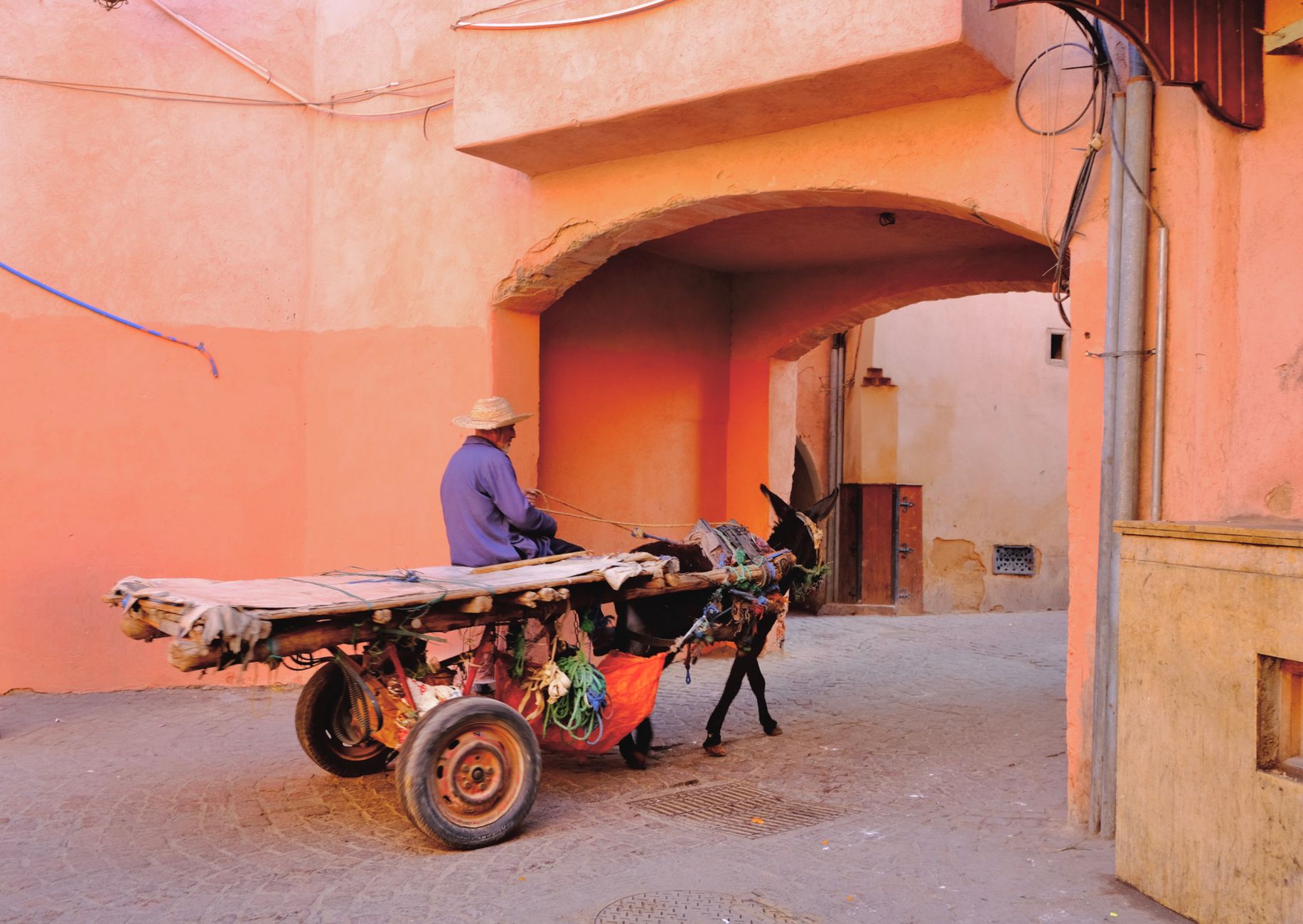
Inside the medina, walk. Streets are too narrow for cars; attempted deliveries by moped happen but are rare. This is the reality, not a limitation. You move as fast as a person walks, which is actually faster than sitting in traffic.
From the medina to Gueliz (the new town, where European-standard shops and restaurants are), use a petit taxi. These are shared taxis that run fixed routes. Agree on the fare before getting in—roughly 20–30 MAD (€2–3) for most trips. The driver will pick up other passengers; this is normal and reduces your share of the cost.
Your riad (traditional guesthouse) will rarely have a visible sign or a street number from the exterior. This is not a mistake. Instead, your accommodation sends GPS coordinates or a meeting point before you arrive. Save these. The entrance is usually an unmarked door opening directly onto a medina street. Once inside, the layout becomes apparent. This system—invisible from the street, revealed once entered—is genuine Moroccan residential architecture, not a quirk.
What to see and how long to spend
Bahia Palace: 14 rooms of 19th-century interiors with carved plaster and painted ceilings. €3 entry. Go at 8:30am when it opens; by 10am, groups have arrived. Most visitors spend 50 minutes here. The coherence of design is genuinely impressive—not hyperbolic restoration, but intact original work.
Saadian Tombs: historically important, architecturally significant. €2.50 entry. Plan 20–25 minutes. The tomb chambers are small; the value is in understanding the dynasty, not in scale.
Jardin Majorelle: Yves Saint Laurent's 1930s garden with intense blue-painted structures, exotic plants, and a small museum of Berber textiles. €10 entry. Deservedly popular. Queue before 9am or after 4pm to avoid coach groups. Allow 60–90 minutes.
Chouara Tannery: working leather tannery from the 11th century. Free entry to view from leather shops above it. You'll smell it before you see the dye pools. The sensory intensity is accurate—neither sanitized nor staged. Spend 20 minutes, buy nothing, or buy one small leather item if you wish.
Mellah (Jewish Quarter): less visited than the main souks, genuinely residential, with narrower streets and a different architecture pattern. More interesting to walk than the tourist-facing sections because there's less script. No fee.
Skip the Marrakech Museum if you only have three days in the city. Better to walk. Most visitors report disappointment relative to time spent.
How many days do you need?
Three days: Two full days exploring the medina thoroughly (covering the main souks, Jemaa el-Fna, the tannery, Bahia Palace, Mellah). One day trip: Ourika Valley (45 minutes by shared taxi, a river valley with Berber villages and waterfalls) or Essaouira (2.5 hours on a comfortable bus, a coastal city with real beach and fish restaurants). Evenings on Jemaa el-Fna. This works as a first visit.
Four to five days: Adds either an Atlas Mountain day (Imlil village and Toubkal foothills, 1.5 hours south) or an overnight in Essaouira. More time in the medina without rushing.
Seven days: Viable if you're adding Fez (4 hours by train; stay overnight, as Fès el-Bali medina takes a full day to navigate) or a 2-night desert camp near Merzouga in the Sahara (9 hours by road; flying from Errachidia back to Marrakech rather than driving is the sensible choice, though it costs more).
Most first-timers underestimate how much time the medina alone requires. Three days is appropriate; don't compress it into two days and a day trip.
Marrakech or Fez: which to visit first?

This is not a question of authenticity. Both cities are authentic and touristy simultaneously. It's a question of infrastructure and orientation difficulty.
Marrakech has better international-standard accommodation, easier taxi logistics, and a more legible medina. Navigation is possible after one confused walk. Fez's medina (Fès el-Bali) is significantly larger, has fewer streets that map onto any logical system, and has less tourist-adjusted infrastructure. Guides are nearly mandatory for first-timers. Hotels are harder to find by accident.
Visit Marrakech first. It teaches you the basic navigation logic of a Moroccan medina and your own tolerance for unstructured space. Fez comes second, after you've built that confidence. This isn't hierarchical—Fez is architecturally richer and more complex. But it's better undertaken after Marrakech.
When to visit: temperature is the primary variable
March to May (spring): 22–30°C, occasionally hitting 32°C. Comfortable. Rain is possible but light.
October to November (autumn): 18–26°C, ideal temperatures. Clear skies. This is peak season for tourists and prices reflect it. Book accommodation 6–8 weeks ahead.
June to August (summer): 40°C+ regularly; July hits 42°C. Walking in the medina during midday becomes impractical. If you must visit, spend 10am–6pm indoors or in shaded riads, do everything early and late. Water consumption increases significantly.
December to February (winter): 12–18°C daytime, 5–8°C at night. Days are mild and clear; evenings are genuinely cold by southern standards. Mountain day trips are feasible. Less crowded than autumn.
Avoid June–August unless heat tolerance is genuinely not a concern.
Getting there and the practical details
Flights: Direct flights from London, Paris, Amsterdam, Madrid, Rome. Marrakech Menara Airport is 6km southwest of the medina.
Airport transfer: Grand taxis (shared fixed-route) have a set rate of 70–100 MAD (€6.50–9.50) to the medina; negotiate before entering. Uber operates but costs marginally more. Official hotel pickups cost €15–20.
Trains: If already in Morocco, the Tangier–Marrakech line runs 9–10 hours. Marrakech–Fez is 4 hours. Book through ONCF (the national railway). Night trains exist but are uncomfortable and not worth the cost savings.
What to wear: Cover shoulders and knees in the medina. This is practical, not performative. You'll receive less verbal attention, and it's cooler than exposed skin in the heat—counterintuitive but true with the right fabric. Linen and cotton breathe better than synthetics. Gueliz and tourist establishments are more relaxed; shorts are acceptable.
Currency and payment: Moroccan Dirham (MAD). Cards are accepted in hotels, restaurants in Gueliz, and most retail shops. The medina requires cash. Withdraw from ATMs (reliable and ubiquitous) rather than exchanging at the airport.
Phones: Local SIM cards from Maroc Telecom or Orange are €5–10 with 10GB data. Your accommodation's WiFi covers basic navigation inside the medina.
Language: French is more useful than English. "La shukran" (no thank you), "Merci" (thank you), and basic directionals work. Google Translate offline will handle the rest. Touts often speak English; they'll approach you in English.
Marrakech suits first-time visitors to Morocco who want medina experience without the disorientation of Fez, coupled with straightforward day-trip infrastructure. Visit October–November for ideal temperatures and fewer crowds than December, or March–May if those months are unavailable. The experience requires comfort with negotiation, tolerance for attention, and acceptance that not everything will be signposted—exactly the skills that prepare you for the broader country.