Why the Section Choice Matters
The Great Wall is not one thing. Built and rebuilt over 2,000 years by successive dynasties, it's a collection of walls, fortifications, and signal towers constructed across terrain ranging from the North China Plain to near-vertical mountain ridges. The condition, accessibility, crowds, and character of different sections vary enormously.
Most visitors to Beijing take a day trip to one section. The three most visited are Badaling, Mutianyu, and Jinshanling. Badaling is the busiest by a significant margin. Mutianyu is the most commonly recommended for first-time visitors. Jinshanling is the best choice for hikers and photographers. Several restored and unrestored sections sit between and beyond these.
Mutianyu: The Best All-Round Option
Mutianyu is 73 km northeast of Beijing's city centre, about 1.5 hours by car or organised transport. The section is well-restored, relatively uncrowded compared to Badaling, and set in particularly good mountain scenery — the ridge here forms several dramatic turns and the forest below the wall is dense with colour in autumn (October) and spring (April–May).
The wall at Mutianyu is reached by cable car from the valley (one way or return; 100 RMB return) or on foot up a stepped path through the forest (steep, 30–40 minutes). The open section runs about 3 km along the ridge with 22 towers, some accessible and some sealed. A toboggan slide descends on the eastern end — it's faster than the cable car and more entertaining, though the seriousness with which you take this trip determines whether that's appealing.
Entrance: 65 RMB. Open year-round, though winter (December–February) brings ice and reduced operating hours. Peak season (May, October, and national holidays) is visibly crowded but never approaches the saturation of Badaling on a public holiday.
Badaling: Accessible but Crowded
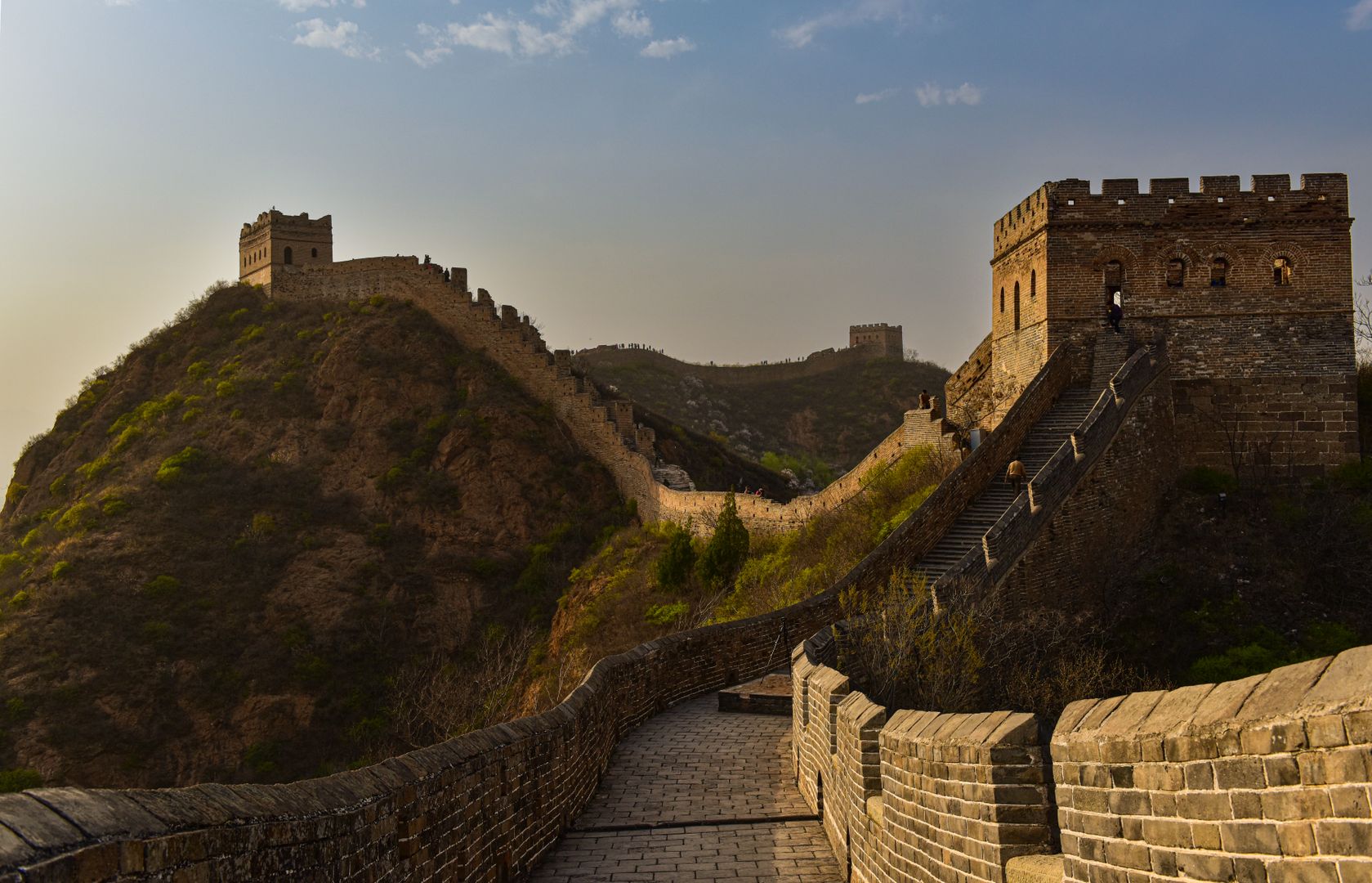
Badaling is 70 km northwest of Beijing and the closest major section to the city. It's also the most visited tourist site in China — receiving over 10 million visitors annually. The wall here was extensively restored in the 1950s and is the best-engineered for accessibility: wide steps, handrails, lifts on sections, and facilities throughout. The Chinese government uses it for state visits and official photography.
On major Chinese public holidays (National Golden Week in October, Spring Festival in February), the crowds at Badaling reach a scale that reduces the wall to a slowly moving queue. On an ordinary weekday in February or March, it's quiet enough to walk in relative peace. On a Saturday in October, it's neither of those things.
The advantage: there is a high-speed train station at Badaling, part of the new S2 line from Qinghe Station in northern Beijing. The journey takes about 50 minutes and costs 30 RMB — the most direct public transport connection of any major wall section. Entry: 40 RMB in off-season, 65 RMB in peak season.
Jinshanling: For Hikers
Jinshanling is 130 km northeast of Beijing — two hours by car, or a combination of train to Luanping and taxi. The section receives far fewer visitors than Mutianyu or Badaling and the wall here is partly restored, partly in its original deteriorated state. The contrast — intact battlements in some towers, crumbling ramparts in others — makes for more atmospheric photography and a more genuine sense of the wall's age.
The classic hike is the 10 km traverse from Jinshanling to Simatai, a more dramatic (and at times exposed) section to the east with precipitous drops and near-vertical access paths. The Simatai end is commercialised with a resort complex; the Jinshanling-to-Simatai trail itself is the reason to come. The hike takes 4–5 hours and requires booking tickets for both sections separately.
Entrance: 65 RMB at Jinshanling. No cable car — access is entirely on foot. Not appropriate for visitors with limited mobility or those expecting an easy visit.
What to Know Before You Go
The wall faces north across the mountain ridges that protected China's imperial heartland. Morning visits face into the sun on most sections; afternoon light hits the south-facing sides for better photography. Overcast days reduce the drama but eliminate the glare.
The wall at altitude is exposed. Even in summer, the ridge is consistently 5–8°C cooler and windier than Beijing. Bring an extra layer regardless of the forecast. In winter (November–March), ice on the wall surface is a genuine hazard on steeper sections — poles and grippy footwear are not excessive precautions.
Organised day tours from Beijing are the most common approach: minibus transport, entrance fees, and lunch included for 200–350 RMB per person. Private cars or DiDi are faster and more flexible. Public buses exist for some sections but require planning and transfers. The S2 train to Badaling is the only fully reliable public transport option.
Frequently Asked Questions
Which section of the Great Wall is best to visit?
Mutianyu for most first-time visitors — well-restored, scenic, and less crowded than Badaling. Jinshanling for hikers and photographers. Badaling if you want the fastest access from central Beijing via train.
Can you walk from one section to another?
Not generally — sections are separated by gaps, private land, and terrain that isn't passable without significant effort. The Jinshanling-to-Simatai route is the best-established multi-section hike near Beijing.
Is the Great Wall visible from space?
No — this is a persistent myth. The wall is too narrow (typically 4–8 metres wide) to be seen from low Earth orbit with the naked eye. Several astronauts have specifically debunked the claim.
When is the best time to visit the Great Wall?
April–May and September–October for the best weather and foliage. Avoid Chinese national holidays (Golden Week in October, Spring Festival in January–February) when visitor numbers are extreme. February and March are cold but exceptionally quiet.