
Xi'an's Place in Chinese History
Xi'an (Chang'an in its imperial name) served as China's capital under thirteen dynasties, including the Qin, Han, and Tang. The Silk Road began here, making it the starting point for the overland trade route that connected China with Central Asia, Persia, and eventually Rome for over a millennium. The Tang Dynasty, China's most cosmopolitan imperial era (618–907 CE), made Chang'an the largest and most diverse city in the world, with a population of around a million people including merchants, diplomats, and religious communities from across the known world.
That history is visible in the city's physical fabric: the 14 km of Ming Dynasty walls that still encircle the old city, the concentration of mosques serving the descendants of those Silk Road merchants, and the museum at the Terracotta Army site that contains one of the most remarkable archaeological discoveries of the 20th century.
The Terracotta Army
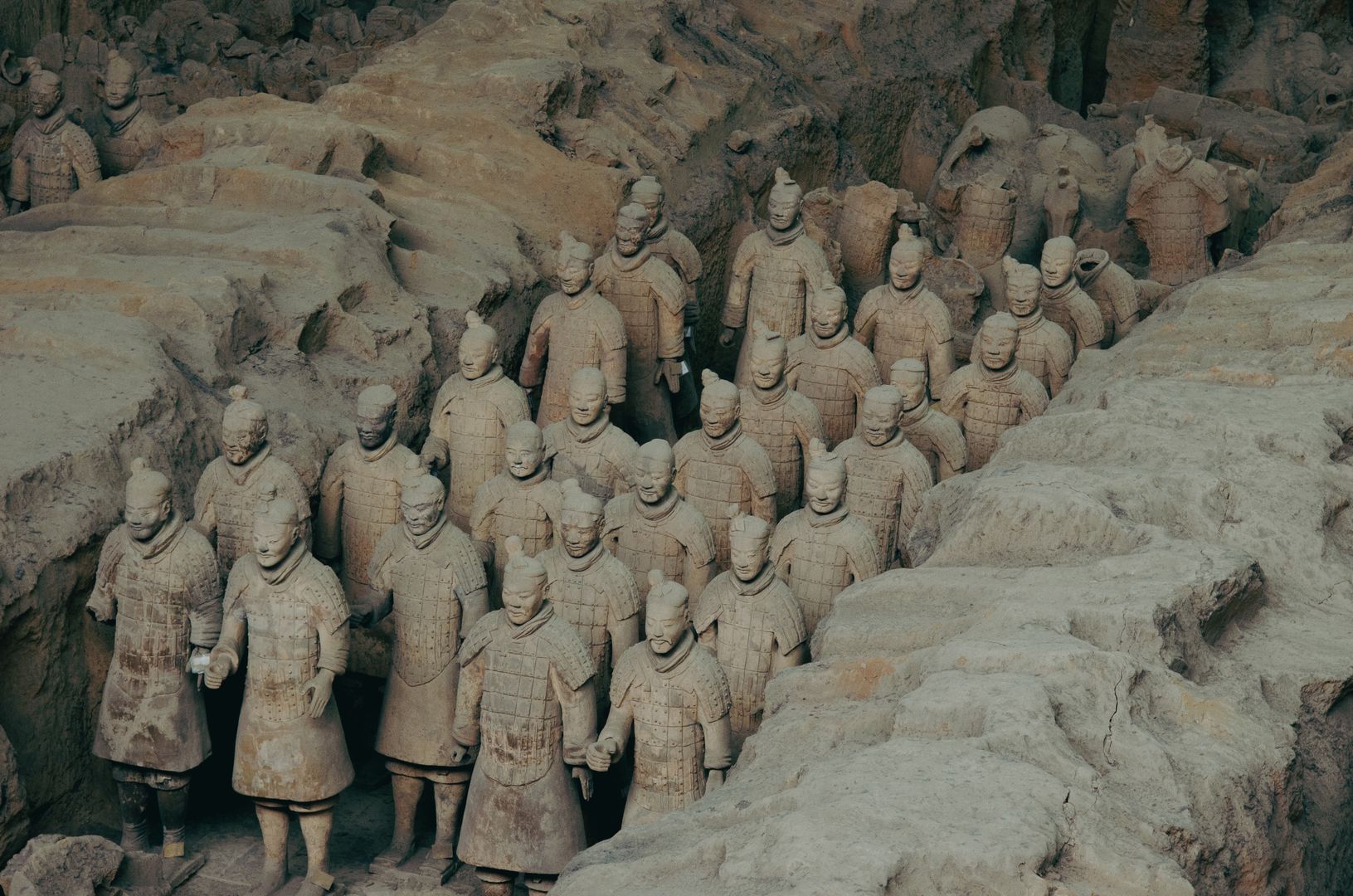
The Terracotta Army was discovered in 1974 by farmers digging a well in Lintong District, 35 km east of Xi'an city centre. What they uncovered was the burial army of Qin Shi Huang (259–210 BCE), the first emperor of unified China — 8,000 life-size clay soldiers, horses, and chariots buried in three pits to guard the emperor in the afterlife.
Pit 1, the main excavation hall, covers 14,260 square metres and contains approximately 6,000 soldiers in formation. The figures are visible from a raised walkway around the perimeter and from the central viewing platform. The scale is the first surprise: the hall is enormous and the formation extends to a vanishing point. The second surprise is the detail — each face is individually modelled, no two are identical, and the original polychrome paint (now lost to oxidation after excavation) meant each soldier was a distinct individual in appearance as well as military rank.
Active excavation continues in Pit 2 and Pit 3; archaeologists are deliberately working slowly, having learned from Pit 1 that the painted surfaces deteriorate within minutes of air exposure. The museum's bronze chariots, excavated near the main mausoleum mound (not yet excavated), are in a separate building and are remarkable engineering objects — two half-scale bronze vehicles with articulated horses, 3,400-year-old precision metalwork.
Entrance: 150 RMB. Book timed tickets online in advance. The drive from Xi'an city centre takes 40–50 minutes by bus from the East Bus Station; tourist buses run regularly and cost 7 RMB. Allow 3–4 hours for the full site.
The Ancient City Walls
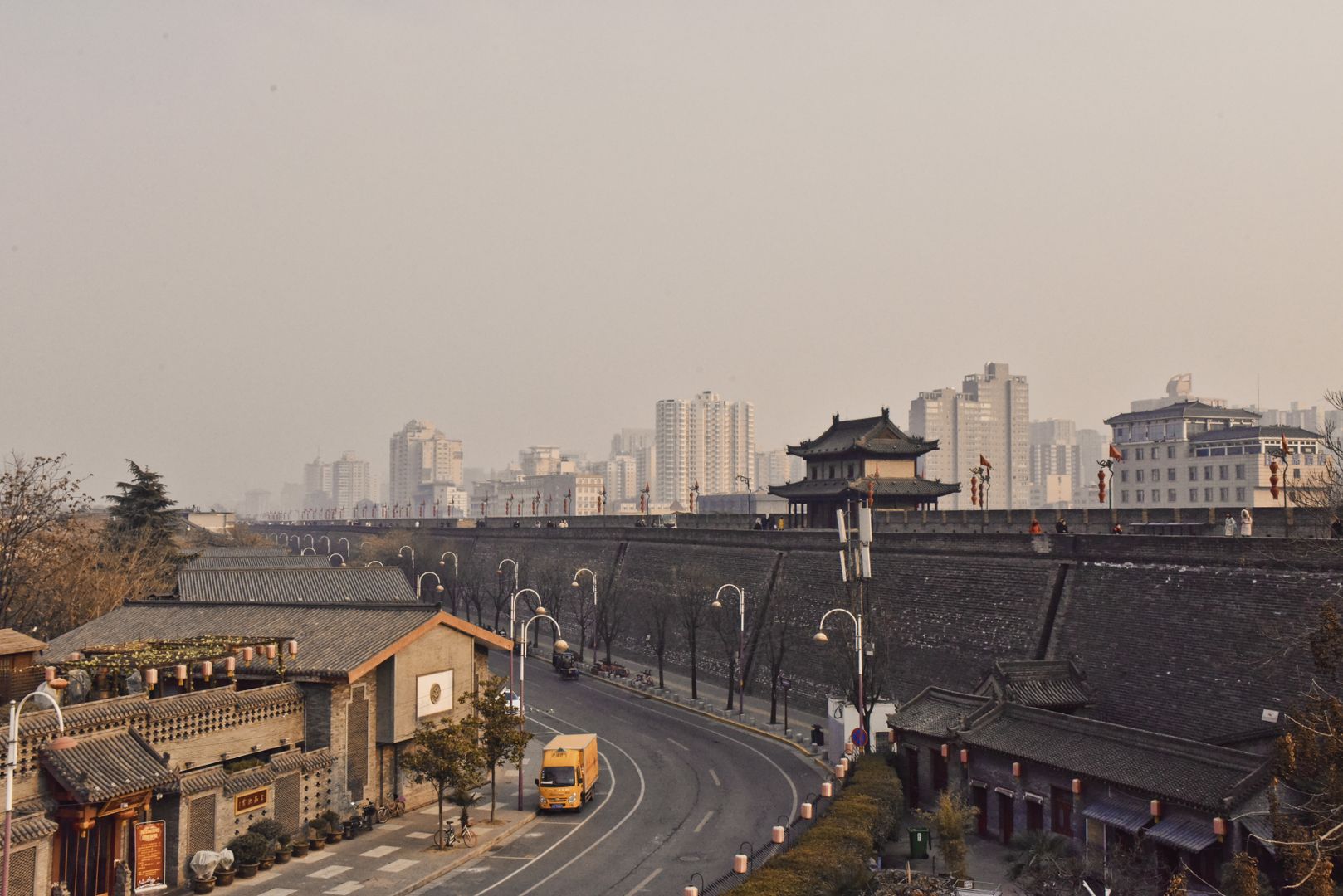
Xi'an's city walls are the best-preserved Ming Dynasty walls in China — 14 km of continuous fortification encircling the historic core of the city, 12 metres high and 15 metres wide at the base. The walls were built between 1370 and 1378 and have been continuously maintained since. Walking the full circuit takes 3–4 hours on foot; cycling is faster (bike rental on the wall: 45 RMB for 100 minutes) and gives a better sense of the scale.
Access points are at the four main gates: South Gate (Yongning), North Gate (Anyuan), East Gate (Zhongshan), and West Gate (Anding). The South Gate has the most elaborate gatehouse complex — three concentric gates, a watchtower, and a moat — and is the most photographed. Entry: 54 RMB. The walls are open until 9:30pm and are lit at night, which changes the character of the walk.
The Muslim Quarter
The Muslim Quarter (Huimin Jie) is a dense network of streets and alleys northeast of the Drum Tower, home to the Hui Muslim community descended from the Central Asian merchants who settled here during the Tang Dynasty. The community has maintained an unbroken presence in Xi'an for over 1,300 years and currently numbers around 60,000 people.
The Great Mosque of Xi'an, founded in 742 CE and rebuilt in the Ming and Qing Dynasties, is at the centre of the quarter. It's one of the oldest Islamic mosques in China and built in Chinese architectural style rather than the dome-and-minaret form of Middle Eastern mosques — pagoda-shaped minarets, carved wooden screens, and incense burners that reflect the fusion of Chinese and Islamic aesthetics that developed here over centuries. Entry: 25 RMB; dress modestly.
The food street outside the mosque — Beiyuanmen — sells the distinctive Hui cuisine of Xi'an: rou jiamo (the "Chinese hamburger" — flatbread stuffed with slow-braised spiced beef or lamb), yangrou paomo (a soup of hand-torn flatbread in lamb broth), and biangbiang noodles (thick, belt-width noodles with chilli oil, the character for "biang" being the most complex in common Chinese writing). The street is crowded in the evening; smaller alleys branching from it have the same food with fewer tourists.
Big Wild Goose Pagoda
The Big Wild Goose Pagoda (Dayan Ta) was built in 652 CE to house Buddhist scriptures brought from India by the monk Xuanzang, whose 17-year pilgrimage to India and back formed the basis of the 16th-century novel Journey to the West. The pagoda stands 64 metres high and can be climbed for views over the southern city. The large plaza surrounding it has a fountain show each evening — somewhat grandiose but popular with locals. Entry: 50 RMB for the pagoda interior; the surrounding park is free.
Frequently Asked Questions
How far is the Terracotta Army from Xi'an?
35 km east of the city centre — about 40–50 minutes by tourist bus from the East Bus Station, or 50–60 minutes by taxi or DiDi.
How many days do you need in Xi'an?
Two days: one for the Terracotta Army, one for the city walls and Muslim Quarter. A third day allows the Big Wild Goose Pagoda and the Shaanxi History Museum (one of China's best provincial museums, free entry).
What is rou jiamo?
A flatbread stuffed with slow-braised spiced beef or lamb — Xi'an's street food staple, often called the "Chinese hamburger." Sold throughout the Muslim Quarter for 15–25 RMB. One of the best things to eat in China.
Is Xi'an worth visiting without the Terracotta Army?
Yes — the city walls, the Muslim Quarter, and the Shaanxi History Museum would justify a visit independently. But most people come for the Terracotta Army, and it fully earns the trip.


