What Tibet Travel Actually Involves
Tibet — formally the Tibet Autonomous Region (TAR) of China — is not a standard travel destination. Foreign visitors require two permits beyond the standard Chinese visa: the Tibet Travel Permit (TTP), issued only through a registered Tibetan travel agency, and for areas outside Lhasa including Mount Everest Base Camp, the Alien Travel Permit and Military Permit. Independent travel without a guide is not permitted. These are not informal restrictions that can be worked around — they are enforced at checkpoints throughout the region.
The permit system means that most foreign visitors book through a Tibetan or Chinese travel agency that handles the TTP application as part of a package. The process takes 15–20 days for the permit to be issued. Applications cannot be made from inside China or Tibet — they must be submitted before entering the country (or at minimum, while in a mainland Chinese city with enough time for processing).
Tibet is periodically closed to foreign tourists, particularly around the anniversary of the 1959 Lhasa uprising (March) and sensitive political periods. Check the current access status before booking anything non-refundable.
Getting the Permit
The Tibet Travel Permit is obtained by registering with a licensed Tibetan travel agency and booking a guided tour. The agency submits permit applications to the Tibet Tourism Bureau on your behalf. You provide passport details, Chinese visa information, and itinerary specifics. The permit is a physical document that you receive before travel begins and must carry throughout Tibet.
Reputable agencies include Tibet Vista, Tibetan Snow Lion Tours, and several others with established track records for foreign visitors. Prices vary significantly — a guided tour covering Lhasa and surrounding area for 4–5 days runs 800–1,500 USD per person including guide, vehicle, and accommodation, but not flights or trains.
Getting There

Two main routes reach Lhasa: by air and by train.
Lhasa Gonggar Airport (LXA) is 60 km south of the city. Flights connect from Chengdu (2 hours), Beijing (3.5 hours), Shanghai (5 hours), and several other mainland cities. The altitude gain is rapid — you're at sea level one hour and at 3,600 metres two hours later. Many visitors experience altitude effects on the first day regardless of fitness level.
The Qinghai-Tibet Railway (the "Sky Train") runs from Xining (in Qinghai province) to Lhasa in 22 hours, crossing passes above 5,000 metres. The train ascends gradually over two days, giving the body more time to acclimatise than flying. Carriages are pressurised and supplemental oxygen is available. The journey over the plateau — vast grasslands, herds of yak, and the Tanggula mountain range — is one of the more remarkable train rides in the world. Hard sleeper berths cost 800–1,200 RMB.
Altitude Sickness
Lhasa sits at 3,650 metres. Acute Mountain Sickness (AMS) affects a significant proportion of visitors, regardless of age or fitness. Symptoms include headache, nausea, fatigue, and disrupted sleep, typically appearing within 6–12 hours of arrival and peaking on day two. The symptoms usually pass within 2–3 days as the body adjusts.
The standard advice: avoid heavy exertion on the first two days, drink more water than usual, avoid alcohol, and don't ascend further if symptoms are present. Diamox (acetazolamide) is widely used as a prophylactic and treatment; consult a doctor before the trip. The altitude effects at Lhasa are manageable for most healthy adults; the passes above Lhasa on excursions to Namtso Lake (4,718 metres) and Everest Base Camp (5,200 metres) are more demanding.
The Potala Palace
The Potala Palace rises 117 metres above Lhasa's Chakpori Hill on 13 stories of red and white masonry. It served as the winter palace of the Dalai Lamas from the 17th century until the 14th Dalai Lama fled to India in 1959. The current building contains over 1,000 rooms, 10,000 shrines, and around 200,000 statues. It is a UNESCO World Heritage Site.
Entry is by timed ticket (200 RMB) — quota-controlled and requiring advance booking through the official system. The visit follows a prescribed route through the Red Palace (containing the tombs of past Dalai Lamas, sheathed in gold and jewels) and the White Palace (administrative quarters). The views from the upper terraces over Lhasa and the Kyichu River valley below are the visual payoff for the altitude-aggravated climb up the exterior stairs.
Visits are limited to one hour inside — enough for the prescribed route, not enough for a comprehensive exploration. Come early in the morning for the best light on the facade from the Potala Square below.
Jokhang Temple and Barkhor Street
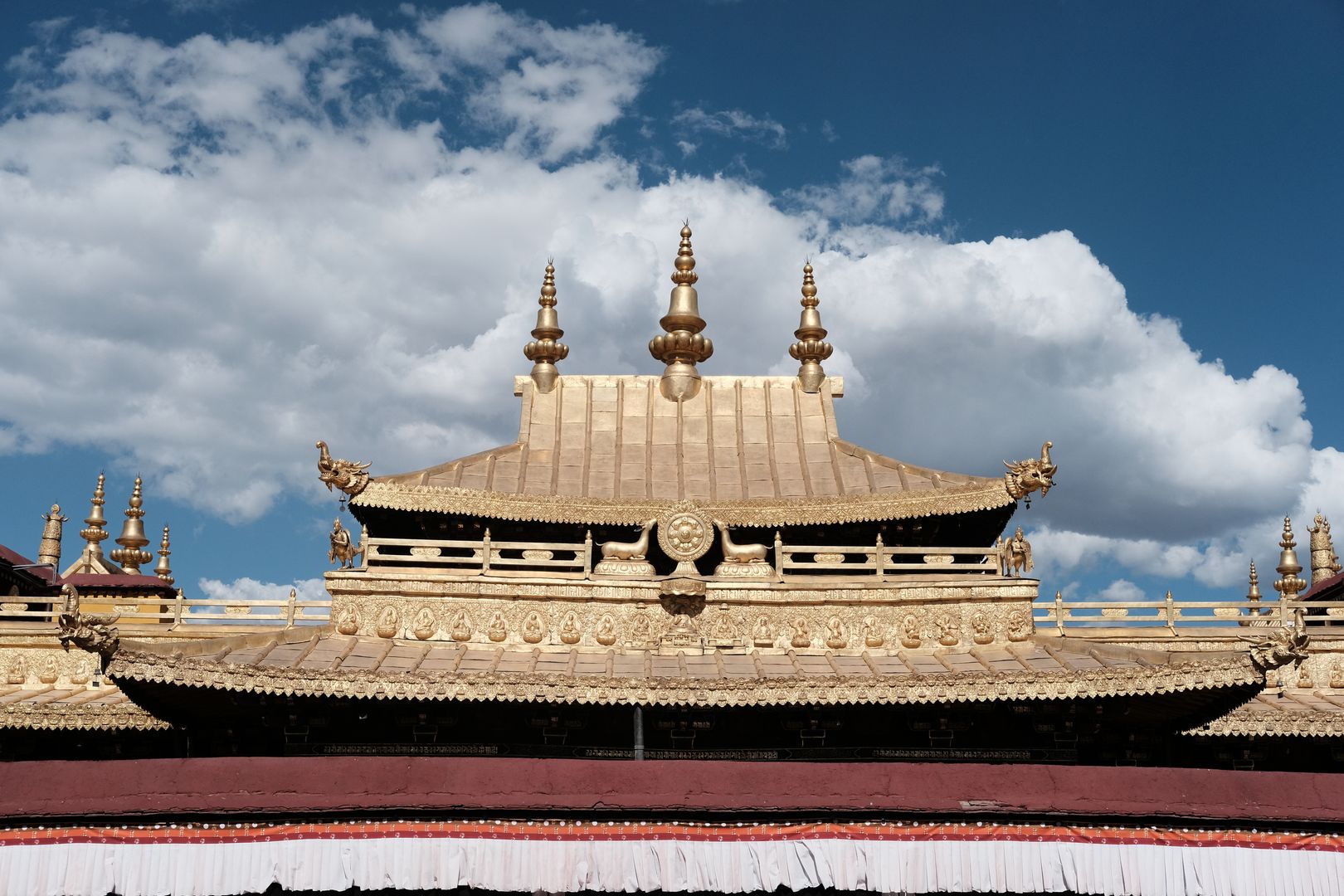
The Jokhang Temple in the centre of Lhasa's old town is the most sacred temple in Tibetan Buddhism, built in the 7th century CE and housing a revered gold statue of the Jowo Shakyamuni (the young Buddha). It's a functioning pilgrimage site — hundreds of devout Tibetans arrive daily, some having walked or prostrated for hundreds of kilometres from other parts of the plateau.
Barkhor Street is the circular pilgrimage route around the Jokhang, followed clockwise by pilgrims spinning prayer wheels, reciting mantras, and stopping at the incense burners outside the temple. The street also functions as Lhasa's main market for traditional Tibetan goods — turquoise and coral jewellery, yak wool blankets, thangka paintings, and incense. The combination of active religious practice and commerce is a distinctly Tibetan register.
Sera Monastery, 5 km north of the city centre, hosts the daily monk debate in the courtyard at around 3pm — an animated, rapid-fire exchange in which monks challenge each other's understanding of Buddhist scripture, accompanied by emphatic hand-clapping to punctuate points. It's open to visitors and is unlike any other religious practice visible in Asia.
Frequently Asked Questions
Do you need a special permit to visit Tibet?
Yes — foreign visitors need the Tibet Travel Permit in addition to a standard Chinese visa. It's obtained through a licensed Tibetan travel agency, takes 15–20 days to process, and cannot be applied for inside China or Tibet.
Can you visit Tibet independently without a guide?
No — independent travel for foreign visitors is not permitted. All foreign tourists must be accompanied by a licensed Tibetan guide, a requirement that is enforced at checkpoints throughout the region.
Is altitude sickness a serious concern in Lhasa?
It affects most visitors to some degree. Headache and fatigue on the first day or two are normal. Serious altitude sickness is rare at 3,650 metres but can develop if you ascend to higher areas (Namtso, Everest Base Camp) before fully acclimatising. Diamox helps; rest and hydration are essential.
When is Tibet open to foreign tourists?
Tibet is generally open from April to November, with the full season running May–October. March is typically closed or restricted around the March 10th anniversary of the 1959 uprising. Closures can be announced with little notice during politically sensitive periods.