

Hvar is the longest island in the Adriatic at 68km, but the parts that most visitors come for occupy a few square kilometres at the western tip. The island has been a tourist destination since the Austrian imperial period in the 19th century; it has the best-developed infrastructure of any Croatian island, prices that have converged toward Dubrovnik levels in peak season, and a nightlife scene that defines the island's reputation in Northern Europe. These facts are not contradictions — they describe the same place appealing to different visitors in different ways.
Getting There from Split
Two options, neither requiring a car.
Catamaran (passengers only): Split harbour to Hvar Town. Jadrolinija and the faster Krilo service. Journey time 1 hour, approximately €9–12 each way. Multiple departures daily in summer; fewer off-season. Book the Krilo line ahead for July–August — it sells out. The catamaran arrives at Hvar Town harbour directly.
Car ferry: Split harbour to Stari Grad (the older town, 20km east of Hvar Town by road). Jadrolinija. Journey time 2 hours, approximately €45–55 for a car and two passengers. Runs multiple times daily, year-round. For visitors with a car, this is the route; the road from Stari Grad to Hvar Town takes 25 minutes.
From Split airport: no direct ferry. Take a taxi (20 minutes) or public bus (25 minutes) to Split ferry terminal (Trajektna Luka), then the relevant service.
Hvar Town
Centred on Trg Sv. Stjepana — St Stephen's Square, one of the largest in Dalmatia — framed by the Venetian Loggia on the north side and the cathedral on the east. Morning coffee, afternoon aperitivo, evening promenade; the square functions as the social core of the town at every hour.
The Fortica fortress (also called Španola) above the town: 16th-century Venetian, panoramic views of the Pakleni Islands and the coast. Entry €7, 15 minutes' walk from the square.
Costs: coffee €4–5, pizza and pasta €14–20, fish mains €22–35. July and August add significant yacht traffic and the most active club scene in Croatia. This suits a specific type of visitor and genuinely puts others off; both reactions are appropriate.
Stari Grad: The Alternative
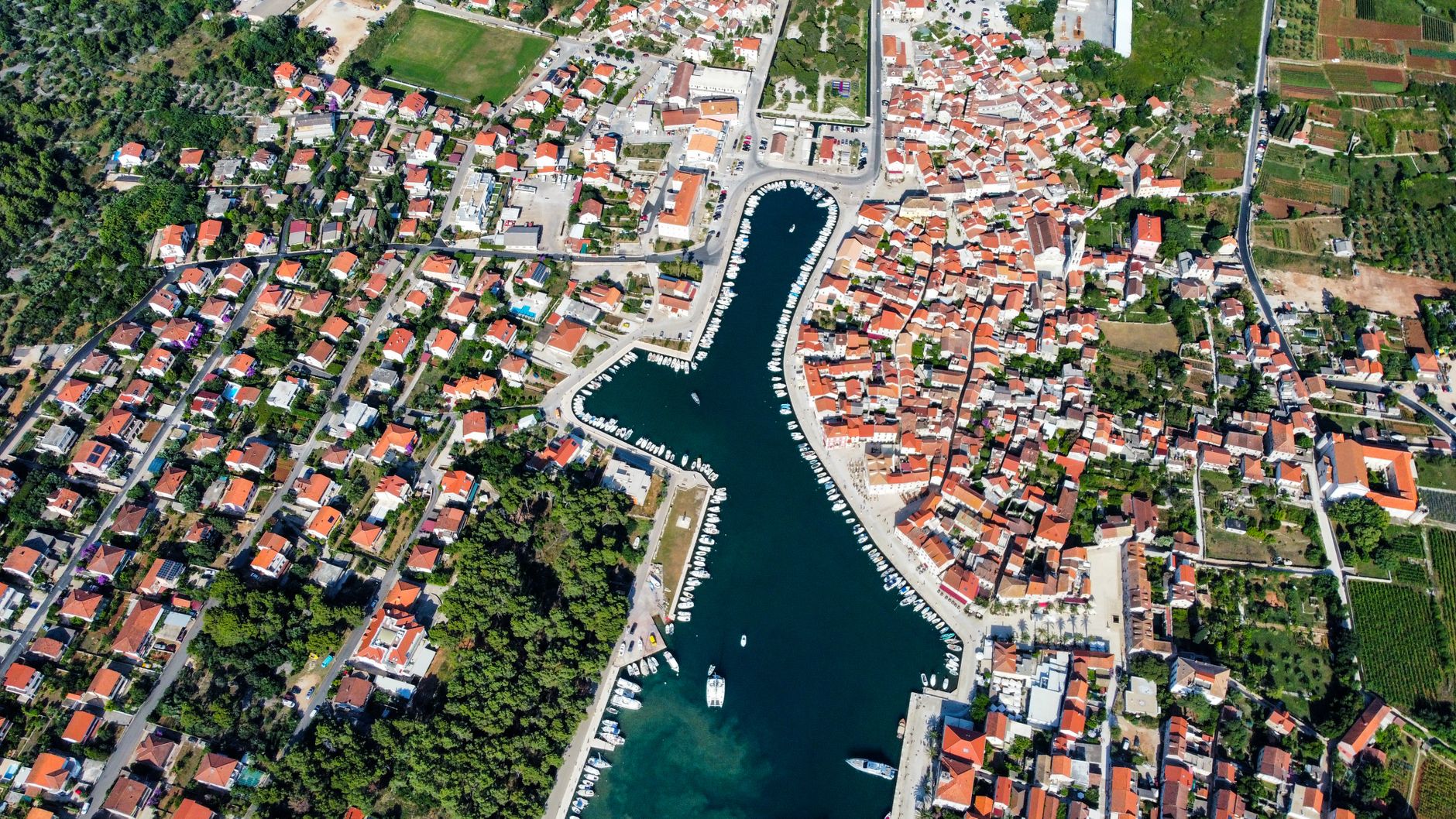
Stari Grad is one of the oldest continuously inhabited settlements in Europe, founded by Greek colonists in 384 BCE. The Stari Grad Plain behind the town is UNESCO World Heritage: an ancient agricultural field system with divisions unchanged for 2,400 years. The dry-stone walls, field plots, and watchtower structures are the original Greek layout — the most intact ancient field system in the Mediterranean.
The town itself is quieter than Hvar Town, with stronger local character and better value at restaurants. Tvrdalj, a Renaissance fortified manor house built by the poet Petar Hektorović in the 16th century, is the main visitor attraction (€4). Stari Grad is the correct base for cyclists and visitors who want to explore the island's interior — lavender fields (peak June), Plavac Mali vineyards, and the largely abandoned stone villages of Velo Grablje and Brusje.
The Pakleni Islands
A chain of small islands directly offshore from Hvar Town, accessible by water taxi from the harbour (€5–7 per person each way, departing continuously from 9am in season).
Palmižana: the main stop — pebble coves, clear water, yacht moorings, and the Meneghello restaurant complex in the pine forest. The established option for a beach day.
Jerolim: closest island, naturist section on the far side, limited facilities.
Stipanska: quiet, good anchorage, few visitors.
Hvar's own coastline offers limited beach access — the Pakleni Islands are where most visitors actually swim.
Lavender and Interior
The interior of the island produces lavender, which peaks in June (the Velo Grablje area is the main zone). Plavac Mali grapes — DNA-confirmed as a parent variety of California's Zinfandel — produce full-bodied, high-alcohol reds (14–15%) from the island's vineyards and the Pelješac peninsula. E-bike rental available in Hvar Town (€30–40/day) for exploring the inland road network.
When to Go

June: the best single month. Lavender in bloom, sea at 22°C, lower accommodation prices than July–August, manageable crowds. Pre-book ferries but accommodation is available.
September: sea at its warmest (25°C), comfortable air temperature, costs 30–50% below peak, most operators still open through mid-October.
July–August: maximum crowds, maximum prices, and maximum nightlife. Book ferries and accommodation 3–4 months ahead. The island functions under pressure but you need to manage expectations.
Frequently Asked Questions
Is Hvar overrated?
The party-island reputation is accurate for July–August in Hvar Town. The historical and natural qualities (Stari Grad Plain, Pakleni Islands, the interior) are largely unrelated to that reputation. Visitors expecting one and encountering the other are disappointed in both directions.
Can you visit as a day trip from Split?
Yes — 1 hour by catamaran each way, 6 hours in Hvar Town is enough for the old town and a water taxi to the Pakleni Islands. Arrive on the first morning departure.
Are there sandy beaches?
No. Hvar's coastline is almost entirely rock and pebble. The swimming is from rocky platforms and pebble coves; the water is clear and the conditions are good, but beach-chair-on-sand is not the format.
How far is Hvar from Dubrovnik?
By public transport (ferry connections via Split): 5–6 hours. Hvar is more logically combined with Split than Dubrovnik.
What is the ferry booking situation in peak season?
The Krilo catamaran (faster, passenger-only, Split–Hvar Town) sells out and requires advance booking in July–August. The Jadrolinija car ferry to Stari Grad has more capacity and queues rather than selling out, but arrives at the less convenient town. For foot passengers, book Krilo ahead.


