

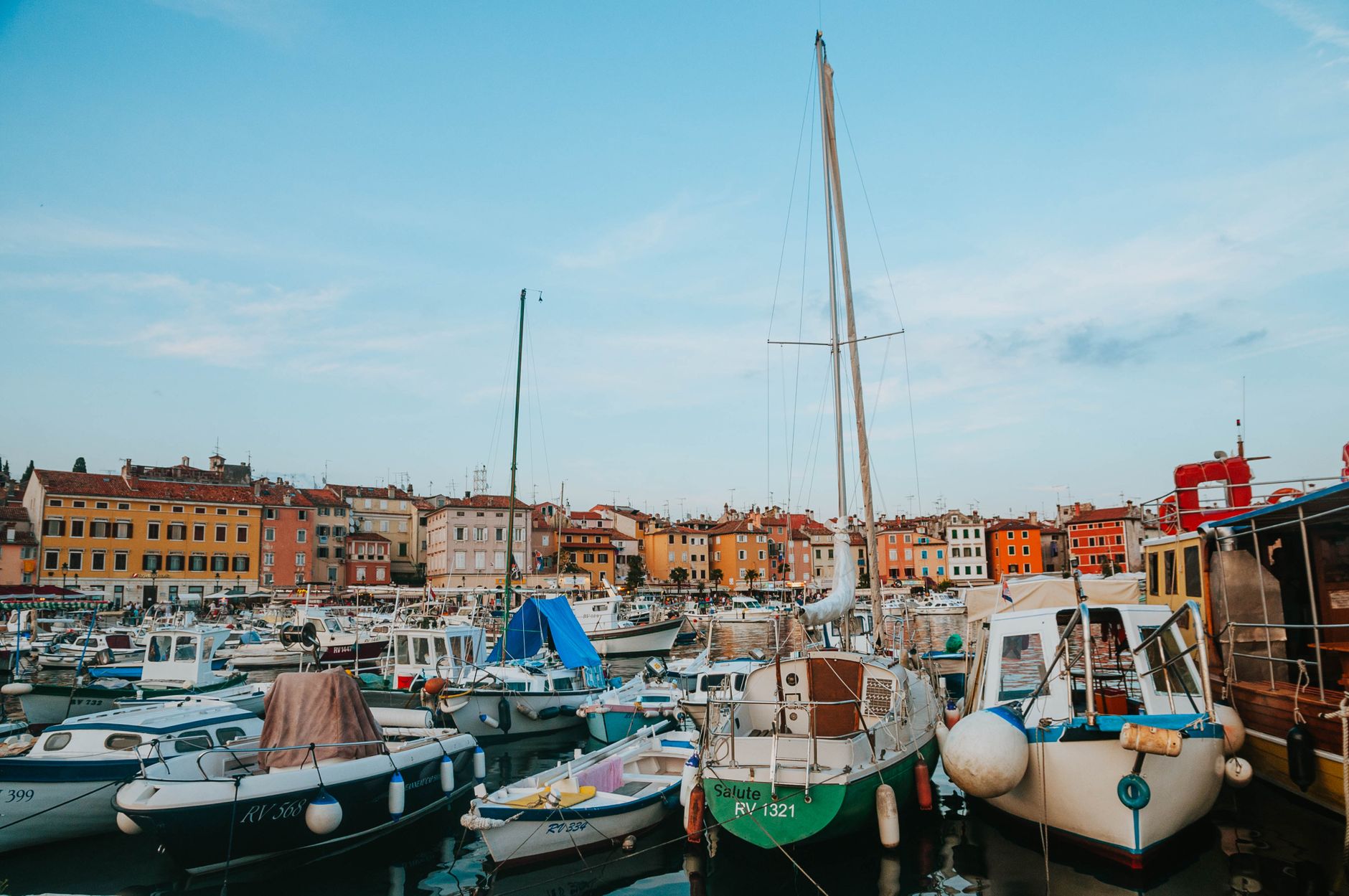
Rovinj's old town occupies a peninsula that was an island until the 18th century, when the channel was filled with rubble. The result is a compact knot of narrow streets radiating uphill from the waterfront to a Baroque church on the summit, with the Adriatic on three sides. Five hundred years under Venetian administration (1283–1797) are visible in every stone staircase, coloured facade, and the lion of St Mark above the town gate. It is the most photographed town in Istria and among the most Venetian-looking places on the Croatian coast — which attracts visitors and also means the comparison to Dubrovnik gets made constantly. Rovinj is smaller, less famous, and in season significantly less overwhelmed.
The Old Town Peninsula
The main gate into the old town is the Balbi Arch (1679), with a Venetian lion above it and a Turkish head below — a propagandist marker of civilisational position. Inside, the streets are too narrow for cars and in some sections too narrow for two people with bags to pass each other comfortably.
Church of St Euphemia (Crkva sv. Eufemije): the Baroque church on the summit, built 1736 on a spur of rock that gives it the highest position in the old town. The 61-metre campanile is modelled on the campanile of St Mark's Basilica in Venice and is the climbable element — steep internal ladders, €2 entry, worth it for the rooftop view of the tile-covered peninsula, the surrounding islands, and the Lim inlet to the south on clear days.
Inside the church: the sarcophagus of St Euphemia, a 4th-century marble casket brought from Constantinople in 800 CE by tradition, said to contain the remains of the 3rd-century martyr. The church is plain; the tower is the reason to climb.
Grisia Street: the main lane ascending from the harbour to the church. Every August the Grisia Art Exhibition (since 1967) lines the walls with works by local artists. On non-exhibition days, the permanent galleries along the street sell Istrian art at less tourist-marked prices than the harbour area.
The harbour (Luka): the fishing harbour on the north side of the peninsula. The outdoor fish market operates Tuesday–Sunday, 7am–noon. The evening promenade (korzo) runs along the seafront from the harbour to the south-facing Lungomare waterfront — the standard Rovinj evening activity.
Rovinj vs Dubrovnik
Both are walled Adriatic towns with Venetian architectural heritage.
Rovinj: smaller (14,000 people), no UNESCO World Heritage designation driving international tour circuits, no cruise ship infrastructure of Dubrovnik's scale, better access to Istrian countryside and wine, less expensive.
Dubrovnik: world-class city walls (2km circuit, the strongest reason to visit), more to do within the old town, better island connections (Hvar, Korčula, Mljet), the specific Game of Thrones filming association. Peak season brings 30,000+ cruise passengers some days — manageable in the early morning and evening but genuinely impactful midday.
For a quieter Adriatic town, better wine, and a useful base for an Istrian road trip: Rovinj. For the specific experience of walking the Dubrovnik walls above the Adriatic: Dubrovnik.
Swimming Near Rovinj

The old town has no sand — swimming is from rocks and concrete platforms below the town walls, accessed via alleys between houses on the southern side. Clear water, immediate access.
Zlatni Rt (Golden Cape): a protected forested cape 2km south of the old town, with shaded rocky coves and clear water. Access on foot from the old town (25 minutes along the waterfront) or by bike. No cars permitted. The holm oak forest is the best natural space near Rovinj.
Banjole and Barbariga (12–15km south): sandy beaches accessible by car, less crowded than the town areas. The road south along the Istrian coast has multiple coves without tourist infrastructure.
Lim Fjord
The Limska Draga (Lim Canal/Fjord) is a 10km-deep drowned river valley 12km south of Rovinj — resembling a fjord visually though not glacially formed. The inlet contains oyster and mussel farming operations; a restaurant at the head of the inlet (various operators) serves the oysters immediately from the water at €12–18/dozen.
Access: boat tours from Rovinj harbour (€15–25, 2–3 hours including swimming) or by car to the cliff viewpoint above, then down to the restaurant by the narrow access road (10km of single-lane track).
The Istrian Road Trip Circuit
Rovinj's position in the middle of Istria makes it the obvious base for covering the peninsula's main sites.
Pula (35km south): the Roman amphitheatre (1st century CE, capacity 20,000, the sixth largest surviving Roman arena in the world). 1–2 hours, entry €10. Also the triumphal Arch of the Sergii and the Temple of Augustus in the town centre.
Poreč (40km north): the Euphrasian Basilica (6th century, UNESCO), with Byzantine mosaics in the apse that predate Ravenna's San Vitale by a decade. Entry €3.
Motovun (60km northeast): a hilltop walled town in the Mirna truffle valley, surrounded by oak forest where white truffles are found October–January. The Motovun Film Festival in July is well-regarded in the European independent film circuit. Local Malvazija white wine available throughout.
Getting to Rovinj
From Zagreb: bus, 3.5–4 hours, €15–20. Several daily. The bus station is 1km from the old town gate.
From Pula: bus, 1 hour, €7. Pula has the main Istrian airport (PUY) with seasonal direct flights from London, Frankfurt, and other European cities (June–September).
From Split: bus via Zagreb, 8–10 hours. Better to fly to Pula.
From Trieste (Italy): bus, 2.5 hours, €12. The most direct connection from northeast Italy.
When to Visit Rovinj
May–June: best Adriatic window. Temperatures 22–26°C, the sea reaching 20°C by June, the old town before peak summer crowds. May is particularly good.
September: summer heat easing (24–27°C), sea still 23°C, the Italian domestic tourism that fills Istria in August has gone. Excellent.
July–August: peak Adriatic season. Rovinj is genuinely busy but not overwhelmed. Boat trips and better restaurants need advance booking.
October–November: truffle season in Motovun and Buzet (the Istrian Truffle Days festival is in October), the town quieter, accommodation cheaper.
Frequently Asked Questions
How many days do you need in Rovinj?
Two nights: one day for the old town and Zlatni Rt; one day for a day trip to Pula (Roman amphitheatre) or Poreč (Euphrasian Basilica). Three days adds Motovun and truffle country.
Is Rovinj in Croatia or Italy?
Croatia. Rovinj (Italian: Rovigno) was under Venetian and then Austro-Hungarian administration for most of its history and has a small Italian-speaking minority community today. The peninsula has a dual-language heritage but is firmly Croatian sovereign territory since 1947.
What is the best viewpoint for the Rovinj skyline photograph?
From the water — either from a rented kayak or a harbour boat trip. The view of the campanile and the densely packed old town from the open sea to the southwest is the image.
Is the Lim Fjord actually a fjord?
No — it is a ria (a drowned river valley), not a fjord (which requires glacial origin). The visual resemblance is strong enough that it has been called a fjord by local tourism marketing since the 19th century.


