

Phnom Penh is a city of 2.2 million people on the confluence of the Mekong and Tonle Sap rivers. For most visitors it's a transit stop between Siem Reap and the Vietnamese border, allocated one or two nights. That's enough to see the main sites but not enough to register the pace of change in the city — the new towers going up along the riverside, the concentration of good restaurants and bars around BKK1 and Daun Penh, the growing creative and expat presence. Two to three days is a better allocation if the Khmer Rouge history is treated as the serious subject it is rather than a quick check.
Tuol Sleng (S-21)
Tuol Sleng was a secondary school converted by the Khmer Rouge in 1975 into Security Prison 21 (S-21). Between 1975 and 1979, approximately 17,000 people were detained here, systematically tortured to extract confessions — usually false — of counter-revolutionary activity, and then transported to the Killing Fields for execution. Fourteen survived the fall of the regime in January 1979. The Vietnamese army arrived days after the final prisoners were killed and documented what they found.
The prison has been preserved as a genocide museum (USD 3, audio guide USD 3 additional). The classrooms-turned-cells are largely intact — the wooden-partitioned individual cells in Building C, the iron bed frames and rusted shackles, the systematic photograph archive of prisoners on arrival. The audio guide uses testimonies from the 14 survivors; the two still living at the time of the museum's 2012 renovation both contributed. The visit takes 2–3 hours if done seriously. It is not a comfortable experience; it is an important one.
Choeung Ek Killing Fields
Choeung Ek, 15km southwest of Phnom Penh, was the primary execution site for prisoners transferred from S-21. The orchard here was used between 1975 and 1979 for mass killings; 129 mass graves have been identified containing the remains of approximately 17,000 people. A stupa built in 1988 holds 5,000 skulls as a memorial.
The audio guide (included in the USD 6 entry) is the most effective way to experience the site — it uses survivor testimonies, historical context, and periods of silence to structure a walk through the orchard. The path passes the mass graves (marked with signs), the tree against which children were killed, and the excavated depressions still visible in the ground. It takes 90 minutes. The site is rural and quiet; the combination of apparent peacefulness and historical weight is the most persistent quality of the visit.
The Royal Palace and Silver Pagoda
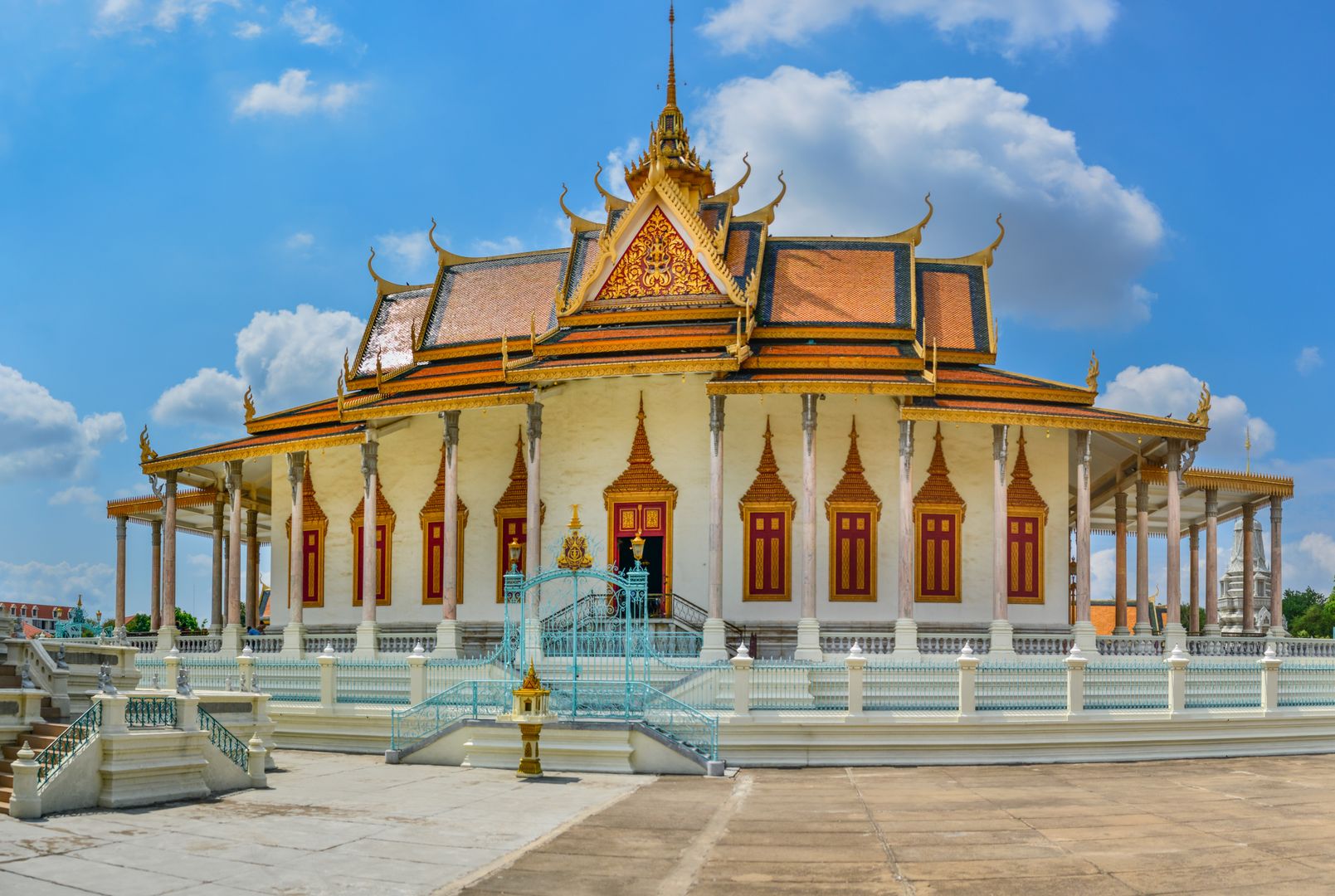
The Royal Palace complex (USD 10) on the Tonle Sap waterfront was built in 1866 on the site of an earlier palace; much of the current structure dates from the early 20th century. The Throne Hall, used for coronations and state ceremonies, is the most architecturally significant building — a multi-tiered Khmer-style roof in green and gold tiles. Many sections of the palace are closed to the public as the king resides there seasonally.
The Silver Pagoda, within the compound, is named for its floor of 5,000 silver tiles. The Emerald Buddha (actually Baccarat crystal) and a solid gold Buddha studded with 9,584 diamonds are the primary objects inside. Photography inside the pagoda is limited. The surrounding gallery holds 640m of continuous mural depicting the Reamker (the Cambodian version of the Ramayana).
The Riverside and the Markets
Sisowath Quay runs 3km along the Tonle Sap riverfront through central Phnom Penh — tourist restaurants and bars facing the water, backpacker hostels one block back, and a pleasant evening promenade for Cambodians and visitors alike. The confluence of the Tonle Sap and Mekong rivers is visible at the southern end of the quay; the Tonle Sap reverses direction twice a year (flowing south in dry season, north in wet season to fill the great lake) — one of the more unusual hydrological phenomena in Southeast Asia.
Phsar Thmei (Central Market), an Art Deco rotunda built in 1937, is the city's most architecturally distinctive market — four wings radiating from a central dome, selling gold jewellery, antiques, electronics, clothing, and food. Phsar O Russei (Russian Market), in the south of the city, is denser and more local — the better option for textiles, silk, and produce. Phsar BKK (Boeung Keng Kang market) is the neighbourhood market for the main expat district.
Food in Phnom Penh
Cambodian food is less internationally known than Thai or Vietnamese cuisine and tends toward subtlety rather than heat — lemongrass, galangal, kaffir lime, and fish paste (prahok) provide the characteristic flavours. Fish amok (a coconut curry mousse steamed in banana leaf, traditionally made with freshwater fish from the Tonle Sap) is the national dish by consensus and available in every tourist restaurant; the better versions are at local establishments. Lok lak — stir-fried beef with lime-pepper sauce and a fried egg on a bed of lettuce and tomato — is the most reliable lunch option.
The area around Street 278 (Pasteur Street) and Street 240 in BKK1 has the densest concentration of restaurants, from Khmer family restaurants to French-Cambodian fusion. The Foreign Correspondents Club (FCC) on the Riverside has the best river view and prices to match; Romdeng (Street 174) is the best-known upmarket Cambodian restaurant. Night food markets on the riverside and at Street 19/108 run from early evening.
Getting Around Phnom Penh
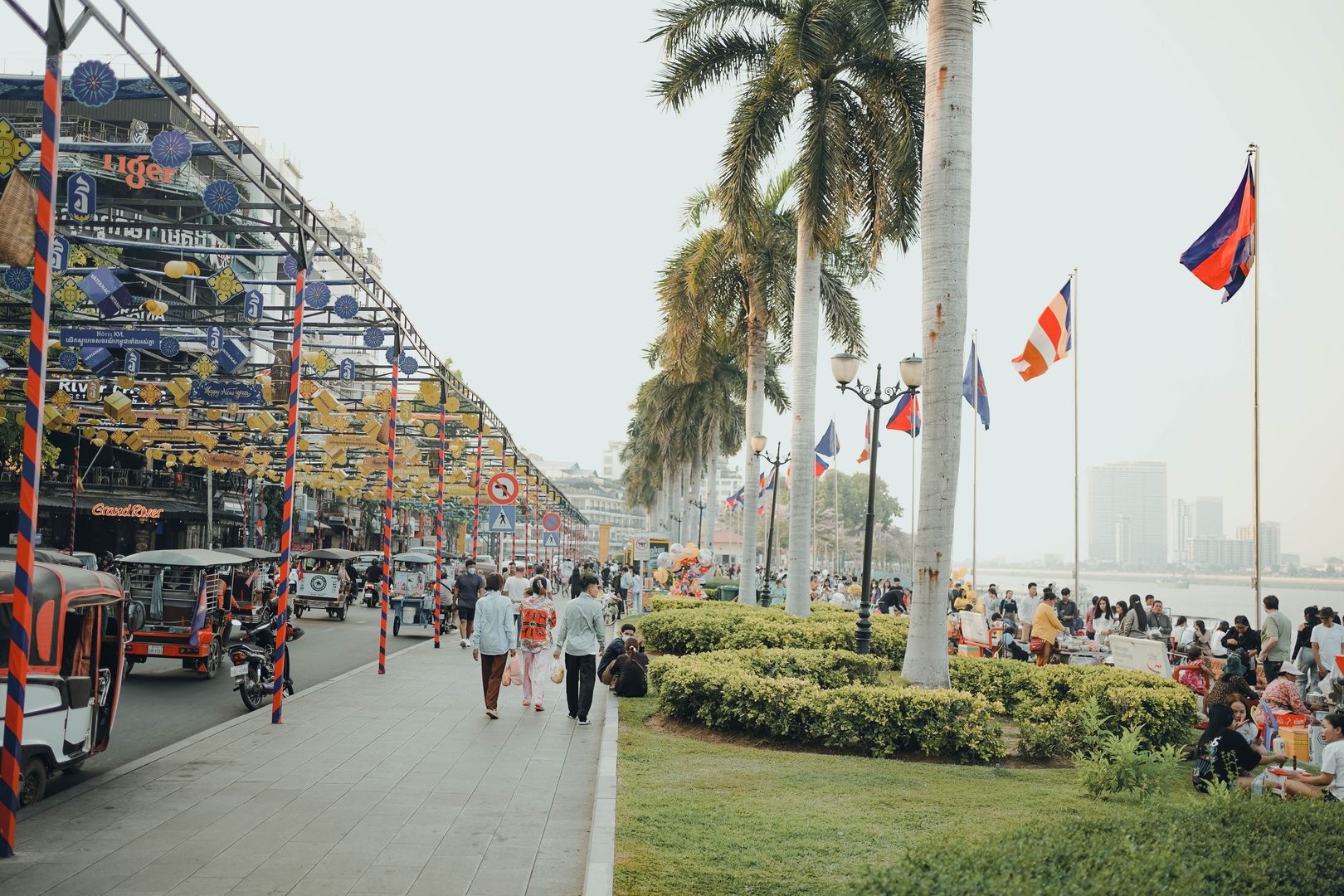
Tuk-tuks and app-based motorcycle taxis (Grab, PassApp) are the standard modes. A tuk-tuk between the main tourist sites costs USD 2–5; a Grab motorcycle taxi USD 1–3. Walking covers the riverside and central area comfortably. The city's road logic is approximate rather than systematic; addresses in Phnom Penh use street numbers (odd numbers run north–south, even numbers east–west) which makes navigation more predictable than in many Southeast Asian capitals.
Practical Costs
A guesthouse room in central Phnom Penh runs USD 15–35; mid-range hotels in BKK1 USD 50–90. Restaurant meals run USD 4–10 for Khmer food; USD 10–20 at tourist-facing restaurants with western menus. A tuk-tuk for a full day (Royal Palace, S-21, Killing Fields) costs USD 20–30. Entry fees: Royal Palace USD 10, S-21 USD 3, Choeung Ek USD 6. Cambodia uses US dollars for most tourist-facing transactions; prices are generally comparable to Vietnam and considerably cheaper than Thailand.


