
Plovdiv has been inhabited since the 6th millennium BC, making it one of the oldest continuously occupied cities in the world. The city has been successively Thracian (as Eumolpia), Macedonian (renamed Philippopolis by Philip II of Macedon in 342 BC), Roman, Byzantine, and Ottoman before becoming the second city of independent Bulgaria. Each period left visible evidence; the layers are more compressed and more immediately accessible here than in most European cities of similar antiquity. In 2019, Plovdiv was a European Capital of Culture, which accelerated the development of cultural infrastructure but also introduced the crowds and pricing pressure that follow such designations.
The Old Town
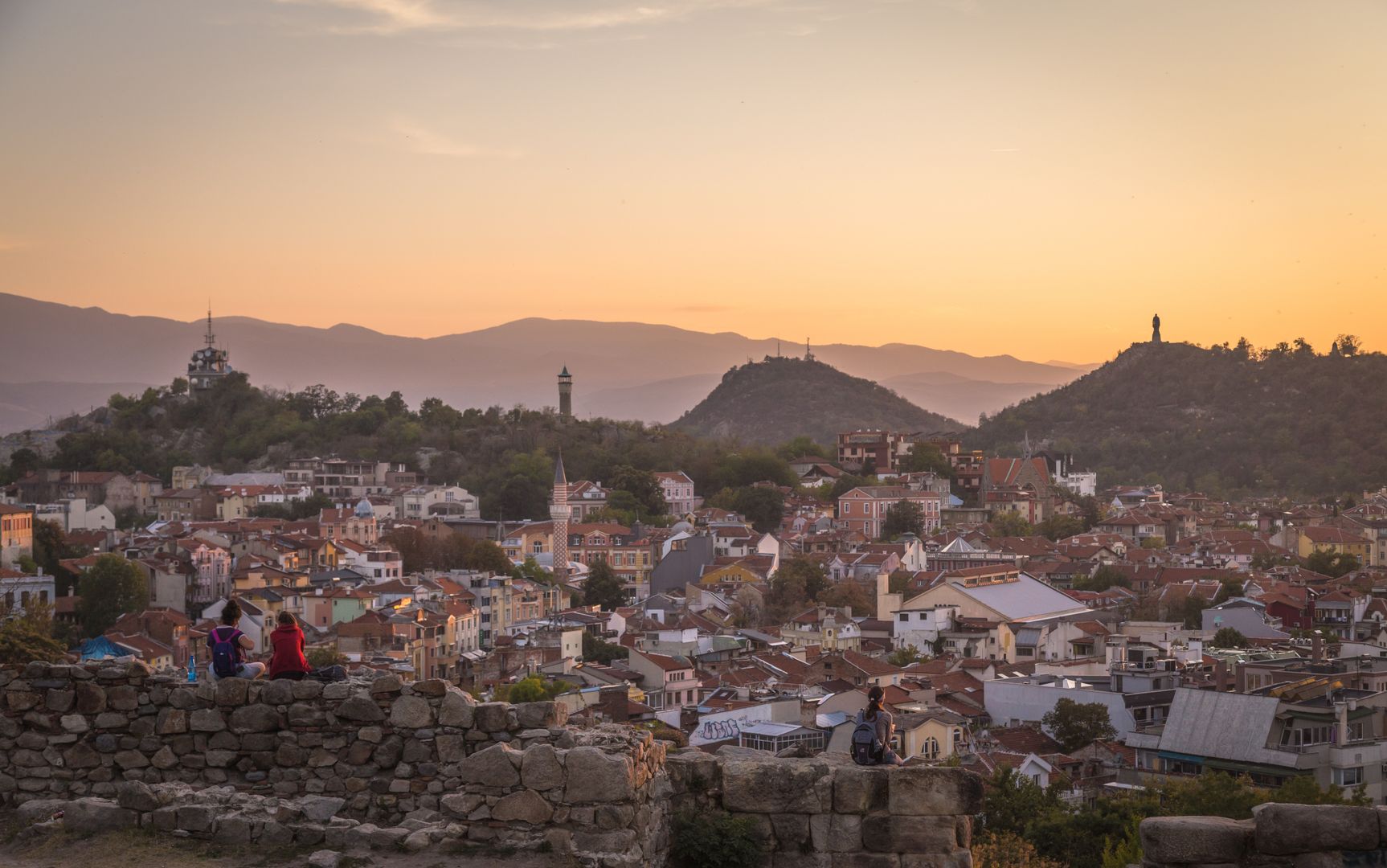
Plovdiv's Old Town (Stariyat Grad) occupies three of the city's hills — Nebet Tepe, Taksim Tepe, and Djambaz Tepe — and contains the highest concentration of National Revival architecture (19th-century Bulgarian merchant houses) in the country. The houses characteristic of this style are asymmetric bay-windowed structures projecting over the street on wooden beams, with elaborately plastered facades and interiors of richly decorated wooden ceilings. Several are open as house museums: the Hindlian House (€2, merchant's house built 1840, original furnishings intact), the Kuyumdzhioglu House (Ethnographic Museum, €5, exceptional ceiling paintings), and the Georgiadi House (Historical Museum, €3).
The streets of the Old Town are cobbled, the gradient is steep, and the density of well-preserved buildings is higher than any comparable area in Bulgaria. Walking the full circuit — from the northern Nebet Tepe fortification walls (Thracian origin, Roman and Byzantine additions) to the southern end of Djambaz Tepe — takes two to three hours depending on how many houses you enter. The views over the city from the hilltops extend to the Rhodope Mountains to the south and the Balkan Range to the north.
The Roman Theatre of Philippopolis
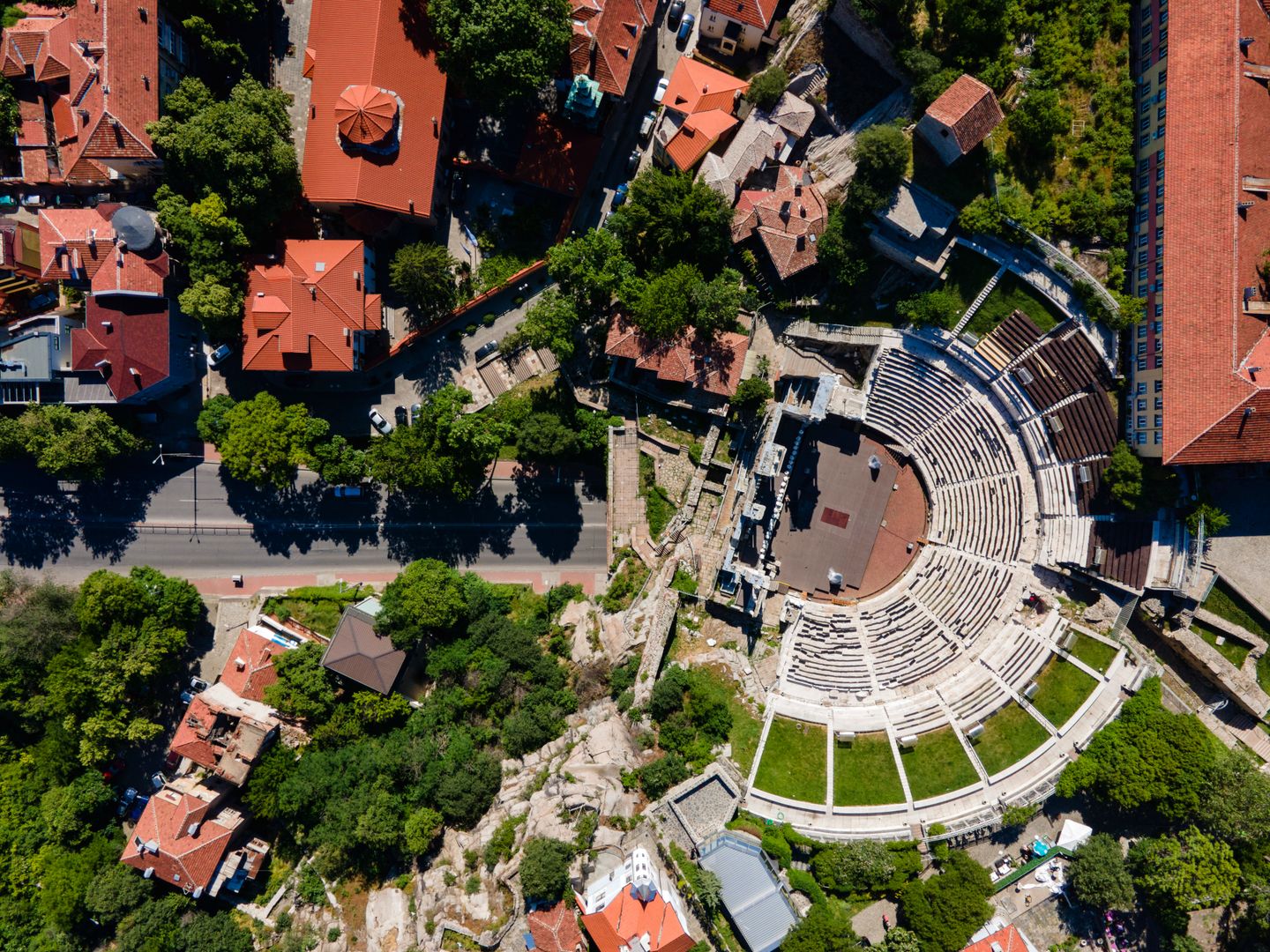
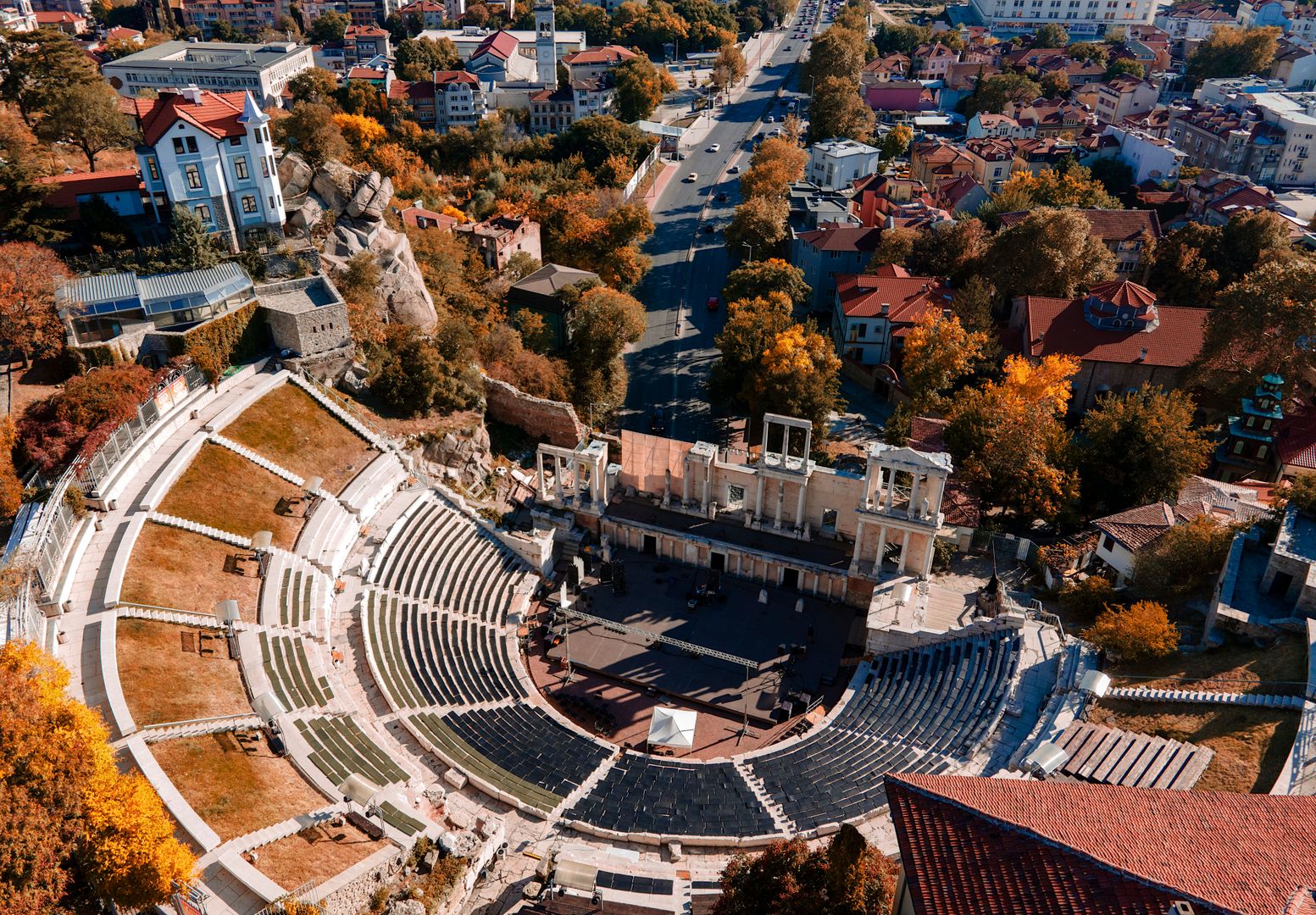
The Roman amphitheatre (2nd century AD, capacity 7,000) was accidentally rediscovered during a landslide in 1972 and excavated over the following decade. It occupies the saddle between two of the Old Town hills, with its stage looking south over the modern city. The marble seating is largely intact; the stage structure (scaenae frons) has been partially reconstructed. Entry is BGN 5 (€2.50).
The theatre is still used as a performance venue — the Plovdiv Opera season runs from September through June with performances on the ancient stage; ticket prices start at BGN 10–20. The combination of 2nd-century marble seating and contemporary sound equipment is either exhilarating or dissonant, depending on your attitude toward archaeological sites as living cultural venues. The view from the upper rows over the city at night, with the stage lit below, is the most atmospheric way to experience the theatre.
Kapana Creative District
Kapana (meaning "The Trap," from the district's maze of narrow streets) was a traditional craftsmen's quarter through the Ottoman and early modern periods. Urban decline through the latter 20th century left it semi-abandoned. A regeneration project beginning around 2015, accelerating through the 2019 Capital of Culture year, converted it into a dense concentration of independent cafés, galleries, bars, craft workshops, and restaurants within six or seven streets in the triangle between bul. Hristo Botev and the Old Town.
The district works at human scale — no building is taller than three storeys, most are 19th century, and the street furniture (outdoor seating spilling onto every available square metre, murals on blank walls, occasional installations) is managed by the independent businesses rather than by a central authority. It's busiest Thursday through Saturday evenings; the morning is quieter and the café culture more apparent. The Kapana Fest (twice annually, spring and autumn) fills the district's streets with street food, live music, and craft stalls. The district is small enough to walk end-to-end in 10 minutes; the point is not size but concentration.
The Plovdiv Museums and the Ancient Stadium
The Ancient Stadium of Philippopolis (2nd century AD, capacity 30,000) is largely buried under the central pedestrian street (Knyaz Alexander I), with one curved end excavated and visible under a glass floor in the underground level of the Trimontium hotel. The two visible rows of marble seating, with original carved seat numbers, are accessible from the hotel lobby (free). A fuller view of the stadium's scale requires understanding that the pedestrian street above it follows the stadium's straight section — the street curves at both ends where the hippodrome bends.
The Regional Archaeological Museum (€4), on Saedinenie Square next to the main post office, holds the region's archaeological finds including the Panagyurishte Gold Treasure (a set of nine gold vessels from the 4th–3rd century BC, among the most technically accomplished examples of ancient goldsmithing in existence). These are the originals; Sofia's National History Museum holds replicas. The museum is small enough to cover thoroughly in an hour.
Day Trips from Plovdiv
Bachkovo Monastery (30km south, 45 minutes by bus) is Bulgaria's second-largest monastery, founded 1083, with a refectory containing 17th-century murals and an active monastic community. The surrounding Rhodope Mountain landscape is more dramatic than the Rila approach to Rila Monastery. The village of Asen's Fortress (3km from Bachkovo, accessible by trail) is a partially-preserved medieval fortress on a sheer cliff above the Asenitsa gorge — not reconstructed, just ruins on rock, free to reach on foot.
The Rhodope Mountains villages — Shiroka Laka (traditional stone houses, bagpipe festival in August), Kovachevitsa, and Leshten — require a car and a full day but represent the most intact traditional Bulgarian rural architecture in the country. The Assen's Fortress trail continues through the gorge to the Devil's Bridge (Dyavolski Most), a medieval 14th-century humpback stone bridge over the Arda river, one of the best-preserved in the Balkans.
Getting There and Practical Costs
Plovdiv is 140km southeast of Sofia by road (2 hours by car or 2h15 by direct express train, BGN 10–13 one way). Regular bus services run from Sofia's central bus station every 30 minutes (2 hours, BGN 12–15). Plovdiv Airport has limited direct connections to Western Europe. Within Plovdiv, the Old Town and Kapana are walkable from the centre; the outlying sights require a taxi (BGN 5–10) or bus. A hotel in the Old Town or city centre runs €35–65; a room in a guesthouse in the Old Town itself (of which there are several in converted Revival houses) €40–75. Restaurant meals run €4–8 for Bulgarian food; Kapana's cafés charge €1.50–2.50 for coffee.