

Rajasthan is one of the few places in India where the historical setting is as dramatic as the guidebooks claim. The Mehrangarh Fort above Jodhpur, the lake palaces of Udaipur, the sand dunes outside Jaisalmer, the pink-walled City Palace of Jaipur — these are not overrated. They require planning to experience well, because the distances between them are significant and the heat from March onwards is severe. A two-week Rajasthan itinerary moving through the four major cities is the standard circuit, and it works because each stop has a distinct character and the logistics between them — train, bus, or private car — are straightforward if booked ahead.
The Two-Week Circuit: Jaipur → Jodhpur → Jaisalmer → Udaipur
Delhi arrival → Jaipur (3 nights) → Jodhpur (2 nights) → Jaisalmer (2 nights) → Udaipur (3 nights) → Pushkar (1 night, optional) → Delhi departure. This sequence follows the geography and the daylight train schedules. Most travellers arrive at Delhi's Indira Gandhi International Airport and travel by overnight train or early-morning flight to Jaipur, using the first evening to adjust. The return journey allows a 3-hour stop in Pushkar (Rajasthan's pilgrimage town on a sacred lake) if desired, but it adds logistics; cutting it keeps the itinerary cleaner.
Jaipur: Three Nights
Jaipur's primary experience is Amber Fort, 11 km northeast of the city center. This is where the Kachhwaha rulers held court for 400 years before shifting to the City Palace in 1727. Arrive by 9 a.m. — the 4 km uphill jeep ride from the base takes 15 minutes, and the fort fills quickly after 10 a.m. The Sheesh Mahal (Hall of Mirrors) contains 2 lakh (200,000) mirror pieces set into stucco walls and ceilings; candlelight was the original effect, now electric bulbs. The Ganesh Pol gateway and the Sukh Niwas (cool chamber where water flowed through marble channels) justify the €8 entry alone. Allow three hours minimum.
Hawa Mahal, the five-storey pink honeycomb facade overlooking the main bazaar, is best approached from the side street (Johari Bazaar) rather than the front, which offers no angles. The interior staircase to the rooftop costs €2 and gives genuine rooftop views across Jaipur's grid. The building is fundamentally a facade — four rooms deep — so don't expect vast palace interiors.
Jaipur's bazaars are coherent by product. Johari Bazaar specializes in block-print textiles: cotton sarongs, wall hangings, and dress fabric printed by hand with wooden blocks. Prices start at €3–4 for basic cotton, up to €20–40 for silk prints. Nehru Bazaar is the blue pottery quarter — plates, bowls, tiles — with easier direct purchasing from workshop owners than from shopfront middlemen. The MI Road area (north of the old city) has semi-precious stone dealers and lapidary workshops; the quality variation is extreme, and unless you're buying for investment, a single shop visit with a known reference is safer than comparison shopping.
Food in Jaipur: Lassiwala on MI Road is a morning institution, a two-person stand serving lassi in clay cups (€0.30). Dal baati churma is the signature Rajasthani dish — red lentil dal cooked with roasted wheat dumplings and sweet semolina churma — available at any thali restaurant in the old city. For an evening splurge, Rajmahal Palace buffet (City Palace area, reservations necessary, €25–30) offers Rajasthani and Mughlai dishes in a heritage setting.
Jodhpur: Two Nights, 6 Hours by Train from Jaipur

Mehrangarh Fort rises 125 metres above Jodhpur on a rocky outcrop visible from every part of the city. This is one of India's most imposing forts — the sheer scale of the ramparts and the collections inside justify €8 entry and 3–4 hours of your time. The howdah gallery (ornate elephant seats used by maharajas during hunts and ceremonies) and the weapons galleries (swords, daggers, guns from the 17th–19th centuries) are museum-standard. The palace rooms within the fort contain carved wood screens, painted ceilings, and views across the blue city below. Arrive at 9 a.m. for fewer crowds.
The Blue City is a marketing term now — the convention of painting Brahmin houses indigo blue, historically a symbol of Brahmin status, has been extended citywide for tourism. From the fort ramparts at Mehrangarh, the city unfolds as a genuine sea of blue roofs. The Jaswant Thada (free, 200 metres from the fort) is a white marble cenotaph (domed memorial) built in 1899 for Maharaja Jaswant Singh II, set on a platform with views across the blue city in a different register — lighter, more architectural. Ground-level immersion comes from the rooftop restaurants and cafes on Clock Tower Road (Ghanta Ghar area), where you sit in the blue itself rather than looking down on it.
Clock Tower Market is the city's commercial heart and the place most itineraries underemphasize. The covered spice section — accessed from the west side — sells cardamom, saffron, chili varieties, and Rajasthani masala blends by weight from open sacks. Prices are €2–4 per 100g for most spices, higher for saffron. This is less curated than Jaipur's tourist bazaars and more functional; vendors will sample spices and fill small bags on the spot.
Street food: Shri Mishrilal Hotel, on the Sardar Market circle, is the reference for Jodhpur's signature dishes. Mirchi bada — large chili peppers stuffed with spiced potato and deep fried — costs €0.50 for two. Makhania lassi, a thick saffron lassi with khoya (condensed milk), costs €1 and is richer than standard lassi. Both are genuinely worth eating.
Jaisalmer: Two Nights, 6 Hours by Bus or Overnight Train from Jodhpur
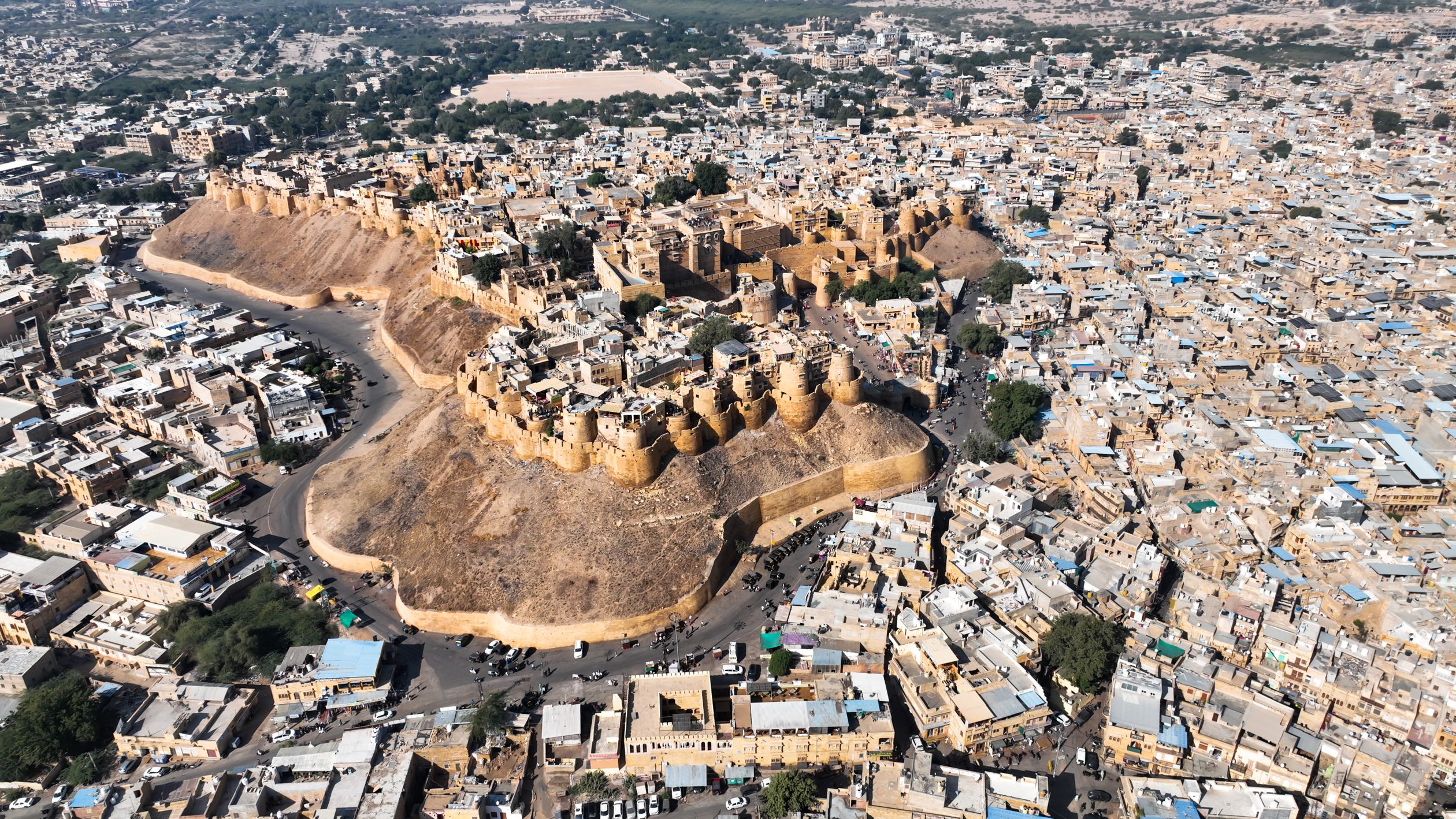
Jaisalmer Fort is unusual because it remains a living settlement. Three thousand residents live inside the fort walls, in carved havelis (mansions) and narrow lanes that collapse into tourist cafes on the fort's south edge. The fort itself contains twelfth- to fifteenth-century Jain temples with marble lattice screens and intricate ceiling work (€2 entry), and the Patwa ki Haveli complex — seven interconnected merchant mansions with mirror work, painted ceilings, and intricate carved sandstone — forms the largest group of aristocratic housing inside an Indian fort (€5 entry). These are functional museums, not reconstructions; families still live in parts of the complex.
The Thar Desert experience centers on camel safaris to the Sam and Khuri dune fields, 40 km from Jaisalmer. A typical overnight safari involves two hours riding a camel to a camp site, sleeping in a tent on the sand (or on a mattress in the open), waking for sunrise, and returning by camel in the morning. The dunes themselves are 15–30 metres high — not Sahara-scale — but the silence and the star density at night are genuinely striking. Camps range from basic (thin mattress, shared bathroom, simple dal and roti meals, €25–40 per person) to private operations (better bedding, hot water, more elaborate food, €80–120). Book through your accommodation rather than from street agents in the fort; the commission chains add 30–40% markup and no quality benefit.
Honest assessment: the dune safari is worth doing once. The camel riding is slow and the animal's gait is jarring; most travellers sit uncomfortably for the first hour. The sunset over the dunes is genuine, the night sky is authentic, and the experience of waking in the desert is a highlight. But Jaisalmer's appeal is concentrated — two nights is enough. Adding a third night means a second dune trip or an extra day in the fort, neither of which deepens the experience.
Udaipur: Three Nights, 8 Hours by Bus from Jaisalmer
Udaipur is built around Lake Pichola with the City Palace of the Mewar maharajas dominating one shore and the Lake Palace Hotel (a white marble palace floating on an island) visible from the waterfront ghats. This is Rajasthan's most visually coherent city and the one that most closely matches the aesthetic in guidebook photographs.
The City Palace (€10) is the largest palace complex in Rajasthan, accumulated over 400 years by successive maharajas. The Mor Chowk (Peacock Courtyard) features glass-tile mosaics of peacocks and parrots embedded in the sandstone walls — a Mughal technique adapted for Indian aesthetics. The Crystal Gallery (€10 additional) houses nineteenth-century Victorian crystal furniture, chandeliers, and decorative pieces gifted to or collected by the maharajas. The palace's scale and detail justify three hours of exploration; the route is one-directional and well-marked.
Lake Pichola boat rides depart from the City Palace waterfront (€8 return, 45 minutes) to Jag Mandir, a seventeenth-century island palace built as a pleasure retreat and now operating as a heritage hotel. The boat ride alone is worthwhile — the view of the City Palace and its reflection across the water is the city's signature image. A sunset boat ride (€12, one hour) is the standard tourist activity and genuinely good, though crowded in peak season (December–January).
Sajjangarh, the Monsoon Palace, sits 5 km uphill from the city center (tuk-tuk €5 return). This nineteenth-century palace was built as a hunting lodge with panoramic views across Lake Pichola and the city below, and it is best visited at sunset. Currently the palace is undergoing restoration and access changes periodically; check current status before including it in your itinerary.
Jagdish Temple (free) is a seventeenth-century Indo-Aryan style temple 150 metres from the City Palace entrance. Built in 1651 by Maharaja Jagat Singh, it remains active with daily worship. The temple is open to visitors (remove shoes) and the carved stone interior is excellent Hindu temple architecture.
Getting Around Rajasthan: Train, Bus, or Car
Indian Railways operates the Mandore Express (Jaipur–Jodhpur, 5.5 hours, €6–12 sleeper tier, overnight services also available) and overnight trains between Jodhpur and Jaisalmer (6 hours, €5–10 sleeper). Book at irctc.co.in at least two weeks ahead for these routes; specific train-date combinations sell out quickly. If you hold a non-Indian passport, the Foreign Tourist Quota allocation is often available when standard tiers are full — request it when buying tickets.
Private car with driver costs €60–80 per day for a full-day hire (8–10 hours, one driver, one car). This works well for the Jaisalmer–Udaipur leg if bus timings are poor, and for flexible departures from Jaipur toward the fort. AC buses operate between all four cities (€8–15 depending on distance and operator quality). Government buses (RSRTC) are cheaper but less comfortable; private operators like Ashok Tours offer AC and WiFi for €2–3 more.
When to Travel: October Through February
The best time to visit Rajasthan is October through February. Peak December through January offers the best weather (15–25°C daytime, 8–12°C at night), though accommodation prices are highest (€100+ per night for mid-range hotels). March marks the beginning of temperature climb toward 35°C; April through September is 40–48°C during the day, making fort visits exhausting and outdoor activities difficult. This is also the monsoon season (June–September) when some roads become unreliable and many heritage properties reduce visiting hours.
October–November is ideal: temperatures are comfortable (20–30°C), accommodation is cheaper than December–January, and visitor numbers are lower. February is still good weather but the beginning of the season squeeze; book accommodation 4–6 weeks ahead.
What Most Itineraries Get Wrong
Most guides recommend adding Mount Abu (Rajasthan's only hill station) to a two-week itinerary, or squeezing Pushkar into the main circuit. Both are worth seeing once, but both require a day of transport (5–6 hours from Udaipur to Mount Abu, 3 hours from Jaipur to Pushkar) that breaks the rhythm. The four-city circuit is already geographically coherent; adding a fifth city turns the final days into transport rather than exploration. If time allows beyond two weeks, add Mount Abu or Pushkar; within two weeks, the linear path is better used.
Second: most sources understate camel safari quality variance. A poorly organized safari means a camel with sores, a driver who talks the entire ride, and a camp where you sleep on gravel with no bedding. Booking through your accommodation, where reputation is local and repeated, costs €10–15 more but delivers a different experience.
Third: Jaipur's City Palace requires advance booking if you want to see the private palace sections (some areas are still the residence of the maharaja's family). Standard entry gives access to museums and courtyards; request or book "private palace entry" if deeper access interests you.
Rajasthan works as a sequence. Each city has a distinct character — Jaipur's bazaars and forts, Jodhpur's singular blue-city identity, Jaisalmer's desert isolation and living fort, Udaipur's lake-palace romance. The circuit from Jaipur through Jodhpur to Jaisalmer and Udaipur builds a coherent arc, and two weeks is the right duration. Travel by overnight train when possible; waking in a new city each morning suits the rhythm. The forts and palaces are genuinely extraordinary, the food changes city by city, and the logistics are straightforward if booked two to three weeks ahead.


