
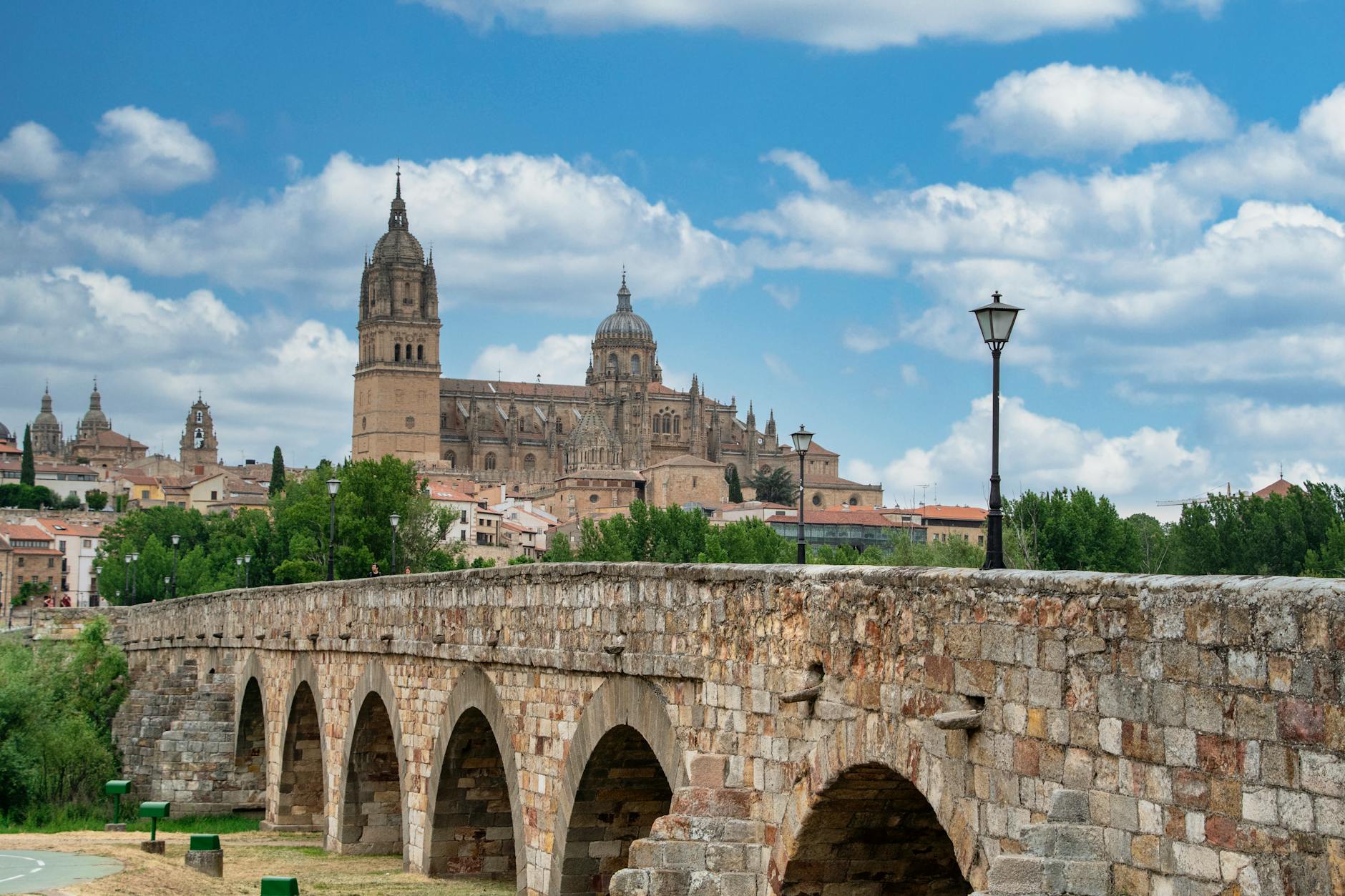
Salamanca has one of the oldest universities in Europe — founded in 1218, making it the first in Spain and the fourth oldest in western Europe. The institution was at the peak of its influence in the 16th and 17th centuries, when it attracted scholars from across Europe and Columbus consulted its cosmographers before his first Atlantic voyage. The architectural legacy of that period covers the city in a specific golden sandstone (arenisca de Villamayor) that glows amber in afternoon light — the effect that earned Salamanca the description "la dorada." Today the student population of 30,000 keeps the city more energetically alive than its size (150,000) would otherwise suggest, and the Plaza Mayor is consistently cited as the most beautiful public square in Spain.
Plaza Mayor
The Plaza Mayor was built between 1729 and 1755 by the Churrigueresque architect Alberto de Churriguera and finished by his student Andrés García de Quiñones. It is a closed rectangular square of 88 arches over three storeys, with a consistent Baroque facade punctuated by portrait medallions of Spanish monarchs and notable figures. The square functions as both the city's social centre and the reference point for all navigation.
The ground-floor arcade contains cafes and restaurants that are expensive by Salamanca standards — a coffee here costs twice what the same coffee costs two streets away. The arcade as a social space (where Salamanticans walk, meet, and argue) is free. The square is at its best at 7–8pm on warm evenings, when the goldenstone walls catch the last of the day's light.
The Two Cathedrals
Salamanca has two cathedrals sharing a wall and connected by interior doorways.
The Old Cathedral (Catedral Vieja, 12th–13th century): a Romanesque building with a lantern tower (Torre del Gallo) whose scalloped stone dome has good claims to being the finest Romanesque vault in Spain. The Retablo de Nicolás Florentino (1440s) filling the apse shows 53 painted panels depicting the life of Christ and the Virgin, capped by a Last Judgment fresco. Entry €5.50.
The New Cathedral (Catedral Nueva, begun 1513, consecrated 1733): a Gothic and Baroque hybrid that took 220 years to build, visible in the stylistic shifts between the western portal (pure Plateresque, one of the most ornate facades in Spain) and the interior (Baroque nave vaulting). The famous astronaut carved in the north doorway was added during a 20th-century restoration — a craftsman's tradition of hiding a contemporary figure among the medieval carvings. Entry €5.50 (combined with the Old Cathedral).
The University Facade

The Universidad de Salamanca building on Calle Libreros (2 minutes from Plaza Mayor) has a 16th-century Plateresque facade covered in carved medallions, heraldic shields, mythological scenes, and — by tradition — a hidden frog on a skull visible to those patient enough to find it. Spotting the frog before anyone points it out is the university's unofficial entrance test; it sits on the right side of the facade, about 2 metres up, on a carved skull in the central vertical band.
The interior includes the original aula (lecture hall) where philosophy and theology were taught in the 16th century, and a library with some of the oldest academic texts in Spain. Entry €10 (guided option available).
Food in Salamanca
The Castilian food tradition in Salamanca is meat-heavy and practical rather than elaborate.
Hornazo de Salamanca: a thick bread-crusted pie filled with chorizo, jamón, pork loin, and hard-boiled egg, traditionally eaten on the Monday after Easter (Lunes de Aguas) when students returned from a week outside the city's restrictions. Available year-round at traditional bakers on and around the Plaza Mayor.
Lechazo asado: roast baby lamb in a wood oven — the standard Castile Sunday lunch. Good at the traditional restaurants in the old town (Mesón Las Conchas, Restaurante Lis).
Farinato: a smoked sausage unique to Salamanca and western Castile, made with pork fat, paprika, and wheat flour — dense, fatty, fried at the table. An acquired taste.
The student bar circuit on Calle Prior and the adjacent lanes serves the cheapest tapas in the old town — ordered with a beer or wine, the standard Castilian way, at €1–2 per tapa.
Getting to Salamanca
From Madrid Chamartín: Alvia or regional train, 1h30, €15–30. About 10 services daily. The AVE does not serve Salamanca directly; the Alvia (semi-high-speed) is the fastest train.
From Madrid Moncloa Bus Station: ALSA bus, 2h30, €15–20. Regular departures. The bus takes longer than the train but is cheaper and drops at the central bus station adjacent to the old town.
From Valladolid: regional train, 1h, €10. Valladolid is on the main AVE network — useful for connecting Salamanca to a broader Castile itinerary.
From Porto (Portugal): bus via Guarda and Vilar Formoso, 3.5 hours, €15–25. The Portugal–Salamanca connection is underused; Salamanca is the closest major Spanish city to the Portuguese border.
When to Visit Salamanca
Spring (March–June): best window. Temperatures 14–24°C, the university fully in session (atmosphere is thinner in summer when students leave), the goldenstone warm in afternoon light.
September: the academic year resumes, the city is at its liveliest, temperatures 18–26°C. Excellent.
July–August: the university is on vacation, the student population leaves, the city feels quieter than its architecture deserves. Still fully worth visiting; the monuments are the same regardless of semester.
November–February: cold (4–10°C), the stone facades in low winter light take on a different amber quality. The Christmas lights in the Plaza Mayor are disproportionately good.
Frequently Asked Questions
How many days do you need in Salamanca?
Two days: one for Plaza Mayor, the two cathedrals, and the university facade; one for slower walking, the Casa de las Conchas, the convents, and an evening meal in the old town. A day trip from Madrid is possible (1h30 train) and efficient for the main monuments; an overnight is better for the student-city atmosphere.
What is Churrigueresque architecture?
An extreme form of Spanish Baroque named after the Churriguera family of architects (17th–18th century), characterised by extremely dense surface ornament — every column, entablature, and wall surface covered in carved detail. The Plaza Mayor is the most coherent example in Spain; the University facade is an earlier Plateresque precursor.
Is the frog on the university facade hard to find?
Yes. It is on a skull in the right-hand section of the facade, approximately 2 metres above street level. The position is well-documented online; finding it without assistance is satisfying. Finding it is said to bring luck in exams — a tradition maintained by current students.
Is Salamanca worth visiting without knowing Spanish?
Yes. The main monuments are accessible without language — the cathedrals, the Plaza Mayor, and the university exterior require no Spanish. The student-quarter restaurants are menu-picture or point-and-order friendly. The university museum has some English-language panels.


