Córdoba was the most populous city in western Europe in the 10th century — capital of the Umayyad Caliphate of al-Andalus, with a population estimated at 500,000, a functioning street lighting system, running water in public fountains, and a library of 400,000 volumes. The Mezquita-Catedral, the forest of red-and-white striped arches built between 784 and 987 CE, is what remains of that period most visibly. In the 16th century, a full Gothic cathedral was built through the centre of the mosque's prayer hall — a decision so architecturally controversial that King Carlos I, when he saw it completed, reportedly told the builders: "You have destroyed something unique to build something ordinary." The result is unlike anything else in Europe.
The Mezquita-Catedral
Entry €13 (free 8:30–9:30am Monday–Saturday, though crowded). Allow 1.5–2 hours minimum.
The original mosque was built by Abd al-Rahman I in 784 on the site of a Visigothic church. It was extended four times over 200 years, ending with the mihrab and the Capilla de Villaviciosa additions of 987 under Al-Mansur. The prayer hall that resulted has 856 columns of jasper, marble, and granite, recycled from Roman and Visigothic buildings across the Iberian peninsula, supporting a double arcade system of horseshoe arches in alternating red brick and white stone. The density of the columns — all slightly different in height, adjusted by the raised bases or lower capitals to achieve a uniform ceiling height — gives the interior a forest quality unlike Gothic or Romanesque cathedrals.
The mihrab (prayer niche indicating the direction of Mecca) is the most technically accomplished single space: a carved stone horseshoe arch covered in Byzantine mosaics commissioned from Constantinople by Caliph al-Hakam II in 965. The craftsmen who made them also made the mosaics in the Hagia Sophia.
The Renaissance cathedral inserted into the prayer hall in 1523–1766 is a full cathedral on its own terms — choir stalls, vaulted nave, side chapels — but visually overwhelming in context. It occupies roughly a third of the prayer hall.
The free morning entry window (8:30–9:30am) is genuinely worth the early start — 60 minutes inside the Mezquita with a fraction of the usual tourist numbers is a qualitatively different experience.
The Jewish Quarter (La Judería)
The Judería is the medieval Jewish quarter, a network of narrow whitewashed streets between the Mezquita and the Roman bridge, preserved within the original Moorish street plan. Córdoba's Jewish community was one of the most significant in medieval Europe — the philosopher Maimonides was born here in 1138.
Sinagoga: a 14th-century synagogue, one of only three surviving medieval synagogues in Spain (the others are in Toledo). Entry €0.30. Small — one main room with a women's gallery — but with original plasterwork decorations in the Hebrew inscription style of the period.
Casa Andalusí: a private house museum in a restored 12th-century Moorish building, with rooms organised around a central courtyard with fountain. Entry €4. Illustrates the daily life of the Moorish aristocracy.
Fiesta de los Patios: each May, private house owners in the Judería and surrounding streets open their interior patios to the public in a competition for the best floral display. The patios are covered in geraniums, jasmine, and carnations. It is one of the most unusual civic events in Spain; UNESCO listed it in 2012. If May visits are possible, it is worth timing around it.
Alcázar de los Reyes Cristianos
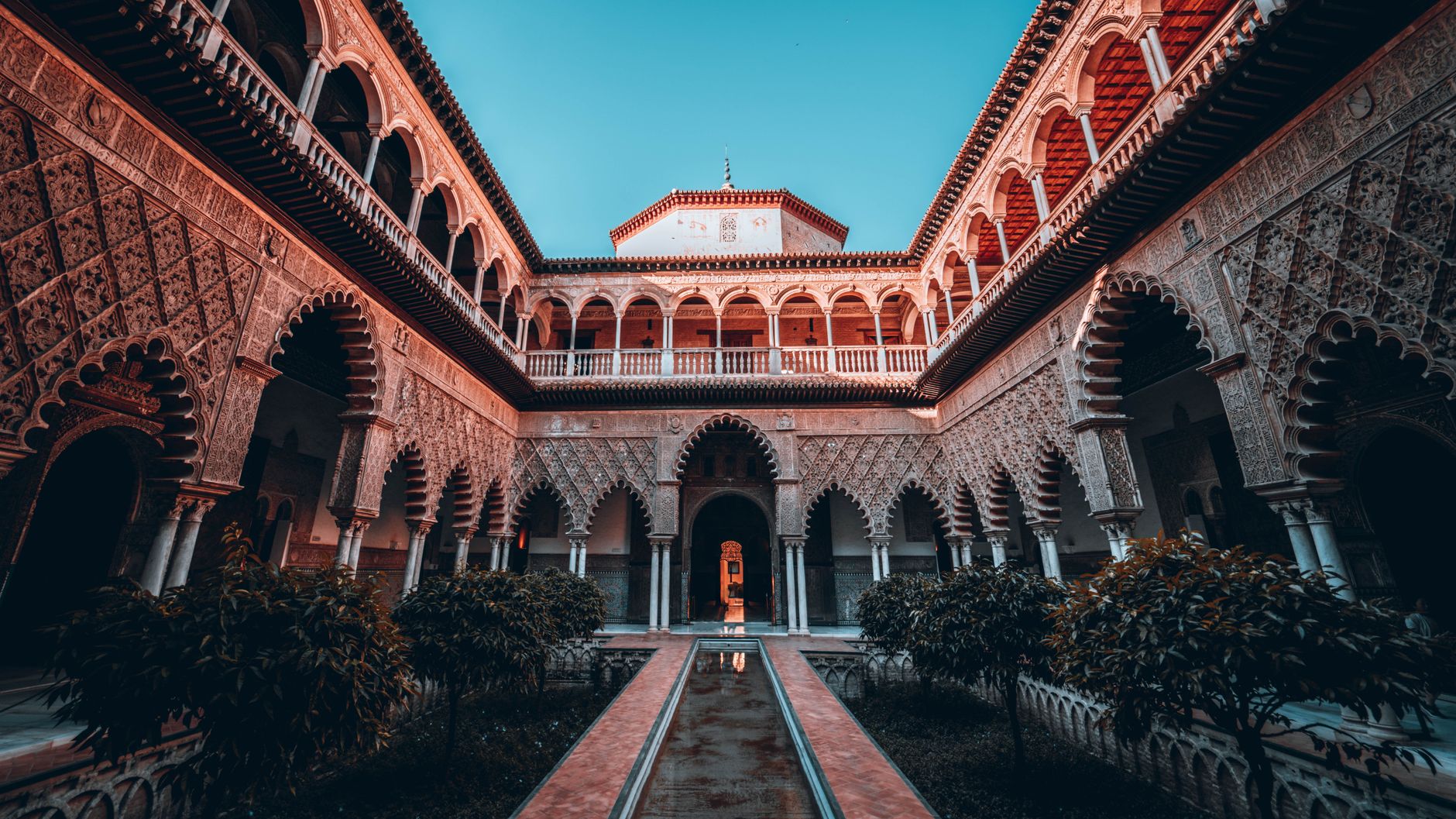
The Alcázar (entry €4.50) was built by Alfonso XI of Castile in 1328 on Moorish foundations. It was used as the main residence of Ferdinand and Isabella during the final phase of the Reconquista and as the headquarters of the Spanish Inquisition for 300 years. The Roman mosaics displayed in the ground floor (1st–2nd century CE, excavated from the garden) are the best in Andalusia. The terraced gardens — fountains, cypress trees, orange trees, and fish ponds — are peaceful in a way the Mezquita is not.
Getting to Córdoba
From Madrid Puerta de Atocha: AVE high-speed, 1h45–2h, €30–80. Fastest and most practical connection. From Seville Santa Justa: AVE, 45 minutes, €15–30. Córdoba and Seville combine easily in a single day. From Málaga Vialia: AVE, 1h, €20–40. From Granada: no direct high-speed. Train via Antequera (2h) or bus (3h, €15–18, more practical).
Córdoba's train station is 1.5km from the Mezquita — taxi (€6), bus, or a 20-minute walk along the Roman bridge approach.
When to Visit Córdoba
March–May: optimal. The Judería patios in May are the specific event. Temperatures 18–26°C, the orange trees in the Mezquita courtyard in bloom in March, manageable crowds.
September–October: strong second choice. Summer heat breaking (30–34°C in September, 22–26°C in October), fewer visitors than spring.
June–August: hot. Córdoba in July and August regularly reaches 40°C — the hottest major city in Spain. It is not impossible to visit (early mornings, the Mezquita interior stays cool, afternoon siesta in a hotel is not optional) but physically demanding. The free morning Mezquita entry at 8:30am is valuable here.
November–February: mild (12–18°C), quiet, some restaurants closed in January. The Mezquita is at its most atmospheric in winter light.
Frequently Asked Questions
How many days do you need in Córdoba?
One full day covers the Mezquita, the Judería, the Sinagoga, and the Alcázar. Two days allows for the Medina Azahara (8km outside the city — the ruined palace complex of Caliph Abd al-Rahman III, partially excavated, and arguably more historically significant than the Mezquita) and a slower pace. For a high-speed day trip from Seville or Madrid, 6 hours in the city is enough for the Mezquita and Judería.
Is the Mezquita free?
It is free to enter from 8:30 to 9:30am Monday–Saturday. Outside those hours, entry is €13. The free morning window is popular but significantly less crowded than the paid hours.
What is Córdoba's signature food?
Salmorejo — a thick cold tomato soup thicker than gazpacho, topped with hard-boiled egg and jamón serrano — is the dish specific to Córdoba. The best are at bars in the Judería and along the river. Flamenquín (a rolled pork and jamón loin, breaded and fried) is the other regional speciality.
How far is Córdoba from the Alhambra in Granada?
180km by road (2.5 hours by car, 2 hours by train via Antequera). The two form a natural Andalusia pairing — the Mezquita representing the Umayyad Caliphate at its peak, the Alhambra representing the final Nasrid emirate before 1492.