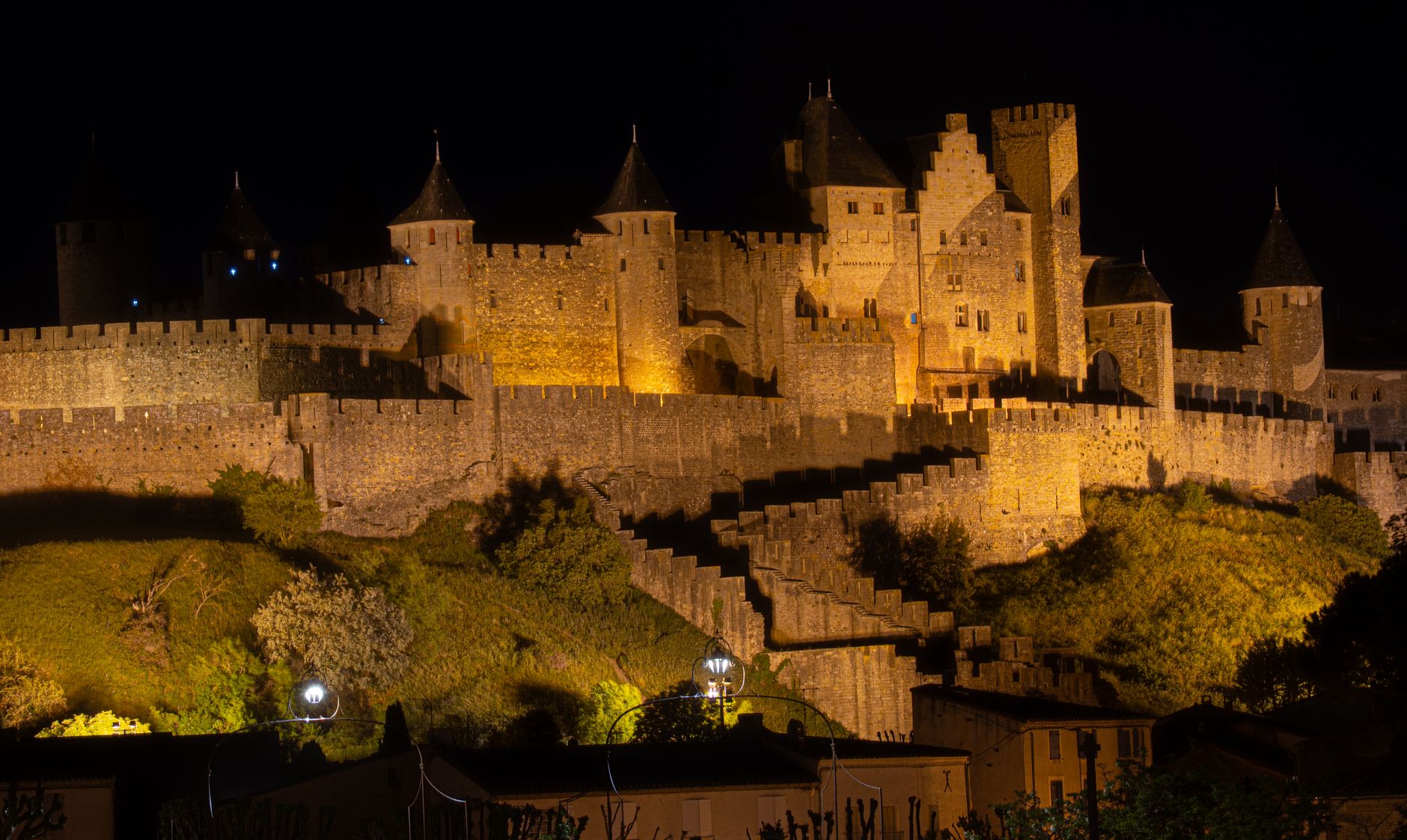

Carcassonne's Cité is the largest medieval fortress complex in Europe: 52 towers, 3 kilometres of double curtain walls, an inner château, and a Romanesque cathedral, all enclosed in a double ring of fortification that withstood every siege mounted against it during the Hundred Years' War. It is also the subject of a 19th-century restoration that has divided historians ever since — Eugène Viollet-le-Duc, who led the work from 1853 onward, added pointed slate turrets to the towers in a northern French style that the original southern Languedoc builders never used. King Carlos I of Spain, seeing a similarly aggressive restoration at another site, reportedly said: "You have destroyed something unique to build something ordinary." The scale of Carcassonne is not ordinary; but Viollet-le-Duc's fingerprints are on most of what you see.
The Cité: What to See
Château Comtal: the inner castle of the Trencavel viscounts, built in the 12th century before the main fortification ring was completed, with its own moat and drawbridge within the Cité. The museum inside covers the Cathar Crusade (1209–1229), the Albigensian heresy, and the medieval history of the Languedoc. Entry €12. The rampart walk along the château courtyard gives the best view of the double-curtain-wall system. Allow 1.5 hours.
The lices (the space between the inner and outer walls — the "killing ground" in siege terminology): a walkable path that runs around most of the Cité perimeter. From the Tour du Trésau to the Porte Narbonnaise, the northwest section shows the full double-wall system at its clearest. Free access from within the Cité.
Basilique Saint-Nazaire: a Romanesque-Gothic basilica inside the Cité begun in the 11th century. The stained glass windows (13th–14th century) are among the finest surviving Gothic glass in southern France, with the complexity and colour quality of the Sainte-Chapelle in Paris. Entry free. Allow 30 minutes.
Avoiding the Worst Crowds
Carcassonne has 3.5 million visitors per year, concentrated between June and September. The Cité on a July Saturday at noon is genuinely unpleasant. The tactics that work:
Arrive before 9am. The Cité is a pedestrian public space from early morning. Tour buses from Toulouse and Montpellier arrive from 10am onward. The 8:30–9:30am window has the fortress largely to yourself.
Stay the night inside the walls. A dozen small hotels and guesthouses operate within the Cité (€80–200/night). After 6pm, day visitors leave and the Cité changes completely — the lit walls at dusk, the empty lanes, and the views over the Aude river valley are the reason to spend the extra money.
Evening visits in summer. The Cité is illuminated after dark in July and August and remains accessible late. Visits after 8pm are significantly less crowded than daytime.
Bastide Saint-Louis: The Lower Town

The Bastide was built between 1260 and 1280 by Louis IX as a planned grid-plan market town on the west bank of the Aude river, separated from the Cité by 800 metres. It has been running the Tuesday, Thursday, and Saturday morning market on the Place Carnot since the 13th century — the covered market hall at its centre is the practical food infrastructure for the town.
The Canal du Midi — 360km of waterway linking Toulouse to the Mediterranean, built 1666–1681 and UNESCO-listed — passes along the southern edge of the Bastide. Walking or cycling the canal towpath in either direction is free and one of the most pleasant ways to spend an afternoon around Carcassonne. The canal itself is better here than in Toulouse — the plane trees lining the towpath reach full summer canopy.
Cathar Country Day Trips
The Languedoc landscape around Carcassonne contains a chain of ruined Cathar fortresses that are more historically significant and less visited than the Cité itself.
Châteaux de Lastours (15km north): four Cathar-era fortresses on adjacent ridges above the Orbiel river gorge. Entry €8, 1.5-hour visit. The ridgeline of four towers viewed from the opposite valley side is the defining image of Cathar landscape. Drive or taxi from Carcassonne (30 minutes).
Château de Peyrepertuse (90km southeast): a ruined Cathar fortress along a 800-metre cliff edge at 800m altitude — the longest Cathar fortress in the chain. The approach on foot takes 20 minutes from the car park. Entry €7. Usually combined with Quéribus.
Château de Quéribus (100km southeast): smaller than Peyrepertuse but with a complete keep. Entry €8. The view from the keep extends to the Pyrenees and the Mediterranean coast on clear days.
Getting to Carcassonne
From Paris Montparnasse: TGV direct, 4h10, €60–100. About 5 services/day. From Toulouse: regional train, 50 minutes, €15. The fastest practical connection. Toulouse is on the main TGV network from Paris. From Marseille: TGV, 2h15, €25–50.
Carcassonne station is in the Bastide lower town — 25 minutes' walk or €10 taxi to the Cité gate.
When to Visit Carcassonne

May–June: mild (20–26°C), the canal towpath green, lower crowds than summer. The best window for the Cathar château circuit.
September–October: Minervois and Corbières wine harvest, cooler temperatures, substantially fewer visitors than July–August.
July–August: hot (30–36°C), maximum crowds, medieval jousting tournaments inside the Cité. Still manageable with early-morning or evening strategy.
November–April: quiet, cooler, some Cité shops closed, all main sites open.
Frequently Asked Questions
Is the Carcassonne Cité authentic medieval architecture?
Partly. The footprint, the tower positions, and the curtain walls follow the medieval plan, and some sections of original stonework survive. Viollet-le-Duc's 19th-century restoration rebuilt, repaired, and substantially altered many elements — most controversially the pointed slate tower caps, which are not documented in medieval Carcassonne. The restoration has its defenders (without it the complex would have been quarried by 1900) and its critics (it imposes a northern French aesthetic on a southern French fortress). The size and setting are genuine.
How far is Carcassonne from Barcelona?
280km by road (2.5 hours via the A9 and A7), or by train from Carcassonne to Perpignan then TGV to Barcelona (total 2.5–3 hours, €30–60). A reasonable connection for those combining the Spanish and French sides of the Pyrenees.
What is the Cathar Crusade?
A military campaign launched by Pope Innocent III in 1209 against the Cathar heresy in the Languedoc — a Christian dualist movement that rejected the Catholic Church's authority, priesthood, and material wealth. The crusade lasted 20 years, destroyed much of the Languedoc's independent culture, and ended Cathar political power. The fortress chain that Carcassonne is the entry point to was built and destroyed during and after this conflict.
What wine is produced around Carcassonne?
The Corbières AOC (south and east of Carcassonne) and Minervois AOC (north) produce robust Languedoc reds from Grenache, Syrah, and Carignan. Both are among the best-value wine appellations in France. Château wineries throughout both areas offer tastings.