
Da Nang sits at the midpoint of Vietnam — roughly equidistant between Hanoi (750km north) and Ho Chi Minh City (950km south). The city was heavily bombed and fought over during the American War; almost nothing pre-1975 remains in the urban core. What exists now is a city built at speed from the 1990s onward: wide boulevards, bridges across the Han River lit with coloured LEDs at night, beach resorts on My Khe, and a municipal government that has invested heavily in both infrastructure and cleanliness. It is functional, comfortable, and lacking in the historical atmosphere of Hoi An or Hue — which is exactly why it works as a hub rather than a destination in itself.
Getting There
Da Nang International Airport has direct flights from cities across Southeast Asia, China, South Korea, Japan, and Australia, as well as connections throughout Vietnam. From Hanoi (1 hour 20 minutes, 700,000–1,500,000 VND on budget carriers) and Ho Chi Minh City (1 hour 25 minutes, similar fares) there are multiple daily services. The airport is 3km from the city centre — a taxi costs 100,000–150,000 VND; Grab is reliable and typically 10–15% cheaper.
The train between Da Nang and Hanoi (14–17 hours) and Da Nang and Ho Chi Minh City (17–19 hours) are scenic routes through coastal mountains and paddy fields. Sleeper berths (300,000–700,000 VND) are practical for overnight legs. The station is central.
My Khe Beach
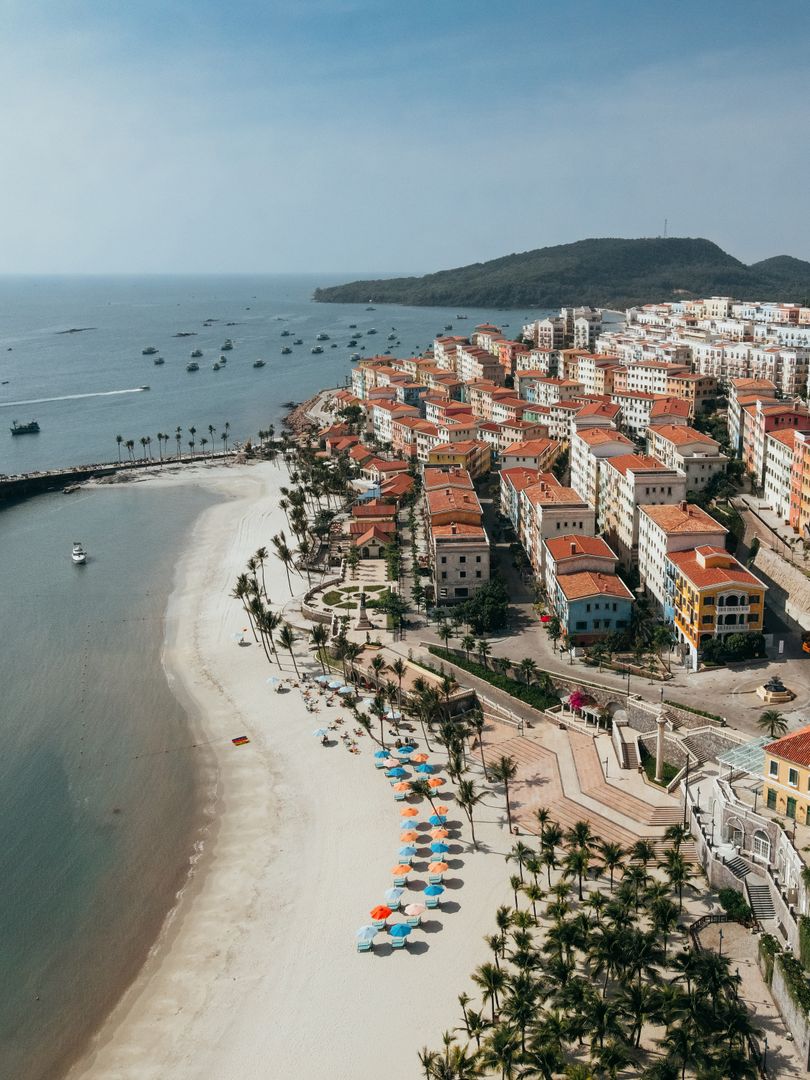
My Khe stretches 30km along the coast east of the city — wide, flat, and cleaned daily. The central section (closest to the city, roughly from the Danang Beach Hotel zone south to the more upscale resort area near Bai Bac) has the most restaurants and the most organised facilities: sunbed rental (50,000–100,000 VND), showers, seafood shacks behind the dunes. The beach faces east and is calmest in the morning; afternoon winds pick up regularly. Swimming is generally safe from March to September; typhoon-related swells make October–January rougher. The US military used My Khe as a rest and recreation beach during the war and left its Western name, China Beach, which still appears in some guides.
Dragon Bridge and the Han River

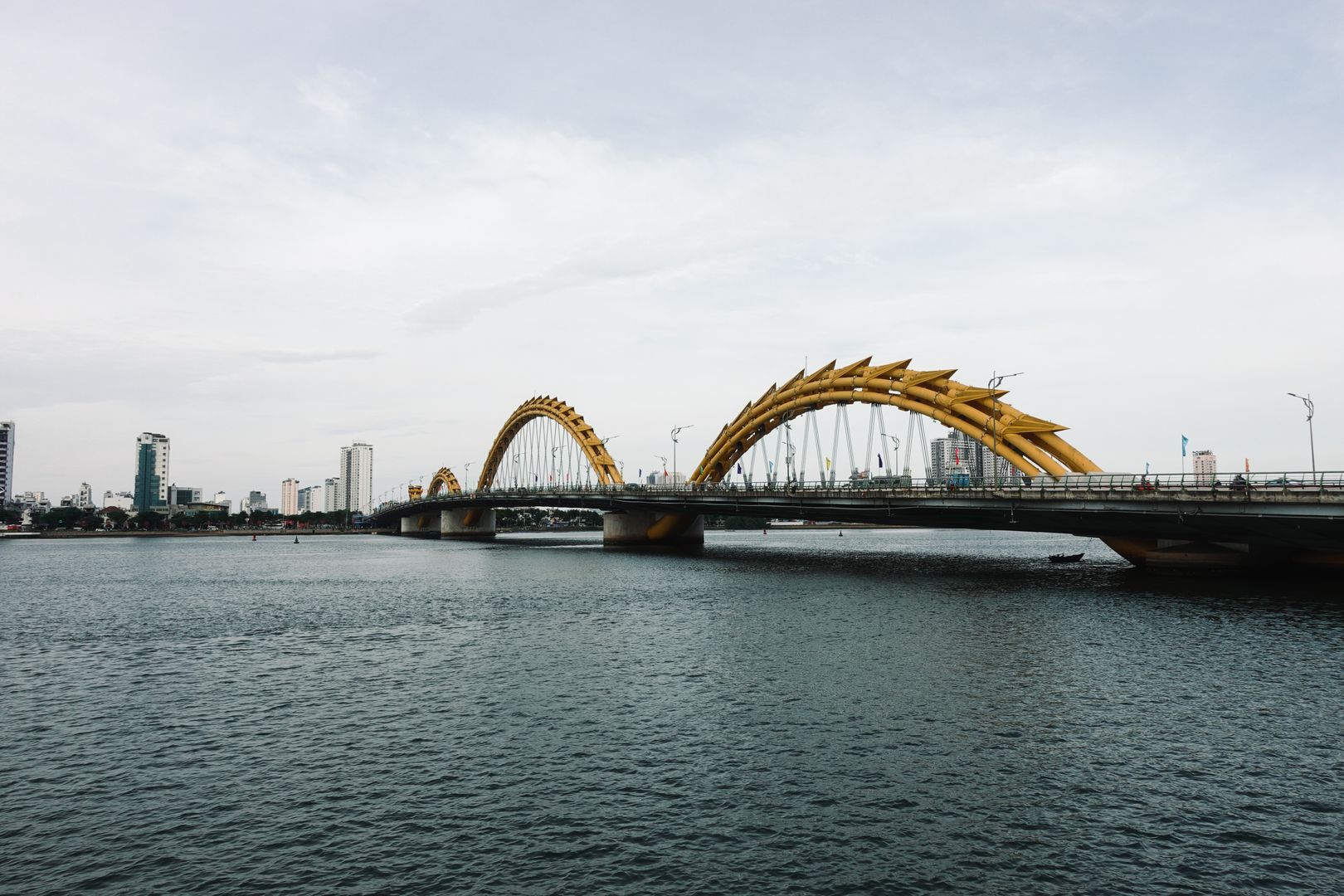
The Dragon Bridge (Cau Rong) crosses the Han River in a 666m dragon shape — the dragon is the city symbol, the bridge is the most visible result of Da Nang's municipal infrastructure investment. At weekends (21:00–21:15, Saturday and Sunday nights), the dragon head at the east end breathes fire and sprays water. This is worth seeing once. The Han River promenade runs along both banks; the night market on the west bank operates nightly from 18:00.
Marble Mountains
The Marble Mountains (Ngu Hanh Son) are five limestone peaks 8km south of the city centre — each named after one of the five elements. The main peak, Thuy Son (Water Mountain), has a network of cave temples inside the marble, including the Linh Ung Pagoda partway up and the Huyen Khong Cave (a large cavern with an opening to the sky through which light falls at certain hours). Entry 40,000 VND; elevator up the steep face 15,000 VND each way. The carving workshops at the base have sold marble souvenirs here for 500 years — production is still active.
Ba Na Hills and the Golden Bridge
Ba Na Hills is a French hill station 25km west of the city (now owned by a resort group) with a French village reconstruction, an amusement park, and several temples at 1,487m altitude. The primary reason to go is the Golden Bridge (Cau Vang) — a 150m pedestrian bridge held aloft by two giant stone hands, built in 2018. Cable car round trip: 750,000 VND. The Golden Bridge photograph is one of the most shared images in Vietnam travel and the construction is genuinely unusual — not particularly Vietnamese in character but difficult to categorise. Worth the time and money if novelty is a priority; not a good use of a day if historical or natural landscapes are the primary interest.
Day Trips: Hoi An and Hue

Hoi An is 30km south — a 45-minute taxi (around 300,000–400,000 VND one-way) or 30-minute motorbike ride. Most visitors based in Da Nang make at least one Hoi An day trip, or split time between the two. Hue, the former imperial capital, is 100km north — a 2.5-hour train or 2-hour car ride. For a day trip, Hue is possible but the train schedule makes it more comfortable with an overnight stay. The road from Da Nang north to Hue passes over the Hai Van Pass — a 21km mountain road over a headland with views of the coast on both sides. The pass is best done by motorbike (rent from Da Nang, 120,000–150,000 VND/day) or as a private car hire; the tunnel beneath the pass is the modern alternative but cuts out the view entirely.
Practical Notes
Da Nang is one of the few Vietnamese cities where Grab functions reliably enough that motorbike rental is not necessary for most visitors (unless doing the Hai Van Pass or exploring beyond the immediate city area). Budget guesthouses in the city centre run 250,000–500,000 VND; beach-facing hotels with pools from 1,000,000 VND upward. Best months: February–August (dry, calm seas). September–November brings typhoon risk and strong swells. The city celebrates its bridge fire shows on Saturday and Sunday nights year-round, regardless of season.
FAQ
Should I stay in Da Nang or Hoi An?
Depends on priority. Hoi An has more historical atmosphere, better restaurants, and a slower pace — but the old town floods regularly in the wet season and accommodation is more expensive. Da Nang has better transport connections, a proper beach, and lower prices. Many visitors spend 2 nights in each and use the proximity to move freely between them.
Is the Golden Bridge worth it?
If you have half a day to spare and 750,000 VND, yes. The bridge itself is a 10-minute walk; the surrounding Ba Na Hills complex fills 3–4 hours if you explore it. Do not make it the only reason to come to Da Nang.
How many days in Da Nang?
Two days: one for the city (Marble Mountains, Dragon Bridge, My Khe beach), one for a day trip to Hoi An. A third day for Hue day trip or the Hai Van Pass is worth adding if the schedule allows.