Fez was founded around 789 AD and reached its peak as Morocco's intellectual and religious capital during the 13th and 14th centuries. The old city — Fez el-Bali — was inscribed as a UNESCO World Heritage Site in 1981 and has barely changed in layout since the medieval period. The 9,000 lanes range from wide market streets to passages so narrow that loaded donkeys scrape both walls. There are no cars, no motorcycles, and no map that reliably shows what's at the end of a given alley. This is either the thing that makes Fez interesting or the thing that makes it exhausting, and most visitors experience both within the first two hours.
How to Navigate the Medina
Fez el-Bali is divided into roughly 150 quarters, each historically associated with a specific trade or ethnic group. The main arteries run from the major gates — Bab Bou Jeloud in the west is the main tourist entry point — toward the Qarawiyyin Mosque at the centre. Navigation is genuinely difficult. The standard advice is to head uphill when lost (the rim of the medina basin gives orientation points) and to memorise three or four key landmarks rather than trying to follow a map in real time.
A guide for the first half-day is worth the cost — not because the medina is dangerous, but because a local who knows the layout will show you connections between quarters that take weeks to discover independently. Official guides are licensed through the tourist office and charge around MAD 300–400 (€27–36) for a half-day. Decline the unsolicited guides outside the main gates, who will invariably route you through shops where they receive commission.
What to See in Fez
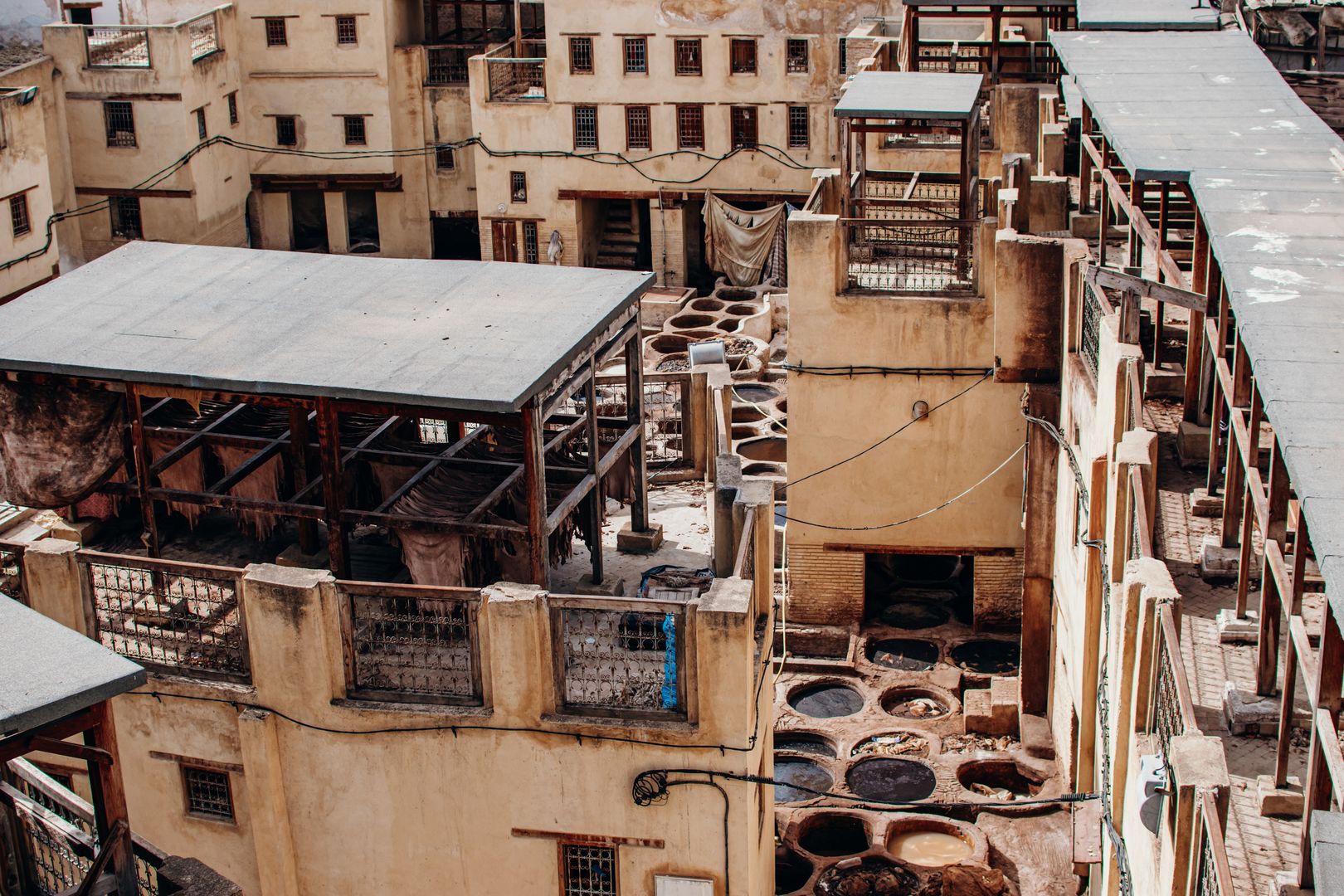
The Chouara Tannery is the most famous single view in Fez — a working leather tannery that has operated on the same site since the 11th century, with stone vats of dye visible from the terraces of surrounding leather shops. The view is free if you enter through any leather shop (they will show you up and expect you to look at merchandise, which you're not obliged to buy). The smell of pigeon dung and tanning chemicals is significant; mint sprigs are sometimes offered at the entrance and are genuinely useful.
The Bou Inania Madrasa (a 14th-century theological college) is open to non-Muslims and worth the MAD 20 entry for its carved cedar and plasterwork. The Al-Attarine Madrasa, adjacent to the Qarawiyyin Mosque, is similar in quality and slightly less visited. The Qarawiyyin Mosque itself — founded in 859 AD, considered the world's oldest continuously operating university — is not open to non-Muslims, but the door views from several surrounding lanes give enough of a sense of the courtyard scale.
The Nejjarine Museum (woodworking and carpentry arts) occupies a restored 18th-century caravanserai and has good exhibits on traditional craft techniques. The Jewish quarter (Mellah) in the adjacent Fez el-Jedid district is quieter and less visited than the main medina — the Ibn Danan Synagogue, still maintained, can be visited with a guide or a small tip to the caretaker.
Fez vs Marrakech
The comparison comes up constantly because most visitors to Morocco go to one or both. Marrakech is more polished and easier to navigate — the main square (Jemaa el-Fna) provides constant orientation, and the medina layout is less labyrinthine. Fez is larger, older, and more intact as a functioning traditional city: the medina population is around 150,000 rather than the increasingly gentrified souk operators of Marrakech.
Fez has less of the late-night entertainment and restaurant scene that Marrakech built around the tourist trade; what it has instead is a sense of daily life continuing without performance. The food culture is different too — Fassi cuisine (from Fez) includes bastilla (pigeon and almond pastry) and dishes that rarely appear on tourist menus in Marrakech. If you're choosing between the two, Fez rewards more patience and curiosity; Marrakech rewards less.
When to Visit Fez
March through May and October through November are the best months. Spring temperatures run 15–24°C; autumn is similar. The medina is walkable without the heat becoming a factor. Summer (June–August) reaches 38–42°C in the medina's enclosed lanes — not impossible but genuinely unpleasant for sustained walking. Winter is mild (8–15°C) and the city is quiet; some riads charge their lowest rates from December through February.
Ramadan is worth considering deliberately: the medina atmosphere changes significantly after sunset, with the fast-breaking meal (iftar) creating a collective energy that's unlike any other time of year. Walking through the medina at dusk during Ramadan is one of the more vivid experiences available. The trade-off is that many restaurants are closed during daylight hours and schedules shift entirely.
Where to Stay in Fez
Staying inside the medina in a riad — a traditional courtyard house converted to a guesthouse — is the obvious choice and available at every price point, from €30 per night for a basic room to €200+ for a boutique property with a rooftop terrace. The courtyard layout means riads are quieter than the lanes outside suggest. The key variables are whether the riad is actually inside the medina (some are in Fez el-Jedid or the new city, which is a significant walk away) and whether the hosts can arrange airport transfers and luggage delivery into the medina, since cars cannot enter.
The Ville Nouvelle (new city), built during the French Protectorate, has standard international hotels and is easier to navigate but misses the point of being in Fez.
Practical Notes

Fez is reached by train from Casablanca (3h45, MAD 110–200) or Marrakech (7–8 hours with a change at Casablanca). Fez–Saïss Airport has direct flights to several European cities including Paris, Brussels, and Madrid. A taxi from the airport to the medina costs MAD 100–150 (€9–13).
The dirham is not freely convertible outside Morocco; exchange at the airport on arrival. ATMs are widely available in the Ville Nouvelle and less so inside the medina. Bargaining is standard in the souks — the opening price is typically two to three times the expected final price. For fixed-price shopping, look for shops with posted prices, which exist but are less common.