
Lecce's historic centre contains more ornate Baroque architecture per square metre than anywhere else in southern Italy. Every church facade, palazzo doorway, and civic building is carved from pietra leccese — a fine-grained golden limestone soft enough to work with a knife when freshly quarried, hard enough to last centuries in the Apulian air. The city sits in the Salento peninsula, the thin heel of Italy's boot, 90km south of Brindisi and 240km from Naples. It functions as a destination in its own right rather than a side trip, and it is substantially less visited than its quality warrants.
What Makes Lecce's Architecture Different
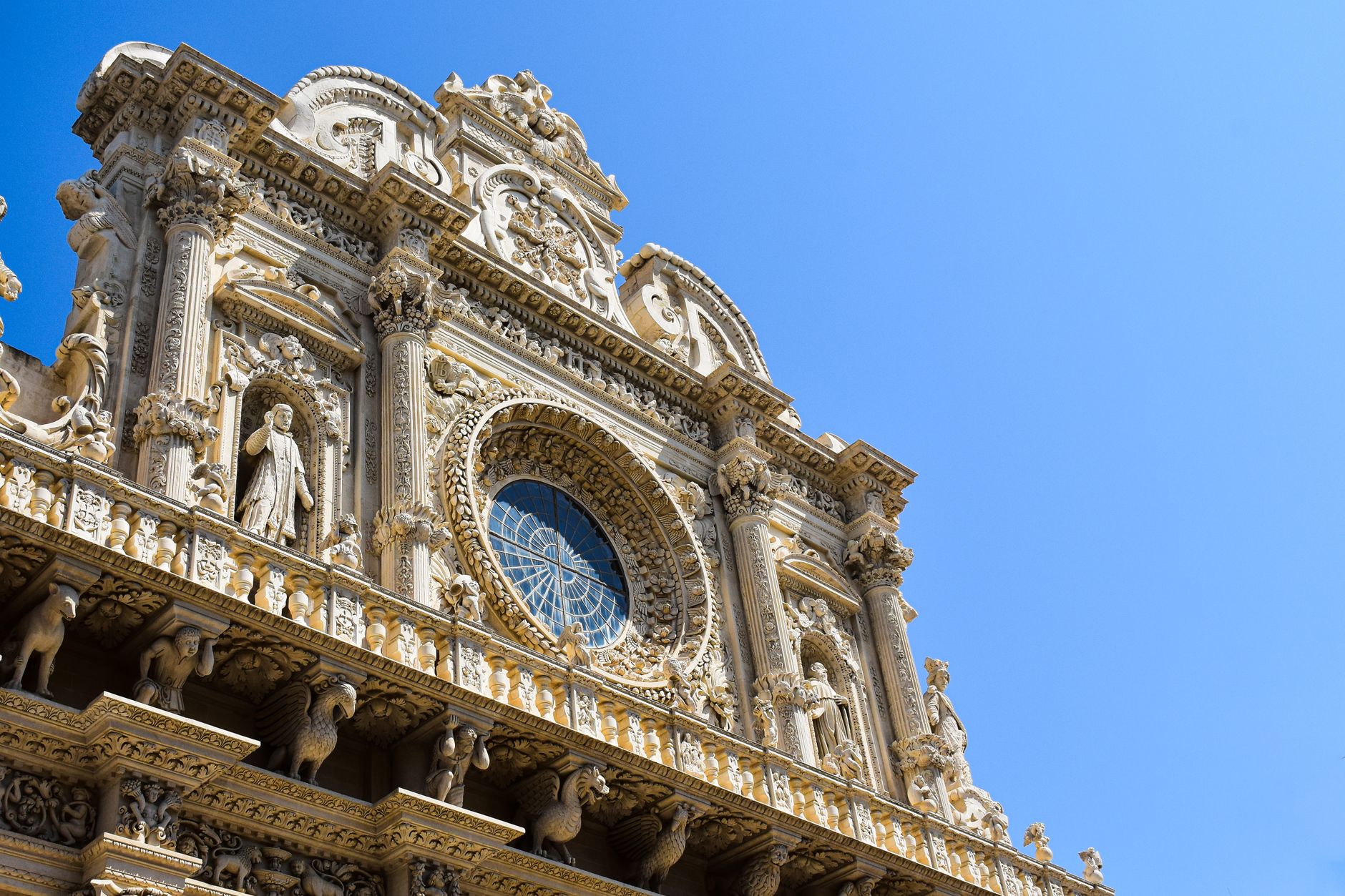
Baroque architecture spread across Europe in the 17th and 18th centuries, but Lecce's version developed in a specific direction because of the stone. Pietra leccese allows for a level of detail — elongated figures, interlocked foliage, layered cornices — that harder stones like marble resist. Local craftsmen took this to an extreme: the facades of the Basilica di Santa Croce, the Church of Sant'Irene, and the Palazzo del Seminario are carved with a density of ornament that borders on excess, which is either the point or a reason to keep moving, depending on your tolerance for decorative elaboration.
The Basilica di Santa Croce is the defining building. Construction ran from 1549 to 1695 — 146 years — and the facade shows it: three distinct stylistic phases visible in the shift from restrained lower register to the rose window flanked by Baroque figures to the crowning frieze of griffins, caryatids, and foliage. The interior is comparatively sober. Entry is free; allow 30 minutes.
Piazza del Duomo is the most composed urban space in Lecce: the cathedral, the bishop's palace, the bell tower, and the seminary arranged around a trapezoidal piazza closed on one side. The ensemble was planned and built within a single century (1659–1746), which gives it a visual coherence most Italian piazze lack. The 70-metre campanile is climbable (€2, limited hours).
The Roman Layer Under the Baroque
Lecce is built on a Roman city — Lupiae — and the street grid still follows the Roman plan. Two significant Roman structures survive above ground.
The Roman Amphitheatre (1st–2nd century CE, capacity 25,000) sits in Piazza Sant'Oronzo, the main public square. About half is excavated and visible; the rest lies under the surrounding buildings and streets. Entry is free; a small museum beneath the piazza explains the excavation.
The Roman Theatre (2nd century CE), discovered in 1929 during construction work two blocks from the amphitheatre, seats 5,000 and is partially excavated. Free entry to the archaeological area. The juxtaposition of Roman ruins and Baroque buildings within a 200-metre radius, with people having coffee at tables in between, is Lecce in miniature.
Food in Lecce

Lecce has specific edible things worth finding. Pasticciotto leccese is a short-pastry tart filled with custard cream, a breakfast staple in every bar in the city — the best are at Caffè Alvino on Piazza Sant'Oronzo, open since 1950. The format is nothing like a croissant; it is a solid, dense pastry requiring at minimum a coffee alongside it.
Caffè leccese is espresso poured over ice with almond milk (latte di mandorle) — not the same as the northern Italian version. The almond milk is pressed rather than blended and has a slightly bitter undertone. Order it in any bar; locals drink it year-round.
Friselle — twice-baked bread rounds soaked in water and dressed with tomatoes, olive oil, and oregano — are the standard lunch street food, available at every panificio in the old town.
The Mercato Coperto (covered market) on Via Ciminelli operates daily until 2pm and has the best selection of Salento cheeses (scamorza, ricotta forte), cured meats, and olives.
Getting to Lecce
Lecce has its own train station with direct Frecciarossa and Intercity connections.
From Rome Termini: Frecciarossa, 4h15, €35–70. Five or six departures daily. From Naples Centrale: Intercity or Frecciabianca, 4–5 hours, €30–60. From Bari Centrale: regional train, 1h30–2h, €10–15. Frequent services. From Brindisi (nearest airport, BDS): train, 30 minutes, €4.
Flying into Brindisi then taking the train to Lecce is the most practical international connection. Ryanair, Wizz Air, and easyJet serve Brindisi from multiple European cities in summer.
When to Visit Lecce
April–June is the optimal window: temperatures 18–26°C, the stone takes on a warm amber colour in the afternoon light, and domestic Italian tourists have not yet arrived in force. The city's university population keeps the bars and restaurants busy year-round, which means atmosphere is not a problem even in low season.
September–October: close second. Slightly cooler than summer, harvest produce in the markets, the Salento coast accessible without the August crowd.
July–August: very hot (32–36°C), the city is busy but not overwhelmed — Lecce's beaches (the Salento coast, 20–30km east or west) draw tourists outward. Staying inside the historic centre in summer means narrow shaded streets that stay tolerable until 11am and after 6pm.
November–March: quiet and cool (8–15°C). Some restaurants reduce hours. Not recommended as a sole destination in winter but works as part of a longer southern Italy itinerary.
What to Skip
The Street of the Cheesemakers (Via dei Formaggi) and similar tourist-labelled lanes are a marketing construct — Lecce's old town is compact enough that you will see everything worth seeing just by walking it without a predetermined route.
The coach tour hop-ons from Brindisi fill the piazze from 11am to 3pm July–August. Visit Santa Croce and the amphitheatre before 10am or after 4pm if this is your window.
Frequently Asked Questions
How many days do you need in Lecce?
Two days is comfortable: one day for the Baroque centre (Santa Croce, the piazzas, the Roman sites), one day for food, slower walking, and a half-day at one of the Salento coast beaches (Otranto, 40km east, or Gallipoli, 37km west).
Is Lecce worth visiting without a car?
Yes. The old town is entirely walkable and the train connections are good. A car becomes useful for the Salento coast and the smaller villages (Acaya, Specchia, Nardò) but is not required for Lecce itself.
What is pietra leccese?
A golden limestone found in the Lecce area, soft enough to carve with hand tools when freshly quarried but hardens on exposure to air. The same stone appears in most of the city's buildings, giving the historic centre a visual unity unusual in Italian cities of this size.
Is Lecce more expensive than other Italian cities?
No — Lecce is one of the more affordable historic centres in Italy. A mid-range dinner runs €20–35/person including wine; cave cocktail bars in the old town charge €6–9 for an Aperol Spritz. Hotel rooms in the centro storico range €80–160 in mid-season.
What is the best beach near Lecce?
Otranto (40km east) has the clearest water on the Adriatic side and a small medieval old town worth an hour. Porto Cesareo (30km southwest) on the Ionian side has shallower, warmer water and is better for families. Both require a car or a bus from Lecce.