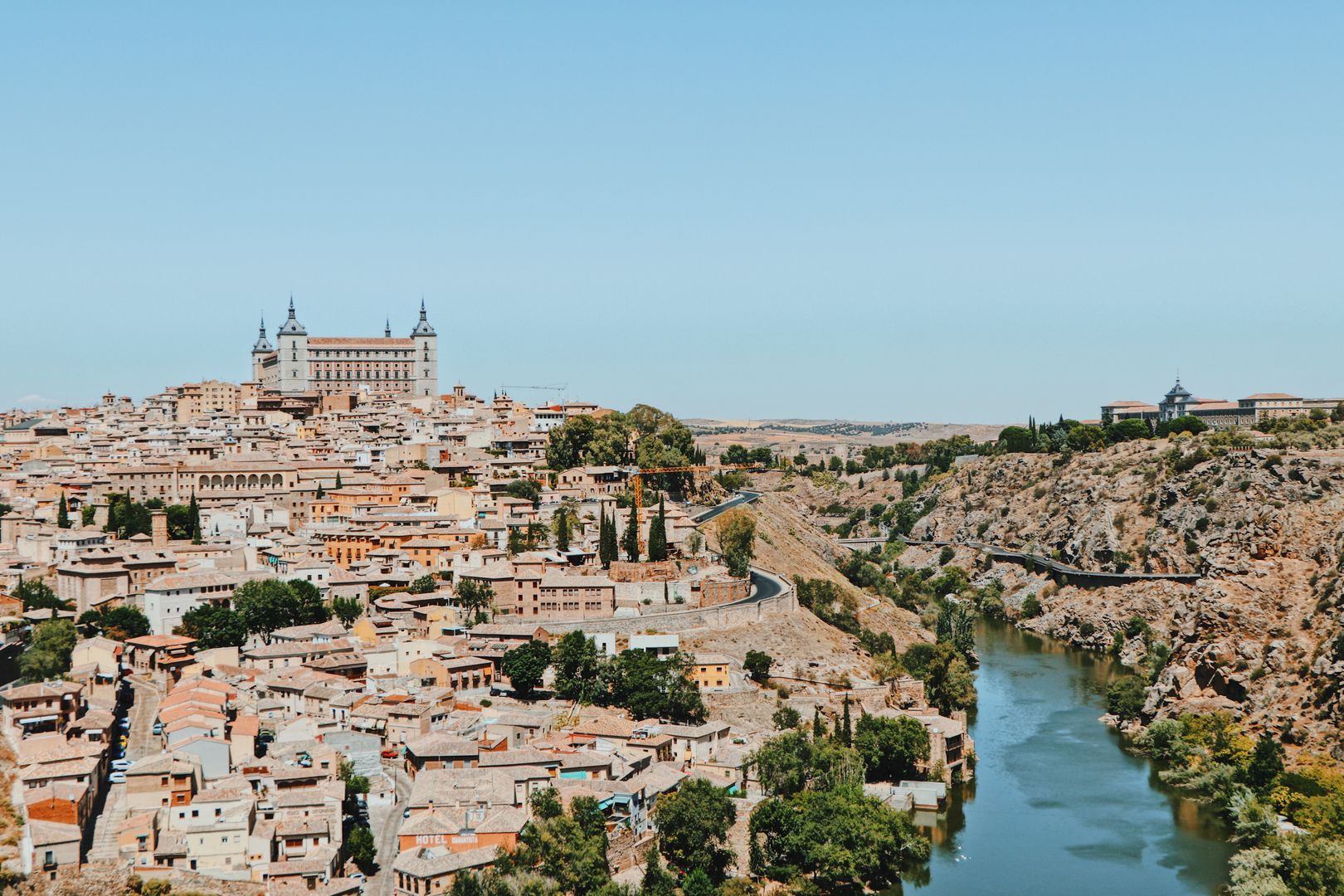

Toledo sits 70km south of Madrid on a granite hill ringed by a bend in the Tagus river — a 16th-century city so unchanged that it functions as a three-dimensional archive of Christian, Jewish, and Islamic coexistence. The problem is timing: on a weekend in July, tour buses outnumber residents; on a weekday morning in November, it's one of the most spatially coherent old towns in Europe. Getting the timing right separates a memorable visit from a queue-management exercise.
How to get to Toledo from Madrid
The high-speed Avant train from Madrid Atocha to Toledo takes 33 minutes and runs roughly every hour. Book online through renfe.com in advance (€13–17 one way). This is the only method worth considering for a day trip — faster and more reliable than the ALSA buses from Estación Sur (€6 one way, 1 hour 20 minutes), and cleaner than driving.
The Toledo train station sits at the base of the old town. Walk uphill for 20 minutes (steep, follow signs marked "Ciudad Vieja"), take a taxi (€6–8), or catch bus line 5 to Plaza de Zocodover, the main square. Walking takes longer but shows you the city's fortifications from below and costs nothing.
If driving: the A-42 motorway connects Madrid directly. Park in the open-air lot at the base of the walls (€1.50–2 per hour) or use the underground Mirador parking (€2.50 per hour). Do not attempt to drive inside the medina — streets are barely wide enough for one car, junctions blind, and you will back into a wall or a pedestrian.
Toledo Cathedral: why it matters and what's inside
The Catedral Primada is one of Spain's four Gothic cathedrals (alongside Burgos, León, and Seville) and took 250 years to build, starting in 1226. It's not the tallest or most ornate, but it's architecturally the most coherent — the proportions and detailing remain consistent across centuries of work.
Admission is €10; allow 90 minutes. Enter from the west façade on Calle Cardenal Cisneros. The interior is shadowy and dense with altarpieces, but three things matter:
The treasury (Sacrístía), on the right side of the nave, holds El Greco's Expolio (The Disrobing of Christ, 1577–79) displayed at eye level — not behind glass in a dark corner like most great paintings. The canvas is 2.85m tall, and Greco positioned it so you meet the figures' gaze directly. This is why people travel to Toledo.
The choir in the central nave contains carved walnut stalls (1495–1504) with biblical and historical scenes. Walk behind it to see the back panels, which are often overlooked.
The cloister (claustro) is small and peaceful, a usable space rather than a museum piece. Sit for five minutes if the light is right.
Bring cash: the donation box accepts cards, but the official ticketing system can be slow on crowded days.
The Alcázar: views and fortress history
The Alcázar dominates Toledo's skyline — a massive fortress castle on the city's highest point, originally built in the 9th century and rebuilt several times, most completely by Emperor Charles V in the 16th century. The National Military Museum (Museo del Ejército) occupies the interior, but most visitors come for the exterior and the views.
Walk to the top for free — the building is surrounded by a open plaza. The view south across the Tagus valley and west toward the Spanish plateau is the clearest image of why Toledo's location mattered: defensible, controlling roads, visible for kilometers. On clear days you can see the mountains beyond the city.
The museum admission is €5 (free on Sunday afternoons). It's competent but not essential for a day trip — exhibits cover Spanish military history from the Reconquista onward, with uniforms, weapons, and some heavy vehicles. Skip it unless you have 45 minutes to spare.
El Greco's Toledo: where to see his work
Doménikos Theotokópoulos, called El Greco, arrived in Toledo in 1577 after failing to secure commissions at El Escorial under Philip II. He lived here until his death in 1614, painted obsessively, and developed a visual vocabulary so distinctive that his work now defines how we see the city — the grey-green light, the vertical-stretched figures, the dramatic stormcloud skies.
The strange fact about El Greco and Toledo is that his paintings are actually accurate to the city's winter light and atmosphere. He didn't distort the place; he recorded its particular quality of illumination and weather.
See his work in three places:
Santo Tomé church: holds The Burial of the Count of Orgaz (1588), his most famous painting — a vertical canvas 4.8m tall showing a count's funeral attended by saints and angels. One room, one painting. Admission €3. This is the single image that defines El Greco's work; don't miss it.
Toledo Cathedral: the Expolio (noted above) is his most direct, emotionally powerful work — the moment before Christ's crucifixion, the soldiers gambling for his robes indifferent to his dignity.
El Greco Museum (Museo del Greco): the house on Calle del Tránsito where he lived from 1577 onward. The collection includes the View and Plan of Toledo (1610), a bird's-eye map of the city painted as an abstract composition of stone and sky, plus portraits and religious works. €3 admission (free Saturday afternoon and Sunday). The rooms are small; allow 45 minutes. His workshop is preserved upstairs with period furniture, giving a sense of how a 16th-century painter's studio actually functioned.
Between the Cathedral, Santo Tomé, and the El Greco Museum, you'll see the full arc of his work. Three museums, €13 total, three hours total time. Worth it.
The Judería (Jewish quarter) and the Mosque
Toledo's Jewish quarter (Judería) occupies the eastern half of the old town. Two surviving synagogues anchor the neighborhood:
Sinagoga del Tránsito (13th century): now the Museum of Sephardic Culture. The interior is austere, with carved wooden ceilings. The museum documents the history of Spain's Jewish community before the 1492 expulsion. Admission €3. Allow 45 minutes.
Sinagoga de Santa María la Blanca (12th century): the name is Christian (assigned after Jews were expelled); the building shows Almohad Islamic influence with white horseshoe arches. It's smaller and simpler than Tránsito, and less crowded. Admission €2.80. Allow 20 minutes.
Both are working synagogues in form, though now operated as cultural institutions. Remove shoes if you enter prayer areas.
Mosque of Cristo de la Luz: a 10th-century Almohad mosque, one of the best-preserved in Spain outside Córdoba. The interior courtyard and sanctuary show Islamic architecture at its most rational — carved stucco, geometric tiles, a ceiling of interlocking wooden beams. Admission €2.80. Allow 20 minutes. The light through the windows is the reason for the name (Light of Christ).
The streets between these monuments are among the quietest in Toledo — narrow, uneven stone, few tourists. Walk them slowly.
Food and practical eating advice

Restaurants in the old town near the main tourist sites — Plaza de Zocodover, Santo Tomé, the Cathedral — are expensive (€18–28 mains) and mediocre. The formula is tourist capture: location over quality.
Walk 10 minutes toward the eastern edges of the medina (near the Judería and Alcázar's base) and prices drop by half. Restaurants here still serve visitors, but local residents also eat there, which is the most reliable quality signal.
Carcamusa: the local specialty, a stew of pork, tomato, peas, and spice — medieval in flavour and origin. Available as a tapa (€4–6) at most bars, or as a full dish. Try it once; it's edible history.
Marzipan (mazapán): Toledo has made this since the 12th century, traditionally credited to a convent using almonds and sugar during a medieval famine. Tourist stalls sell waxy, over-sweet versions. Buy from the traditional confectionery shops instead: Santo Tomé confectionery on Plaza de Zocodover is the best-known, though any confitería marked "desde 19xx" (since [year]) is reliable.
Timing your visit: the one mistake most people make
The single most counter-intuitive fact about Toledo is that the morning matters more than which day you choose. Tour buses arrive on a fixed schedule. Take the first train from Madrid (typically 8:00 or 8:30 am) and you'll have the Cathedral, Santo Tomé, and the main streets to yourself until 11:00 am. By noon, the buses have parked and the medina is full. By 3:00 pm they depart, and the city becomes navigable again.
Day-trip timing:
- Arrive 8:30–9:00 am
- Cathedral and treasury: 9:00–10:30 am
- Santo Tomé church: 10:30–11:15 am
- El Greco Museum or Judería (pick one): 11:15 am–12:45 pm
- Lunch (away from the centre): 1:00–2:00 pm
- Alcázar exterior and views: 2:00–2:45 pm
- Return to station: 3:00 pm (train departs around 4:00 pm)
This schedule avoids the peak crowds and still covers the essential sites.
An overnight stay is worth considering if you have time. Toledo after 6:00 pm, once the day visitors have left, is a different city — emptier streets, clearer light in the plazas, the actual architecture visible without human texture. A single night in a modest hotel (€50–70) transforms the experience.
Frequently Asked Questions
Is Toledo worth visiting as a day trip from Madrid?
Yes, but only with the right timing. Toledo in winter (November–February) on a weekday morning is architecturally and historically extraordinary — a genuinely coherent medieval city. Toledo on a July Saturday is a queue-based experience. The Cathedral alone justifies the trip; everything else is surplus.
What's the fastest way to get there from Madrid?
The Avant high-speed train from Madrid Atocha (€13–17 one way, 33 minutes, roughly hourly service). Book online at renfe.com one to two days ahead. Driving takes 1 hour 20 minutes; buses take 1 hour 20–40 minutes and are slower and less pleasant.
Can you see Toledo's main sights in half a day?
Yes. The Cathedral (90 minutes), Santo Tomé church (30 minutes), and either the El Greco Museum (45 minutes) or the Alcázar exterior (30 minutes) total four hours, leaving time for travel and lunch. Skip the Judería and Mosque unless you have a specific interest in medieval Jewish or Islamic history.
Where should I eat in Toledo?
Avoid restaurants directly facing the main plazas and tourist routes. Walk into the backstreets of the Judería (eastern medina) or south toward Calle Comercio. Prices are 30–40% lower, quality is higher, and you'll sit alongside residents rather than tourist groups.
Is the El Greco Museum worth visiting?
Only if you've seen his work elsewhere and want a deeper dive. The three key paintings (Cathedral Expolio, Santo Tomé Burial, and the Museum's View and Plan) together take 2.5–3 hours and €16 total. If you're short on time, the Cathedral and Santo Tomé alone represent his work faithfully.
How long should I stay overnight if I do?
One night is enough. Spend the morning (8:00–11:00 am) on the main sites while quiet, have a long lunch, walk the quieter neighborhoods in the afternoon, explore in the evening after the tour groups leave, and depart the next morning. A second night adds nothing except rest.
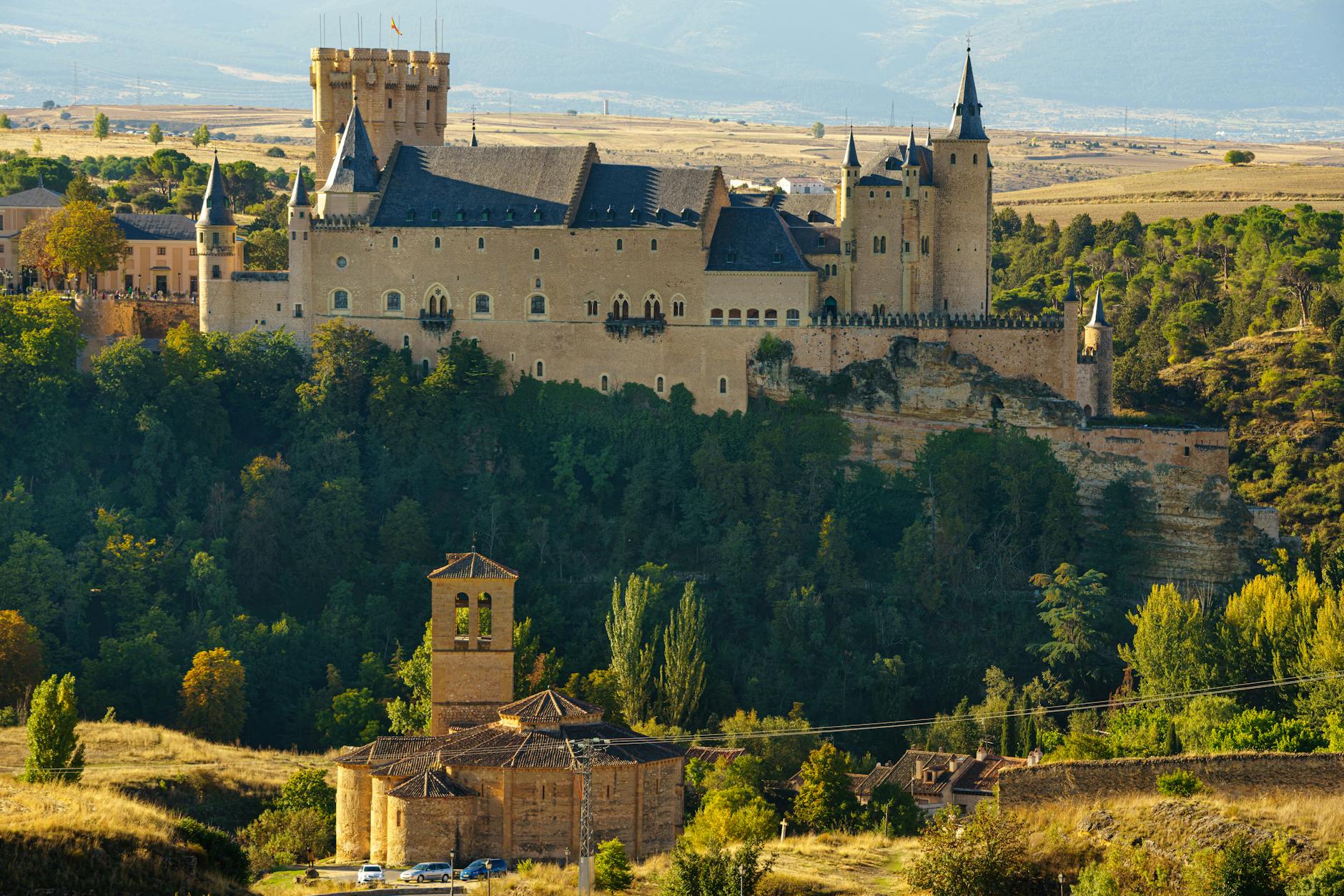
Toledo against other Madrid day trips: Segovia is larger and more about the aqueduct and castle; Ávila is smaller and more purely medieval; El Escorial is a palace complex, not a town. Toledo is the most architecturally coherent and the only one where three religions physically shaped the streets. The Cathedral's Expolio is non-negotiable — the painting that justifies the journey. Go early, go on a weekday if possible, and give the Cathedral 90 minutes instead of 30.


