
Chiang Rai is worth two nights if Chiang Mai has delivered what you wanted from northern Thailand — quieter, smaller, and with three genuinely unusual temples that don't exist elsewhere. The White Temple is the anchor; the Golden Triangle is primarily context and a museum, not spectacle. Most guides oversell the "escape" narrative; the reality is a manageable provincial city where the temples are the content, and the in-between time moves slowly.
How to get from Chiang Mai to Chiang Rai
The bus from Chiang Mai Arcade Station takes three to three and a half hours and costs around 160 THB. Services run hourly from 6:30am through to evening; no advance booking required. The ride is direct, the buses reliable, and it remains the default choice.
Shared minivans (Green Bus operates the main service) depart from Pratu Chiang Mai and take roughly three hours for 200 THB. Slightly faster, slightly more cramped, useful if you time it to leave mid-morning and arrive for lunch.
A forty-minute flight exists via Kan Air and AirAsia, typically 1,200–2,500 THB depending on how far ahead you book. The flight only makes sense if you're on a schedule tighter than two weeks — the airport transfer time and baggage hassle neutralise any speed advantage over the bus.
Driving yourself (motorbike or rental car) is viable if you've done it in Chiang Mai already. The road is Highway 1, well-maintained, and the journey takes three to three and a half hours depending on stops and traffic through Mae Sai.
Overnight sleeper buses from Bangkok exist but terminate in Chiang Mai or Lampang; you'd need to change and lose the time-saving logic.
Avoid the temptation to day-trip from Chiang Mai. Seven hours spent on the road leaves roughly four hours in Chiang Rai, which is enough for one temple only. Stay overnight.
Wat Rong Khun: The White Temple
This is the reason most people make the journey north. Wat Rong Khun is a private contemporary Buddhist temple designed by the artist Chalermchai Kositpipat — entirely clad in white tiles and mirrored glass, deliberately alien, deliberately unsettling. Unlike the traditional temples in Chiang Mai, this one references pop culture throughout: figures from the Alien films, Predator, Hello Kitty, and modern political leaders appear within conventionally Buddhist hell scenes. It functions as satire and devotion simultaneously.
The structure was begun in 1998 and remains unfinished; Kositpipat continues to add details. Entry is 100 THB. Opening hours are 8am to 5pm, with a closure from noon to 1pm. The exterior is the main attraction — white against sky, symmetrical, architecturally precise. The interior is ornate and contains genuine Buddhist relics, but photography is prohibited inside. Most visitors spend 30 to 45 minutes total.
Crowds arrive by 9am. Tour buses from Chiang Mai time their pickups to hit the temple mid-morning, creating a bottleneck on the central bridge where everyone photographs the reflection. Arrive before 8:30am or return after 3pm to avoid the volume. Early morning offers better light anyway.
Getting there: the temple is 13km south of Chiang Rai city centre. Songthaew (red trucks) run from the central bus station for approximately 40 THB per person; ask for Wat Rong Khun, and the driver will drop you at the entrance. A private red truck taxi costs around 250 THB for the vehicle (negotiable depending on whether the driver takes other passengers). Most hotels can arrange transport; expect to pay 300–400 THB through the front desk.
One thing most guides get wrong: they imply Wat Rong Khun is an undiscovered anomaly. It is not. It receives roughly 2 million visitors annually and has been described extensively for twenty years. What remains genuine is the architectural specificity — nothing else in Asia looks remotely similar, and the interior detail rewards a careful walk-through despite the crowds.
Wat Rong Suea Ten: The Blue Temple
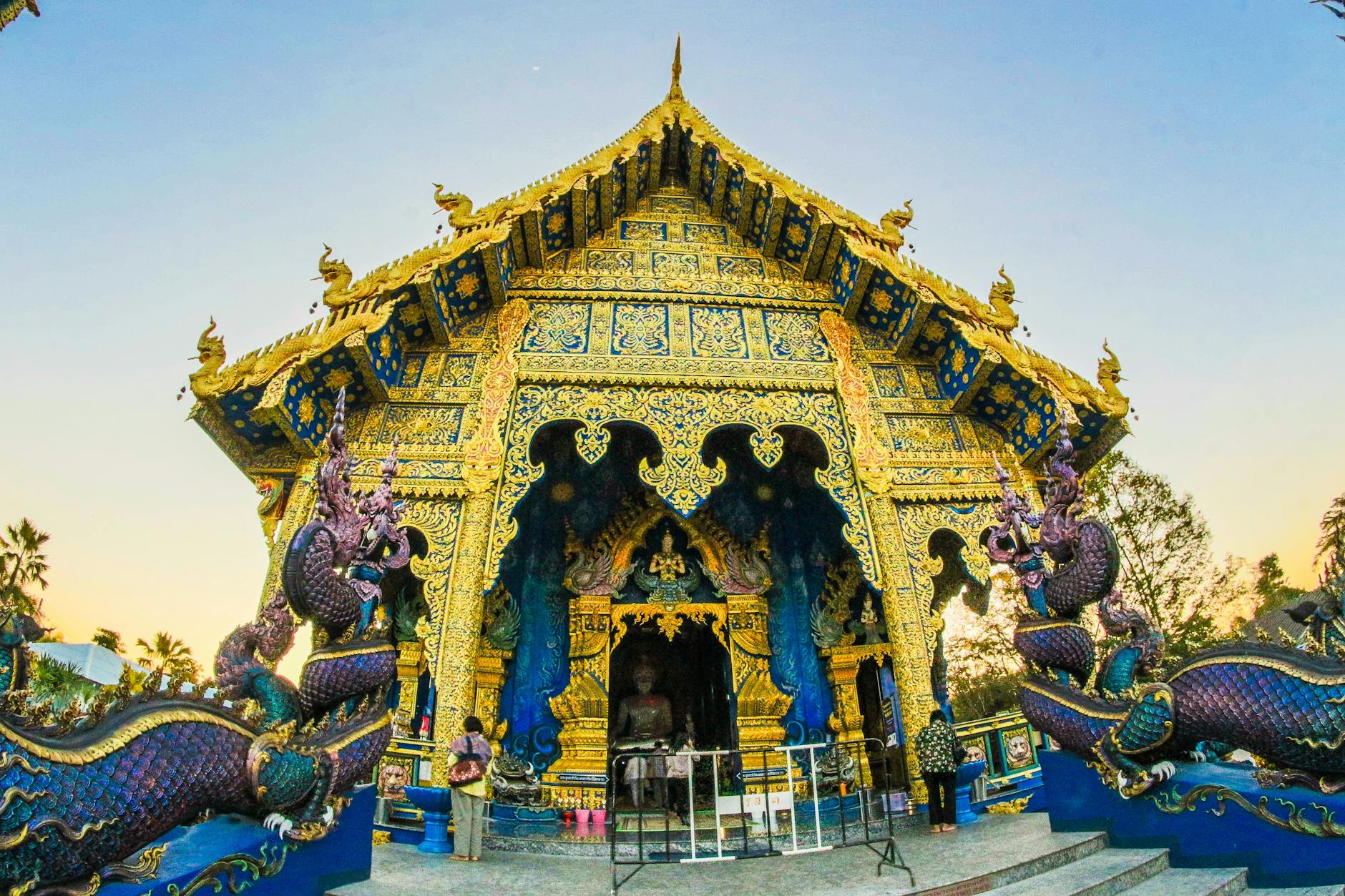
This temple receives perhaps five per cent of the visitors that descend on the White Temple, despite being completed only in 2016 and containing more visually distinctive photography than its white counterpart.
Wat Rong Suea Ten has a deep cobalt-blue exterior, ornate in the traditional Thai style but with a modern execution. The interior features intricate gold naga dragons and Buddha images positioned against the blue. Free entry. Open 7am to 8pm. Photography is unrestricted, and the afternoon light (after 3pm) turns the blue intensely saturated against the sky.
The temple sits three kilometres east of Chiang Rai city centre. Take a motorbike taxi from the night bazaar or your hotel (around 100 THB) or rent a motorbike yourself (200–300 THB per day from shops in the old town). The ride takes ten minutes.
This is a better use of time than queuing at the White Temple at 10:30am. The experience is meditative rather than performative. Spend one to one and a half hours here, walk the grounds, sit by the main chedi, and return to town for lunch. The photography opportunity is superior — clean colours, manageable crowds, no jostling.
Sop Ruak and the Golden Triangle
The Golden Triangle is the confluence of the Ruak and Mekong rivers where Thailand, Laos, and Myanmar meet. The "triangle" itself is a geographic marker — a viewpoint with a golden Buddha statue, a vast gilded temple across the Mekong in Laos (a casino, despite appearances), and a landscape of forested mountains. The view is pleasant but unremarkable; people visit primarily for the fact of being in three countries simultaneously, not the spectacle.
What makes the journey worthwhile is the Hall of Opium museum, located in Sop Ruak village itself. Entry is 300 THB. The museum is genuinely excellent — probably the best-curated regional museum in northern Thailand. It documents the history of opium cultivation in the Golden Triangle, the geopolitical complexity of the region through the twentieth century, and the current crop-substitution programmes. Plan 90 minutes minimum. The exhibits avoid melodrama and present the economics and politics clearly.
The "triangle" crossing itself (a ten-minute boat ride to the Laotian island of Don Sao) costs 200 THB. What you do on the island: walk around, buy duty-free whisky or cheap goods, return. The experience is brief and anti-climactic. It's primarily something to tick off rather than something that justifies the distance on its own.
Sop Ruak is 60km north of Chiang Rai city. Most visitors book a day tour through their hotel or a travel agent (approximately 1,500 THB per person, usually combined with Doi Tung Royal Villa and Mae Fah Luang Garden). Solo drivers should allow three hours each way. Minivans run from Chiang Rai's central bus station to Sop Ruak (around 150 THB, two hours), but return services are less frequent — confirm timing with the driver.
Skip the commercial "opium shows" and elephant interactions advertised heavily in tourist areas. The Hall of Opium offers the actual historical content; the rest is fabrication.
Doi Tung and Mae Fah Luang Garden
Doi Tung is a mountain area 60km north of Chiang Rai, created as part of a royal development programme to replace opium cultivation with sustainable agricultural projects. The Royal Villa (150 THB entry) was the residence of the late Thai Princess Mother and remains furnished with her personal belongings — a modest, personal space rather than a palatial show. Mae Fah Luang Garden (200 THB entry) occupies the adjacent mountain summit, planted with fruit trees, flowers, and walking paths. The altitude (1,300m) brings noticeably cooler temperatures.
The site is worth visiting if you're already heading north to Sop Ruak or have hired a motorbike. It's poorly served by public transport — getting there requires either a day tour or a personal vehicle. A songthaew from Chiang Rai takes one hour and costs roughly 50 THB, but return services are intermittent.
Most of the value lies in the garden walk (one to two hours) rather than the villa itself. Allow two hours total if combining both. The garden entrance fee includes a free shuttle up the final steep sections.
Chiang Rai Night Bazaar

The night bazaar runs nightly from 6pm to roughly 11pm, spanning several blocks of the old town near the clock tower. Vendors sell Hill Tribe crafts (Akha, Hmong, Karen textiles and silverwork), cooked food, dried goods, and tourist items. Prices are reasonable — a handwoven Hmong shoulder bag costs 400–800 THB depending on quality. The crowd is genuinely mixed between locals and tourists rather than purely tour-group dependent.
This is noticeably better than Chiang Mai's night bazaar in terms of authenticity-to-tourist ratio. The goods reflect what nearby hill villages actually produce rather than mass-manufactured souvenir versions. Spend an hour browsing, eat at one of the food stalls (som tam, grilled fish, khao soi), and return to your hotel.
Where to stay in Chiang Rai
Mid-range: Wangcome Hotel (city centre, around 1,200 THB per night) offers reliable air-conditioned rooms, a small pool, and proximity to the night bazaar. Not luxurious, but well-maintained and useful as a base.
Boutique: Laluna Hotel (around 2,500 THB per night, walking distance from the bazaar) provides a smaller property with good breakfast and more thoughtful design than the Wangcome. Booking direct typically yields a discount.
Budget: The old town contains numerous guesthouses in the 500–700 THB range. Haus Berlin and Sabai@Home are reliable; both offer quiet rooms and social atmospheres if you're travelling solo.
Book ahead during high season (November to February), but walk-in options exist year-round in Chiang Rai. The city doesn't fill to capacity the way Chiang Mai does.
A 2–3 day structure
Day 1: Arrive by mid-morning via bus. Lunch in the old town. Spend the afternoon at Wat Rong Suea Ten (the blue temple). Return to the city centre, walk the night bazaar from 6pm onward, eat dinner at a food stall.
Day 2: Wake early and visit Wat Rong Khun before 8:30am (preferably 8am). Spend one hour there. Return to town for late breakfast. Rest in the afternoon (Chiang Rai has limited non-temple content; the city quiet can feel boring after lunch). Visit the night bazaar again if you missed specific items, or walk the Kok River area at dusk.
Day 3 (optional): Book a day tour to Sop Ruak and Doi Tung (1,500 THB). Depart 8am, return by 5pm. Alternatively, rent a motorbike and drive these routes yourself if you're comfortable with Thai roads.
If extending further north: Chiang Khong is a small Mekong-side town 70km north of Chiang Rai, the embarkation point for the slow boat down to Luang Prabang in Laos. The boat journey takes two days and is genuinely scenic and slow. This extends the trip to four to five days minimum.
Chiang Rai versus Chiang Mai
Chiang Mai is larger (roughly one million residents), has more temples (over 300), more restaurants, more nightlife, and more cultural density. It warrants three to four days; many people spend a week.
Chiang Rai is smaller (roughly 70,000 residents in the city proper), has three genuinely distinctive temples plus a handful of conventional ones, minimal nightlife, and moves slowly. It warrants two to three days as an extension, not as a standalone destination.
Chiang Mai's temples are architecturally and historically significant within Thai Buddhism. Chiang Rai's temples (particularly the White and Blue temples) are contemporary artistic statements — unusual rather than culturally foundational.
Visit Chiang Rai only after Chiang Mai has met your expectations. It's not a replacement; it's a continuation with different content.
Who Chiang Rai suits
Chiang Rai works best for travellers who've spent two nights in Chiang Mai, seen the Old City temples, and want something genuinely different rather than more of the same. The White Temple justifies the journey; the rest (Blue Temple, night bazaar, Golden Triangle museum) compounds the value. The city also suits people extending into Laos via the Mekong slow boat — Chiang Rai functions logically as a transition point.
Avoid Chiang Rai if you're on a tight schedule, prefer urban energy, or expect temple-based tourism to provide ongoing novelty. The quiet can feel empty rather than restful. Skip it entirely if you dislike crowds at sunrise (unavoidable at the White Temple unless you commit to 7am arrivals) or if the idea of a contemporary Buddhist art temple feels gimmicky rather than interesting.
Stay two nights if you value the unhurried pace and want to see both temples without stress. Add a third if heading north to Chiang Khong and Laos.
Frequently Asked Questions
Is the White Temple worth the journey from Chiang Mai?
Yes, if you've already spent two nights in Chiang Mai and want something visually and conceptually different. No single temple justifies a day trip; the 14-hour round journey eats the value. Stay overnight and combine it with the Blue Temple and night bazaar.
How early do you need to arrive at Wat Rong Khun to avoid crowds?
Arrive by 8am or return after 3pm. Tour buses begin arriving around 9am, creating significant congestion on the main bridge. Early light is better for photography anyway.
Is the Golden Triangle worth the time and cost?
The river confluence itself is unremarkable — you're visiting for the narrative rather than the view. The Hall of Opium museum (300 THB, 90 minutes) is the actual value. The boat crossing to Laos is brief and anti-climactic. Worth a day tour or self-drive if you have time; not essential.
Can you visit Chiang Rai and Chiang Mai in one trip?
Yes. Spend three nights in Chiang Mai, then two nights in Chiang Rai. This allows both cities to unfold without rushing. The bus connection (three hours) is straightforward and frequent.
What's the difference between the White and Blue temples?
The White Temple is crowded, architecturally bold, and conceptually provocative (pop culture in Buddhist hell scenes). The Blue Temple is quiet, uses traditional Thai ornamentation, and offers better photography. If you can only visit one due to time, choose based on preference for solitude (Blue) or unique architecture (White).
When is the best time to visit Chiang Rai?
November to February offers cool, dry weather and the most comfortable temple-visiting conditions. March to May is hot and dusty. June to October is wet but lush and nearly empty of tourists. The night bazaar operates year-round. Avoid visiting during Thai school holidays (mid-March to mid-April) if you dislike crowds.