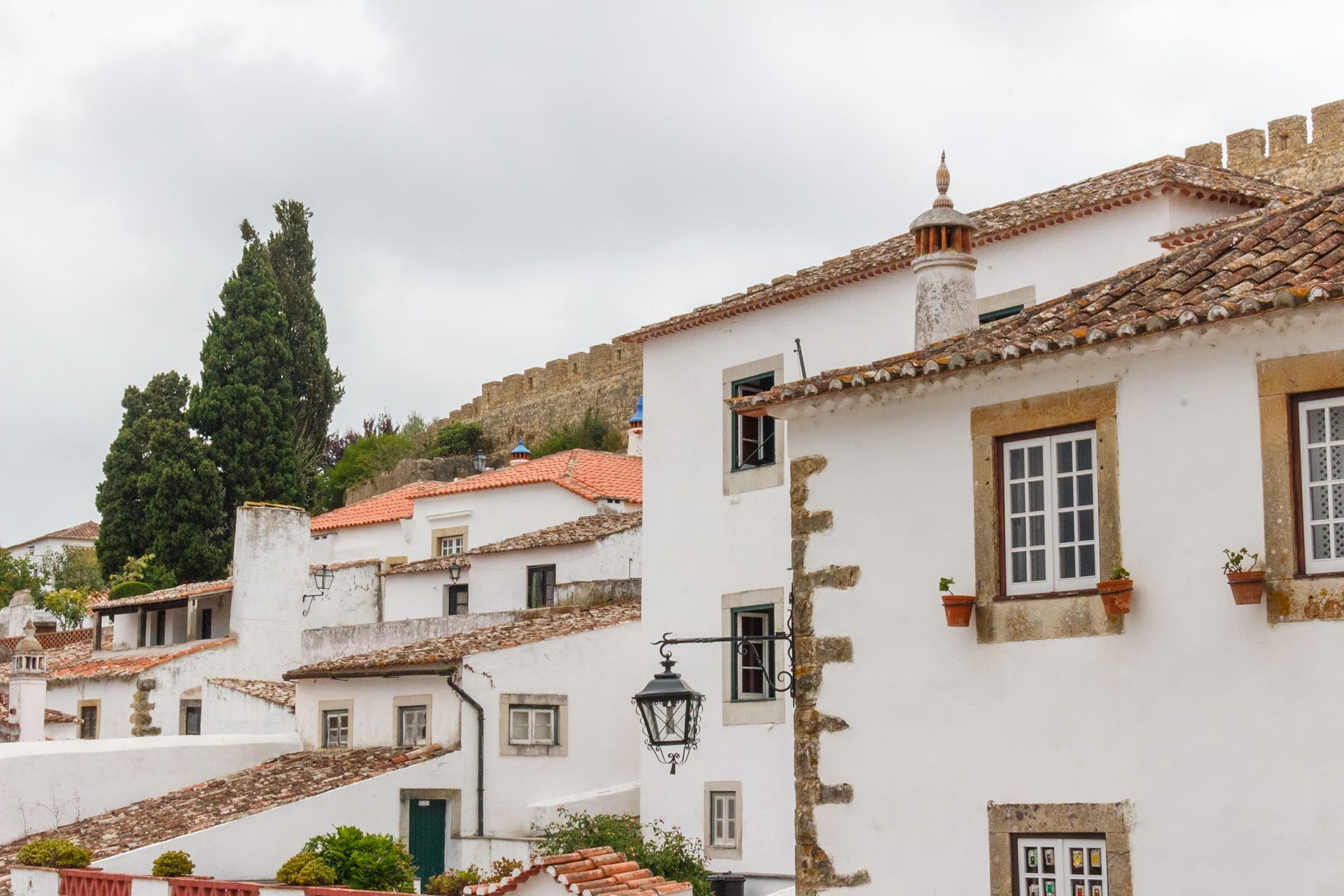
Évora is the capital of the Alentejo, the vast inland plain that covers a third of Portugal's territory between the Tagus river and the Algarve. The city sits on a low hill in the centre of a cork oak and olive landscape, enclosed by 14th-century walls, and contains 2,000 years of successive occupation without any major rebuilding event to erase the earlier layers. A Roman temple, a Moorish quarter, a Visigothic cathedral, and a chapel whose walls are covered in 5,000 human skulls and bones from local monasteries all exist within 15 minutes' walk of each other. Évora has been a UNESCO World Heritage Site since 1986 and is the most complete medieval city in Portugal outside Óbidos.
The Roman Temple
The Templo Romano in the Largo do Conde de Vila Flor is the best-preserved Roman temple in the Iberian Peninsula. Fourteen Corinthian columns of white granite, 7.7 metres tall, stand to their original height; the entablature survives in sections. The temple is generally attributed to Emperor Augustus (1st century CE), though the dedication is uncertain — it has been called the "Temple of Diana" since the 16th century without historical basis for that name.
The columns survived because the structure was incorporated into the medieval town walls and then used as a slaughterhouse from the 13th century until 1836, which kept it from being quarried for building material like most Roman monuments. Entry free; lit at night from 9pm.
Chapel of Bones (Igreja de São Francisco)
The Igreja de São Francisco (Church of St Francis) has a Gothic interior of normal configuration, but attached to the south side is the Capella dos Ossos — the Chapel of Bones. Entry €4.
The chapel was built by Franciscan monks in the 16th century using the bones and skulls of around 5,000 people exhumed from Évora's cemeteries and religious houses. The walls and ceiling are covered with the remains, arranged in geometric patterns: skulls alternating with femurs, vertebrae forming decorative borders around the window frames. Two full mummified bodies hang by iron hooks at one side, identified only as "a man and a boy." The inscription above the entrance (in Portuguese): "Nós ossos que aqui estamos pelos vossos esperamos" — "We bones that are here await yours."
The chapel is not Gothic novelty — it is a functioning memento mori, built in response to the theological preoccupation with death and moral accounting that followed the Black Death. In this context it is more coherent than it appears in Instagram photographs. Allow 45 minutes.
Sé de Évora (Cathedral)

The Sé de Évora (entry €3.50, rooftop €1.50 extra) is the largest Romanesque-Gothic cathedral in Portugal, begun in 1186 and consecrated in 1204. The main portal has 14 apostle figures from the 14th century on the door jambs — among the finest Gothic sculpture in Portugal. The interior houses a Gothic cloister (13th century) and a Museum of Sacred Art with a 13th-century ivory statue of the Virgin considered the most important piece of medieval sculpture in Portugal.
The rooftop access (additional ticket) runs along the top of the nave buttresses and gives an overview of the city, the Alentejo plain extending to the horizon, and the Roman temple below. Worth the extra cost.
Alentejo Wine and Food
The Alentejo is Portugal's most productive wine region by volume — Alentejo DOC produces full-bodied reds from Aragonês (Tempranillo), Trincadeira, and Alicante Bouschet grapes that are Portugal's most commercially successful internationally. The wine infrastructure around Évora includes cooperative wineries with open tasting rooms and estate wineries within 20km. Herdade do Esporão (50km south) and Adega Mayor (60km east) are the best-known for visitors.
Porco preto (Alentejo black pork, from the free-range Iberian pig that feeds on acorns in the cork oak forests) is the food that makes visiting Évora specifically worthwhile. The pork cheeks (bochechas) slow-braised with red wine, and the secretos (a cut from behind the shoulder blade, unknown outside the peninsula) grilled over charcoal, are the specific dishes. Order at any traditional restaurant; Tasquinha do Oliveira (Rua Cândido dos Reis 45) is consistently cited for the quality of its Alentejo pork.
Cação em vinha d'alhos (dogfish marinated in garlic and vinegar then fried) and açorda alentejana (a thick bread soup with poached egg, coriander, and garlic) are the other regional dishes that do not appear much outside the Alentejo.
Getting to Évora
From Lisbon: direct bus (Rede Expressos from Sete Rios bus terminal), 1h30, €12. About 12 departures daily. The bus is faster and more practical than the train.
By train from Lisbon Oriente: Comboios de Portugal intercity service, 1h40–2h (via Pinhal Novo), €13–15. Less frequent than the bus.
By car: 130km from Lisbon on the A6 motorway, approximately 1h30. Parking is available outside the city walls; the historic centre is largely pedestrianised.
From Porto: 3.5 hours by car or 4.5 hours by train (change in Lisbon). An overnight is more practical from Porto.
When to Visit Évora

March–May: best window. The Alentejo plain blooms with wildflowers in spring — poppies, lavender, rockrose — and the temperatures (18–24°C) are ideal for walking the city. Fewer tourists than summer.
September–October: harvest season, wine tastings at estate wineries, temperatures cooling to 20–26°C. Good.
June–August: very hot (35–40°C in July and August — Évora is further inland than Lisbon and lacks Atlantic moderation). The Roman temple lit at night and the evening streets are the right hours to be outside. Not the ideal season for a walking city.
November–February: mild (10–17°C), the city is quiet and all sites are open year-round. Good for a focused visit without summer heat.
Frequently Asked Questions
How many days do you need in Évora?
One full day covers the Roman temple, Cathedral and rooftop, Chapel of Bones, and the old town. Two days allows for a wine estate visit and a drive into the broader Alentejo (the megalithic sites — cromlechs and dolmens — near Évora are among the most concentrated in Europe and require a car).
Is the Chapel of Bones appropriate for children?
Depends on the child and the parents. It is not gratuitously gory — the bones are arranged decoratively rather than violently — but it is an unambiguous display of human remains. The chapel has been a tourist site for over a century; most visitors find it more thought-provoking than disturbing.
What are the megalithic sites near Évora?
The Cromlech of Almendres (16km west) is a circle of 95 granite standing stones from around 5000 BCE — the largest megalithic complex in the Iberian Peninsula and one of the largest in Europe. The Dolmen of Zambujeiro (18km southwest) is the largest dolmen in Portugal, with capstones up to 6 metres. Both require a car; signage is limited.
How is Évora different from other Portuguese cities?
Évora is specifically an Alentejo city — the architecture, food, and pace of life are distinct from coastal Portugal. The Roman temple, Chapel of Bones, and the medieval street plan coexist without the heavy tourism of Lisbon or Porto. The Alentejo wine country accessible from Évora is also fundamentally different from the Douro (Port wine) or Vinho Verde regions.