
Kanazawa is the capital of Ishikawa Prefecture on the Sea of Japan coast, roughly midway between Tokyo and Kyoto as the crow flies but until recently awkward to reach. The Hokuriku Shinkansen reached Kanazawa in 2015, cutting the journey from Tokyo from 4 hours by limited express to 2.5 hours on the bullet train. An extension to Tsuruga (with connections to the Tokaido Shinkansen toward Osaka) opened in March 2024, making a Tokyo–Kanazawa–Kyoto or Osaka circuit practical without backtracking. The city's population is about 460,000; the tourism infrastructure is well developed but not overwhelming.
Getting There
From Tokyo: Hokuriku Shinkansen from Tokyo Station or Ueno to Kanazawa — 2 hours 28 minutes, 14,120 yen unreserved, covered by the JR Pass. Trains run roughly hourly. From Osaka: Thunderbird limited express from Osaka Station or Shin-Osaka to Tsuruga (about 1 hour 20 minutes), then transfer to the Hokuriku Shinkansen extension for the 50-minute leg to Kanazawa. Total Osaka–Kanazawa around 2 hours 10 minutes from March 2024; 7,000–9,000 yen. Kanazawa has no major airport; the nearest with significant domestic service is Komatsu Airport (45 minutes south by bus), with flights from Tokyo and Sapporo.
Kenroku-en
Kenroku-en (entry 320 yen) is one of the three gardens in Japan designated as "great landscape gardens" (the others are Kairaku-en in Mito and Koraku-en in Okayama). The name means "garden combining six attributes" — spaciousness, seclusion, artificiality, antiquity, abundant water, and broad views — a framework from a Song Dynasty Chinese treatise on garden design. The actual garden is a 11.4-hectare hillside site laid out from the late 17th to early 19th centuries by the Maeda clan, who ruled this domain (one of the wealthiest outside Edo) for 14 generations.
The most photographed element is the Kotoji lantern (a two-legged stone lantern by the Kasumigaike pond) — it appears on the garden's publicity material. More striking, if less reproduced, is the winter snow scene when ropes of straw are tied from poles to the branches of the pine trees to prevent them breaking under snow weight (a practice called yukitsuri, visible from roughly mid-November to mid-March). The garden connects directly to Kanazawa Castle Park (free entry to the grounds; 320 yen for the reconstructed palace buildings).
Higashi Chaya District
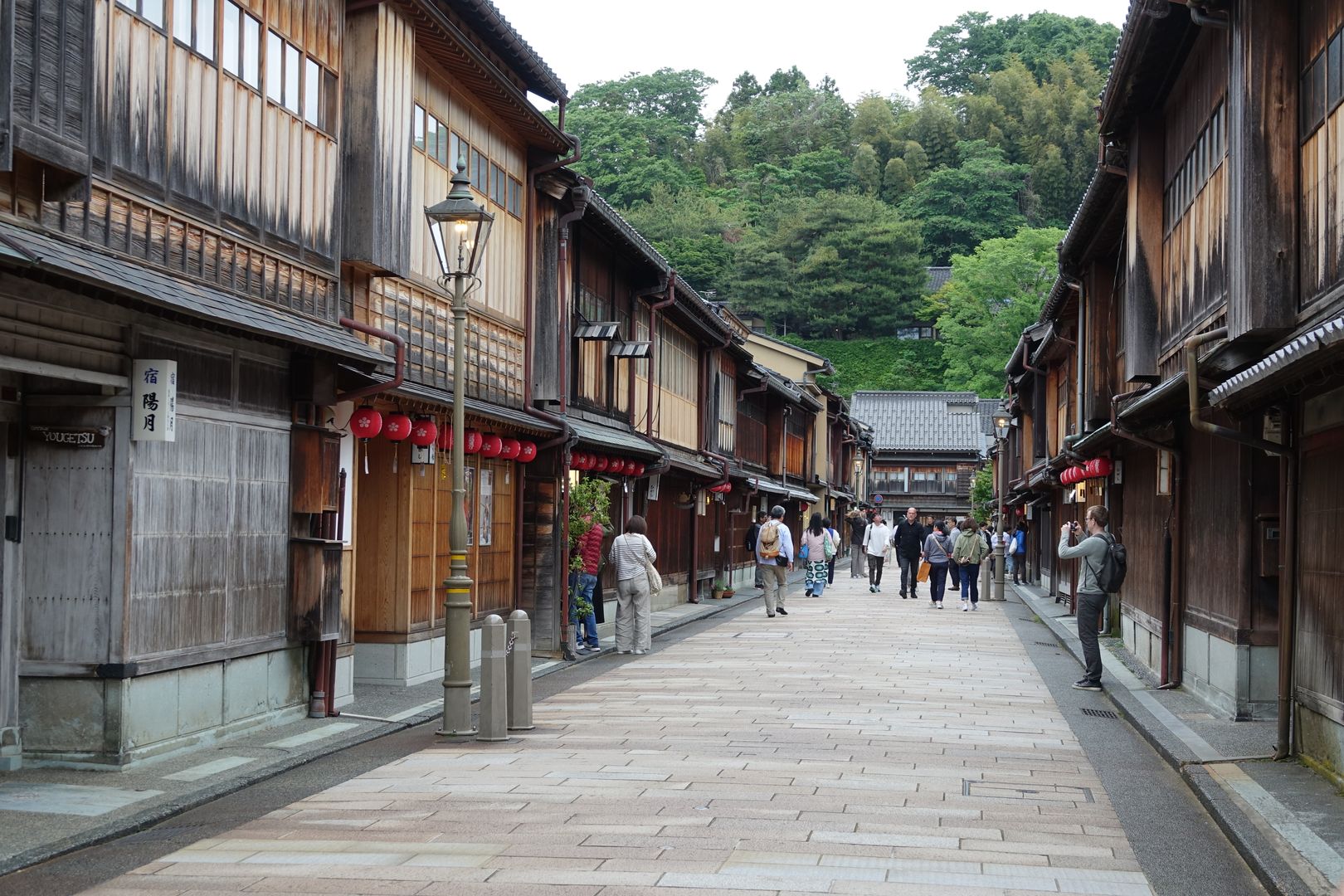
The Higashi Chaya (East Teahouse District) is one of three surviving geisha districts in Kanazawa and one of the best-preserved in Japan. The main street — a 200m stretch of two-storey wooden buildings with slatted latticework facades — was established in 1820. Actual geisha entertainment in the ochaya (teahouses) requires introduction through established connections; the exterior and a few house museums are accessible to independent visitors. Shima (500 yen) and Kaikaro (750 yen, includes gold-leaf matcha) are the two teahouses open to the public. The district is best visited before 10:00 or after 16:00 when tour groups are minimal.
Nagamachi Samurai District
West of the castle, Nagamachi was the residential neighbourhood of middle-ranking samurai during the Edo period. Earthen walls (dobei), narrow alleys, and the occasional preserved garden entrance give a sense of what pre-Meiji urban planning looked like. The Nomura-ke samurai house (550 yen) has the most complete interior open to visitors: tatami rooms, a miniature garden, and lacquerware that the resident Nomura family accumulated over generations. The area is genuinely quiet and not heavily touristed outside cherry blossom season.
Omicho Market
Omicho Ichiba is Kanazawa's central covered market — 200 shops and stalls over three connected buildings, operating since the Edo period. Kanazawa faces the Sea of Japan, which provides particularly fatty cold-water fish: nodoguro (blackthroat seaperch, a local obsession), snow crab (seasonal, November–March), and a variety of shellfish and squid unavailable on the Pacific coast. The market's restaurants open for lunch and serve these ingredients in donburi (rice bowls), sashimi sets, and grilled fish at prices that are reasonable for the quality (1,200–2,800 yen for a full meal). Go at 11:00 before the lunch crowd fills the counter seats.
The 21st Century Museum of Contemporary Art

The 21st Century Museum (free for most permanent collection; 1,000–1,200 yen for special exhibitions) is one of the best contemporary art museums in Japan, housed in a circular glass building at the edge of Kenroku-en designed by SANAA architects Sejima and Nishizawa. The permanent collection includes James Turrell's Blue Planet Sky (a skyframe room where the colour of the sky appears to shift), Leandro Erlich's Swimming Pool installation (a perspectival illusion of a filled pool that visitors can stand under while others appear to be swimming above), and works by Yayoi Kusama. Even if contemporary art is not a priority, the architecture of the building is worth the walk-through.
Practical Notes
The city centre — Kanazawa Station to Kenroku-en to Higashi Chaya — is about 2km across and walkable, though hilly in places. The one-day bus pass (600 yen) covers most tourist routes and is worth buying for anyone visiting multiple districts. Kanazawa's specialty food product is gold leaf (kinpaku) — the city produces 99% of Japan's supply — and gold-leaf-covered soft serve, coffee, and sweets are everywhere. Snow crab season (November–March) roughly coincides with Kenroku-en's yukitsuri installation, making this the most rewarding time to visit for both food and scenery. The Higashi Chaya district, Omicho Market, and Kenroku-en can be covered in one full day; add a second for the castle, samurai district, and 21st Century Museum.
FAQ
Is Kanazawa worth visiting without a JR Pass?
Yes, but the shinkansen fare is significant (14,120 yen from Tokyo). Budget 3,000–4,000 yen per day for food and entry fees on top of transport. Kanazawa is often combined with Shirakawa-go (the thatched-roof farmhouse village in the mountains, 75 minutes by bus) on a multi-day loop.
How many days in Kanazawa?
Two days is the standard recommendation: one for Kenroku-en, the castle, and the 21st Century Museum; one for Higashi Chaya, Nagamachi, and Omicho. One day is possible if rushed.


