
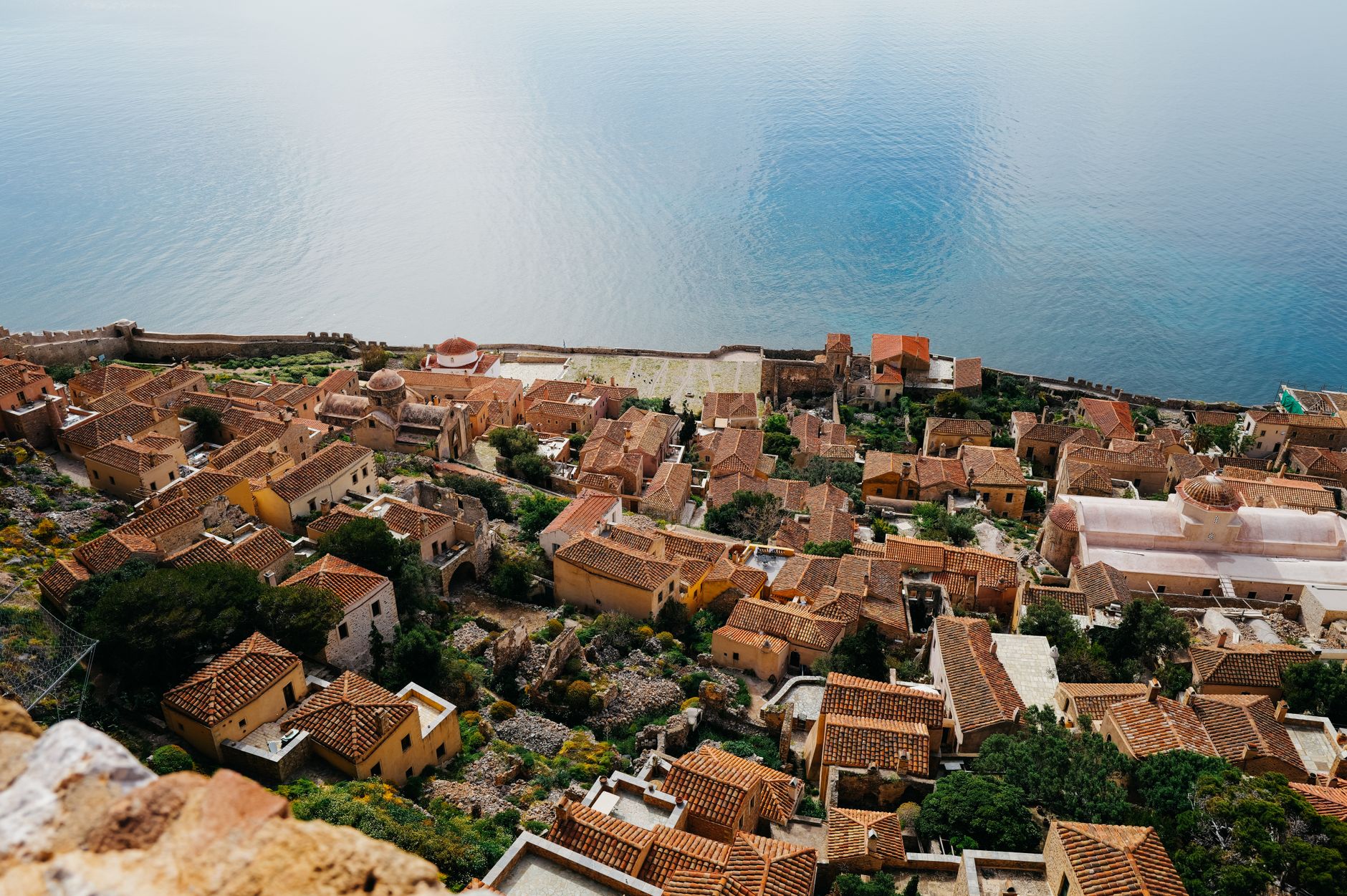
Monemvasia is a medieval walled town built onto a detached rock rising 300 metres above the sea on the southeastern Peloponnese coast. The rock is connected to the mainland by a single 200-metre causeway — the name means "single entrance" in Greek — and everything behind that causeway is car-free. The lower town (Kastro) contains intact Byzantine and Venetian buildings, two churches still in active use, and a single main lane of stone-paved streets with no traffic. The upper town on the rock plateau is largely ruined and largely unvisited, which is a mistake, since the views from the upper citadel over the Laconian Gulf are among the best in the southern Peloponnese.
The Lower Town (Kastro)
The lower town is entered through a single fortified gate in the western wall. Inside, the main street (Maïna street) runs the full length of the settlement — 500 metres — before dead-ending at the eastern cliff face. Side lanes lead up to the defensive walls, down to the sea cliffs, and to the three churches.
Elkomenos Christos (Christ in Chains): the main Byzantine church of the lower town, built in the 13th century and converted to a mosque during Ottoman occupation (1540–1690 and 1715–1821), then restored after independence. The carved marble iconostasis is original Byzantine workmanship. Free entry.
Panagia Myrtidiotissa: a 13th-century church on the main street converted in the Venetian period, with external features showing both Byzantine and Western Gothic influence. Small, free.
Portello: the sea gate at the eastern end of the lower town, cut directly through the cliff face, where boats once unloaded provisions. Steps descend to a small platform 2 metres above the sea. In calm conditions, swimming is possible from the rocks below the eastern walls.
The lower town has accommodation (20+ guesthouses and small hotels, €80–250/night), restaurants, and a handful of shops. Book 6–8 weeks ahead for July–August.
The Upper Town
The upper town occupies the plateau on top of the rock, accessible via a stepped path from the east end of the lower town — 20–30 minutes of climbing. Most visitors to Monemvasia do not make this climb. They should.
The upper town was the main settlement until the 14th century, when the threat of piracy pushed the population down to the more easily defended lower town. The ruins of the upper town — collapsed houses, the partial remains of the Byzantine palace of the despots, storage cisterns — are largely unexcavated.
The Hagia Sofia church at the summit is the exception: an intact 13th-century Byzantine church with a cupola and carved marble floor that survived centuries of abandonment. It is usually unlocked; if not, the key is kept at the lower town's central kafeneion.
The view from the edge of the upper plateau over the open Laconian Gulf, south toward the Mani peninsula, is unobstructed and silent in a way the lower town, however peaceful, is not.
Getting to Monemvasia
By bus from Athens: KTEL Lakonia buses depart from Athens' Kifissos terminal (Terminal A), 5–5.5 hours, €25–30. One or two direct services daily to the Gefyra causeway (the mainland village adjacent to the Monemvasia rock). The bus stop is 200 metres from the causeway gate.
By car: 330km from Athens, approximately 3.5–4 hours via the E65 and A7 through Sparta. Car parking is in Gefyra; no vehicles cross the causeway.
By ferry (seasonal): Flying Dolphin hydrofoils from Piraeus operate seasonally (summer only) to Monemvasia and nearby Neapoli — journey time 4–5 hours. Check current schedules before planning around this option.
There is no airport. Fly to Athens (ATH) and take the bus or rent a car.
Where to Stay
There are no hotels outside the Kastro. All accommodation is within the car-free walled town — traditional stone houses converted to guesthouses, most with 4–10 rooms. This means you sleep inside a medieval Byzantine fortress with no car noise. It also means no lifts, narrow staircases, and limited options for those with mobility restrictions.
Rates: €80–150 (mid-range guesthouses), €200–350 (better-positioned properties with sea views). Book direct rather than through aggregators; most properties here have a better room rate and a cancellation policy more directly negotiated by phone or email.
When to Visit Monemvasia
April–June: optimal window. Temperatures 18–24°C, the rock walls and sea in spring light, the lower town not yet at peak capacity. May is the single best month.
September–October: equally strong. Cooler than summer, sea still warm (21–23°C in September), the upper town visible without heat haze.
July–August: hot (28–34°C), the lower town reaches near-capacity, accommodation booked months ahead. The sea is warm and the walled town stays cool in the shade of the cliff. Not the worst time to visit, but plan ahead.
November–March: quiet (8–14°C), some restaurants close or reduce hours, but the core churches and the upper town are accessible year-round. The lower town in winter is among the most atmospheric medieval spaces in Greece.
Frequently Asked Questions
How many days do you need in Monemvasia?
One full day and night: arrive early afternoon, walk the lower town, climb to the upper town before sunset, stay the night in the Kastro. A second day extends the visit without adding significantly more to see inside the rock — use it for the beach at Pori (3km from Gefyra on the mainland) or a drive to the Mani peninsula (60km southwest).
Is the upper town hard to reach?
The climb takes 20–30 minutes on a paved path with steep sections. It is not technical but requires reasonable fitness. The path is unpaved in the final section near the Hagia Sofia church.
What is the nearest airport to Monemvasia?
Kalamata Airport (KLX) is 120km west, approximately 1h45 by car. It has seasonal direct flights from several European cities (London, Brussels, Frankfurt) from May to October. Athens International (ATH) is 330km, 4 hours by car.
Can you swim at Monemvasia?
From the Portello sea gate on the lower town's eastern cliff face — a small platform above the water accessible when the sea is calm. Better beaches are on the mainland side: Pori (3km north of Gefyra) and Agios Nikolaos (6km south). None are sandy — pebbles and clear water throughout.