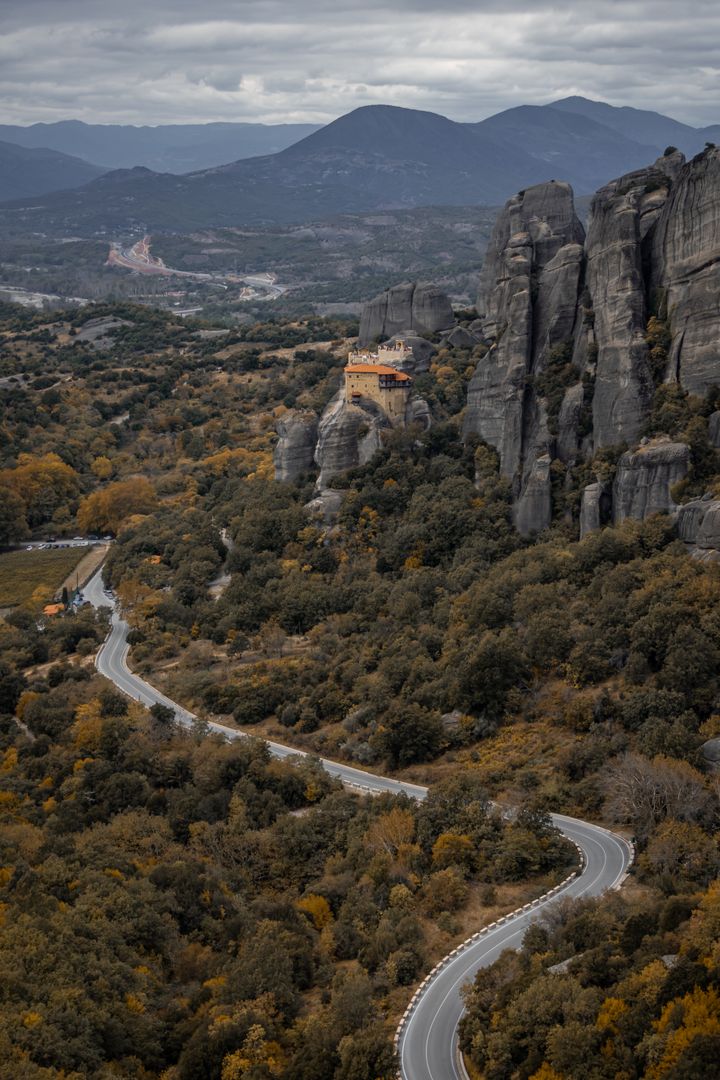

Meteora is sixty rock pillars rising 400 metres from a Thessalian plain, their tops crowned by six active Orthodox monasteries perched on stone so vertical that monks once entered by rope and basket. The photographs are not exaggerated—this is genuinely one of Europe's most otherworldly landscapes. The six monasteries remain functioning communities, not museums, and the landscape around them is traversable on foot through a network of ancient trails and modern roads. Getting there from Athens is straightforward; the real decision is whether to day-trip or stay overnight.
Getting to Meteora from Athens
Train is the clearest option. Larissa Station in central Athens has direct service to Kalambaka (the town serving Meteora) on four trains daily. Journey time is four to four-and-a-half hours; fares range from €15 for slow regional trains to €28 for the faster Intercity service. Book through trainose.gr at least one week ahead during peak season (May–September). The Kalambaka railway station is a ten-minute walk downhill to the central square, where buses and taxis congregate.
Bus is cheaper but slower. Reach Kalambaka via the Athens Liosion terminal: take a direct KTEL bus to Trikala (three-and-a-half hours, €20), then change to a local Kalambaka service (thirty minutes, €3). The Trikala bus terminal is modern and clear; the changeover is straightforward but eats time. Total journey: five to six hours. This route makes sense only if you're arriving in Athens in the late afternoon and want to save €8 per person.
Day-tripping from Athens is technically possible but not recommended. The earliest train departs Athens at 7:10am, arriving Kalambaka at 11:45am. The last train back leaves at 8:05pm. This gives four hours on the ground—enough to see two or three monasteries, not the landscape. The travel itself becomes the day's content. Book the overnight instead; it costs less sleep than the travel time.
From Thessaloniki, the journey is simpler: three hours by direct train or bus to Kalambaka.
The Six Open Monasteries
Only six of the original twenty-four monasteries remain active. All occupy the summits of their rock pillars and require climbing or walking bridges to reach. Dress code is enforced: legs covered below the knee, shoulders covered. Wraps are provided at entrances. Each monastery charges €3 entry; most open Tuesday–Sunday, 9am–5pm, though hours vary by season and closure days rotate. Check the Meteora Monasteries website before visiting specific sites.
Great Meteoron (Monastery of the Transfiguration) is the largest and the oldest, founded in the 1340s by Athanasius. It dominates the highest visible pillar. The main church houses the most complete fresco cycle in the complex and a collection of liturgical objects that anchors the historical importance of Meteora as a Byzantine monastic center. The climb from the parking area is steep—roughly 150 steps of cut stone and metal stairs—but manageable for anyone with basic fitness. Allow one hour to climb, view the interior, and descend. This is the essential monastery visit.
Varlaam, founded in 1518, is the second largest. It sits on the pillar immediately northwest of Great Meteoron. The original windlass mechanism—the rope-and-basket system that monks used for centuries—is still preserved and on display. The main church contains good late-Byzantine frescoes. The access bridge is narrow but secure. A half-hour visit is sufficient.
Roussanou occupies a nearly vertical pinnacle at the northern edge of the complex and presents the most dramatically exposed position: its walls appear to emerge directly from the rock face. Accessed via a modern bridge, it is visually arresting from every angle. The interior is small and simple compared to the larger monasteries, but the exterior atmosphere is unmatched. Twenty minutes to thirty minutes is typical.
St Nicholas Anapafsas, founded in 1388, is the smallest open monastery and the easiest to reach—a short walk from the road on a partly developed approach. Its significance lies in its fresco cycle painted by Theophanis Strelitzas in 1527, one of the finest intact fresco programs in Greece. The style is fluid and the figures are expressive; if you see only one fresco cycle, see this one. Plan thirty minutes.
St Stephen's sits on a plateau rather than an isolated pillar, making it more accessible. It includes a small museum of liturgical objects and has been more heavily restored than the others. It is worth fifteen to twenty minutes if you're passing; it shouldn't be a priority visit.
Holy Trinity is the most dramatically positioned: monks access it via a wooden staircase descending a sheer rock face—140 steps cut into the stone with minimal safety railing. It was filmed in the James Bond film "For Your Eyes Only" (1981). The climb is authentically vertiginous; do not attempt it if you have unmanaged fear of heights. Plan forty-five minutes to one hour, including the descent. The view from the top is the most rewarding in the complex.
Visiting all six in one day is possible but exhausting. A realistic circuit takes five to seven hours on foot (including the 9km trail loop and monastery interiors) or three to four hours by taxi between the sites. Most visitors see three to four monasteries per day.
Where to Stay

Kalambaka is the main town and transport hub. It is a working Greek provincial town with pharmacies, supermarkets, tavernas, and a range of accommodation from €30 guesthouses to €150+ hotels. Hotels here are hotels; they exist to serve visitors passing through to the monasteries. Breakfast, WiFi, and a clean bed are reliable. Book direct or through major platforms; there is no local accommodation booking advantage.
Kastraki, two kilometres away, is a smaller village built directly beneath the rock pillars. The sense of proximity to the monastery peaks is immediate and atmospheric. Accommodation is mostly guesthouses (€40–80) and small hotels (€70–120). Doupiani House is the standard mid-range reference—rooms from €80–120 with views of the monasteries from the breakfast terrace and a genuine sense of place. The walk to Kalambaka takes thirty minutes downhill; a taxi costs €5–7 one way. There are fewer restaurants in Kastraki; plan dinners in Kalambaka or eat at your guesthouse.
Stay two nights minimum to justify the travel from Athens. This gives one full day for the monasteries and trails, one morning for photography, and a reasonable transit day.
Hiking and Moving Around the Rocks
The monastery complex is connected by a nine-kilometre trail loop that can be walked in three to four hours at a moderate pace, covering all six sites. The path is well-trodden and marked but involves significant elevation changes—approximately 500 metres of cumulative ascent and descent. Do this walk early in the day and expect to finish by 2pm; monasteries close at 3pm to 5pm depending on the season.
Start from the Kalambaka end, near the post office, and walk uphill toward Great Meteoron. Most hikers then loop north through Roussanou and Varlaam, descend toward St Nicholas Anapafsas, and return south. This routing follows the natural contours. Wear proper hiking boots; the stone is slippery when damp and the paths include cables and exposed sections.
The Adrachos Gorge trail descends below the pillars into the valley itself. It is less frequented, takes two to three hours, and provides a perspective on the rocks from below—genuinely different from the high views. Start near Kastraki village and follow signed paths. This is worth doing if you have a second full day.
For photography, the late afternoon light (4pm–6pm) hits the western faces of the pillars. The viewpoint south of Roussanou and the road between Roussanou and Varlaam catch this light best. Winter and autumn offer the cleanest light and least haze. Sunrise from Kastraki looking east toward Great Meteoron is notable but requires waking at 6am; the light is less dramatic than sunset.
By taxi, a half-day circuit visiting three to four monasteries costs €60–80 for the vehicle. Guides and drivers are available; a guided walk with commentary costs €80–120 per person and typically includes hotel pickup.
Best Time to Visit Meteora
April–May (spring) is the most balanced season: temperatures range from 18°C to 25°C, wildflowers bloom on the valley floor, and tourist crowds are still moderate. The light is clear and clean. This is the default choice for first-time visitors.
September–October (autumn) offers similar conditions—temperatures 18°C to 26°C—with the bonus of early-morning mist that clings to the rock pillars and burns off by 10am. Photography is exceptional. Crowds thin noticeably by late September.
July–August (summer) brings heat (28°C–35°C), tourist crowds, and haze that can flatten the light for photography. Monasteries remain fully open and accessible. This is the time to visit if you're already in Greece and don't have a choice.
November–March (winter) is underrated. Temperatures drop to 5°C–12°C and snow sometimes accumulates on the pillar summits. Fog and low cloud are common, which transforms the landscape into something genuinely austere. Tourist numbers are minimal. Most monasteries remain open but with reduced hours (some close by 3pm). Winter is the best season for atmospheric photography and for experiencing the landscape as monks have for six centuries: isolated, dramatic, weather-dependent. The risk is that cloud obscures the rocks entirely. Plan flexibility.
How to Structure Your Visit
Two days and one night: Arrive by train in early afternoon. Spend the afternoon and evening in Kalambaka or Kastraki—explore the town, eat dinner, rest. Next morning, walk the nine-kilometre monastery loop or do a taxi circuit of four sites. Return to Kalambaka or Kastraki by late afternoon. Take the evening train or next morning train back to Athens. This is the standard visit.
Three days and two nights: Arrive afternoon of day one. Day two: full nine-kilometre loop plus the Adrachos Gorge trail (eight to nine hours total, split into two walks if preferred). Day three morning: return to the rocks for photography or visit a monastery you missed. Depart by evening. This is the rhythm most visitors choose and seems to balance effort with reward.
One day from Athens: Only if you arrive in Athens with no other options. The train at 7:10am from Larissa gets you to Kalambaka at 11:45am. Visit Great Meteoron and one other monastery (two hours), then catch the 8:05pm train back. It's feasible but exhausting and leaves no time for hiking or atmospheric sitting.
Frequently Asked Questions
Is a Meteora day trip from Athens really worth it?
No, unless you have no other choice. The round-trip train travel is nine hours total; you gain four to five hours on the ground. This is barely enough to see two monasteries and neither hike nor pause. An overnight trip costs €40–60 more for accommodation but transforms the experience from rushed transit into actual landscape immersion. If you're in Greece for two weeks or more, the overnight is mandatory. If you have only a long weekend in Athens, the day trip is acceptable as a cultural obligation but underwhelming.
What's the actual difficulty of hiking the full monastery loop?
The nine-kilometre main trail involves approximately 500 metres of cumulative ascent and descent over four hours. It is moderate hiking, not strenuous, and the path is well-marked and heavily used. Anyone who hikes regularly will find it straightforward. The exposure at Holy Trinity (140 steps on a narrow staircase) is the most intimidating section, not the distance. Wear proper boots because the stone becomes slippery when wet, and carry water.
Can you visit the monasteries independently, or do you need a guide?
You can visit independently. The monasteries are open to the public with posted hours, and the main trail loop is well-signed. A guide adds context (historical detail, theological significance of frescoes) but isn't necessary for movement through the complex. If you care about Byzantine art history, hire a guide for one monastery; otherwise, skip it. The landscape itself is the primary content.
What time of year has the best light for photography?
Winter (November–March) and autumn (September–October) offer the clearest light and least atmospheric haze. Sunrise is notable from Kastraki, but sunset (4pm–6pm in winter, 6pm–7:30pm in summer) is more dramatic, hitting the western faces of the pillars. Winter includes the possibility of snow on the rock summits, which is visually striking but unpredictable. Autumn is more reliably clear.
Do you need a car to visit Meteora?
No. The main monastery loop can be walked on foot; a taxi can connect the six sites for €60–80 per vehicle for a half day. A car is useful for reaching viewpoints and for weather flexibility, but it's not essential. If you're coming from Athens by train, rent a car only if you want to explore the wider Thessaly region (Larissa, Trikala); for Meteora alone, walking and taxi are sufficient.
Are the monasteries still active, or are they tourist attractions?
All six open monasteries are still functioning monastic communities with resident monks. They are not museums. Visitors are guests; dress codes are enforced and photography inside the main churches is prohibited in some monasteries. The presence of tourists is accepted but not particularly welcomed. Treat them as working religious spaces, not heritage sites.
Spend two nights in Meteora if you can. Arrive in mid-afternoon, walk the full monastery loop the next morning in clear light, spend your second afternoon doing a single hike or photographing from fixed viewpoints, and depart the following morning. The 400-metre rock pillars won't move; their power isn't in speed of observation but in sustained presence. The single moment that justifies the journey is standing at the base of Holy Trinity at dusk, watching the light drain from the western faces while the pinnacle remains lit—isolation made visible in stone.