
Ravenna was the capital of the Western Roman Empire from 402 CE until its fall in 476, then the seat of the Ostrogothic kingdom, then the centre of the Byzantine Exarchate of Italy from 540 to 751 CE. Each transition produced a church with mosaics — and that is what survives. The eight UNESCO-listed monuments contain the most complete collection of early Christian and Byzantine mosaic art in the world, technically and artistically beyond anything in Rome, Byzantium's home territory of Constantinople, or the rest of Italy. The city is 75km from Bologna by direct regional train and is easily visited in a day, though a late afternoon and evening after the day-trippers leave is when it is most coherent.
The Eight UNESCO Monuments
All eight sites are open to visitors and can be covered in a single long day. A combined ticket for five of them (San Vitale, Mausoleum of Galla Placidia, Neonian Baptistery, Archbishop's Chapel, and Sant'Apollinare Nuovo) costs €12.50 and is available at the ticket office on Via Salara Vecchia, 800 metres from the station.
Mausoleum of Galla Placidia (c. 430 CE): a small cruciform building whose dark interior, once your eyes adjust, reveals ceiling and wall mosaics of deep blue and gold — a night sky of stars above a lunette showing the Good Shepherd, a grapevine border, and a stag drinking from a fountain. The quality of the tesserae (small glass and stone cubes) is finer here than anywhere else in Ravenna; they were set at angles to catch and scatter candlelight. The building was constructed as a mausoleum but Galla Placidia is buried in Rome. Note: from April to mid-June, a mandatory reservation (€2 booking fee at ravennamosaici.it) is required due to light sensitivity of the mosaics during peak tourist hours.
Basilica di San Vitale (548 CE): an octagonal church whose apse contains two of the most important mosaics in Western art — the Emperor Justinian with his court on one side, the Empress Theodora on the other. Both panels show the imperial court in ceremonial dress; Theodora's panel includes a purple curtain, a fountain, and three Magi on her robe. Justinian is shown holding a paten (liturgical dish) in a composition that deliberately echoes the approach of the Magi. The flat, hieratic figures — no shadow, no depth — are Byzantine rather than Roman in aesthetic, and represent a complete break with the naturalistic tradition that preceded them.
Sant'Apollinare Nuovo (6th century): the processional mosaics along both sides of the nave show a port of Classe on the left, a palace on the right, and two processions of martyrs and virgins converging on the altar. The harbour scene (showing the port of Classis, Ravenna's ancient harbour) is the most complete surviving image of a late antique Mediterranean port.
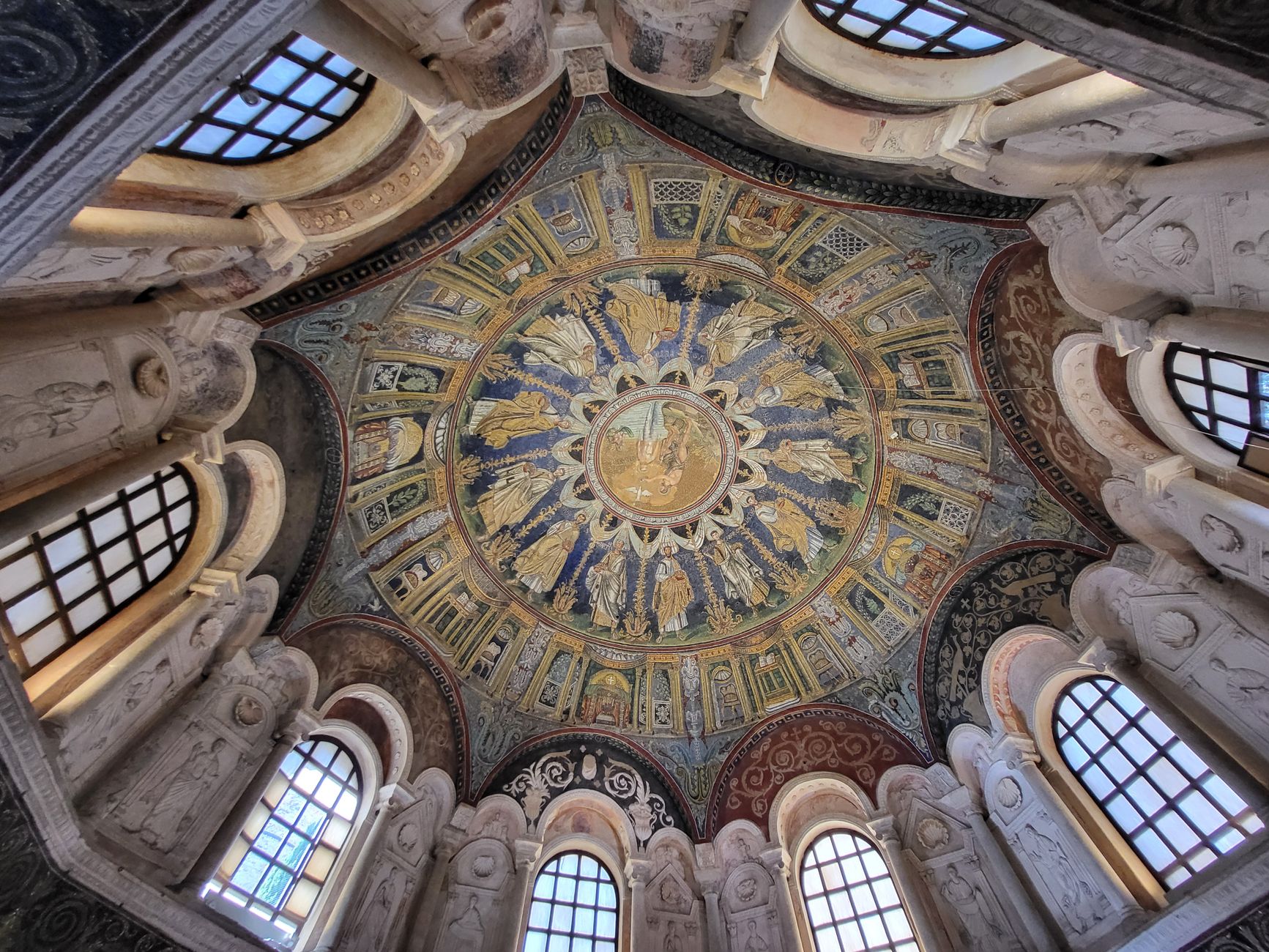
Neonian Baptistery (5th century): the oldest surviving monument in Ravenna, an octagonal baptistery with a mosaic dome showing the baptism of Christ in the central medallion and the twelve apostles circling it. The dome is 9 metres across; looking up from below, the perspective is disorienting in a useful way.
The remaining three UNESCO monuments — Archbishop's Chapel, Baptistery of the Arians, Sant'Apollinare in Classe (5km outside the city), and the Mausoleum of Theodoric — each require specific interest in the variations they represent. Sant'Apollinare in Classe (free entry) has a superb apse mosaic; the others are secondary.
How to Use the Combined Ticket
The combined ticket covers five of the eight sites. Sant'Apollinare in Classe (5km south, bus from the train station, 20 minutes) and the Mausoleum of Theodoric (1.5km northeast, 20-minute walk) are free and not included. The Archbishop's Chapel requires the combined ticket.
Practical sequence: buy the ticket at the Via Salara Vecchia tourist office → San Vitale (5-minute walk) → Galla Placidia (3 minutes from San Vitale) → Neonian Baptistery (10 minutes) → Archbishop's Chapel (5 minutes) → Sant'Apollinare Nuovo (10 minutes). A full circuit of these five takes approximately 3.5 hours with time to look at each properly.
Getting to Ravenna

From Bologna: regional train (Trenitalia), 1h15, €7–9. About 4 services/hour. Bologna is on the Milan–Florence high-speed line — Ravenna works as a day addition between Bologna and Florence.
From Ferrara: train, 1 hour, €7.
From Florence: Frecciarossa to Bologna (35 minutes, €25–35) then regional to Ravenna (1h15). Total around 2 hours.
The station is 15 minutes' walk from the San Vitale mosaic cluster. Bicycle rental is available at the station (€12/day) and is the most practical way to reach Sant'Apollinare in Classe.
When to Visit Ravenna
April–June: the best window. Mild temperatures (18–24°C), the Galla Placidia light best in morning spring light, lower visitor numbers than summer. Book the Galla Placidia reservation at least a week ahead from April to mid-June.
September–October: equally good. No Galla Placidia booking required outside the spring window, similar temperatures, harvest season in the surrounding Romagna countryside.
July–August: hot (30–34°C), Italian domestic tourism peaks. Ravenna never reaches Venice-level crowding but the mosaic interiors are cooler than the streets — a reason to be inside at midday.
November–March: quiet and cool. No Galla Placidia booking required. The mosaics are the same regardless of season.
Ravenna vs Florence
Ravenna has one specific thing done at world-class level, a compact walkable circuit, very few foreign tourists, and accommodation 40–60% cheaper than Florence. It has no Renaissance art, no Uffizi, no Duomo. The comparison is between depth in one subject and breadth across five centuries. For anyone specifically interested in early Christian and Byzantine art, Ravenna is more important than Florence. Most Italy itineraries do not make this choice — they treat Ravenna as an addition rather than an alternative.
Frequently Asked Questions
How many hours do you need in Ravenna?
A focused day trip (4–5 hours in the city) covers the five combined-ticket sites plus the Mausoleum of Theodoric. An overnight allows for Sant'Apollinare in Classe at opening, a longer visit to San Vitale, and the evening when the mosaics close and the city empties.
Why do the Galla Placidia mosaics require advance booking in spring?
Light sensitivity is the official reason — the blue mosaic in the small interior is susceptible to damage from prolonged light exposure, and visitor numbers are controlled with timed-entry slots. The booking fee is €2 on top of the combined ticket.
What makes Ravenna's mosaics different from Roman mosaics?
Roman mosaics are primarily floor-level, decorative, and three-dimensional in perspective. Ravenna's mosaics are wall and ceiling, gold-ground, with flat hieratic figures — the Byzantine aesthetic deliberately rejected naturalistic depth to emphasise spiritual rather than physical reality.
Is Ravenna a good day trip from Venice?
The connection requires a change at Ferrara or Bologna — approximately 2.5 hours each way. Possible but long for a day trip. Better as a stop between Venice and Florence.
What is the Dante connection to Ravenna?
Dante Alighieri was exiled from Florence in 1302, spent the last years of his life in Ravenna at the invitation of the lord Guido Novello da Polenta, and died here in 1321. His tomb is in the Zona Dantesca near the centre — a small neoclassical building with the original sarcophagus. Florence has requested the bones back; Ravenna has declined every time.