
Sapa is a market town at 1,500 metres in the Hoàng Liên Sơn mountains, 380km northwest of Hanoi near the Chinese border. The rice terrace landscapes that cover the valley slopes below town were cut by the Hmong and Dao ethnic communities over centuries and are most photographed in September and October when the fields turn from green to gold during harvest — and again in May–June during the water-filling season when the flooded terraces reflect the sky. The rest of the year they're still attractive but less dramatically so. The trekking infrastructure is well-developed; the question is how to use it without paying tour-group prices for what is fundamentally a walk through villages.
Getting to Sapa From Hanoi
The overnight train from Hanoi to Lào Cai (the junction town at the base of the mountain, 38km from Sapa) is the most comfortable option: depart Hanoi around 10pm, arrive Lào Cai around 6am, then take a 1-hour shared minivan to Sapa (₫50,000). Soft sleeper berths cost ₫350,000–500,000 (€13–19); hard sleeper ₫200,000–320,000 (€7–12). Book tickets on the Vietnam Railways website (vr.com.vn) or through a Hanoi travel agent. Several private train companies (Livitrans, Sapaly) run dedicated tourist carriages on the same track at higher prices.
The alternative is a tourist bus from Hanoi's My Dinh station (8–9 hours, ₫200,000–300,000/€7–11). Comfortable and air-conditioned but takes longer. Some buses operate overnight; daytime departures arrive in the late afternoon. The new expressway has reduced road journey times significantly since 2022.
Trekking: Options and What They Cost
The main trekking routes from Sapa drop into the Muong Hoa Valley and pass through Hmong and Red Dao villages — Cat Cat (closest, 30 minutes from town), Lao Chai and Ta Van (half-day route, 8–10km), and Bản Hồ (full-day, 16km). All involve significant descent and ascent on paths that become slippery in rain; proper shoes are necessary.
Licensed guides are required for trekking into most villages, though enforcement varies. A local Hmong guide hired directly in town (rather than through a hotel or tour operator) costs ₫300,000–500,000 (€11–19) per day for a group of two to four people. The women who approach tourists in the town centre offering guiding are typically Hmong locals with genuine knowledge of the trails and villages — not certified guides but experienced walkers who know the paths well. Going with them informally is the cheapest option and keeps money directly in the community.
Organised treks from travel agencies in town run ₫600,000–1,200,000 (€22–46) per person for a full day with guide and lunch. Homestay treks — where you stay overnight in a village home and trek back the next day — cost ₫800,000–1,500,000 per person and are the most immersive option.
When to Visit Sapa
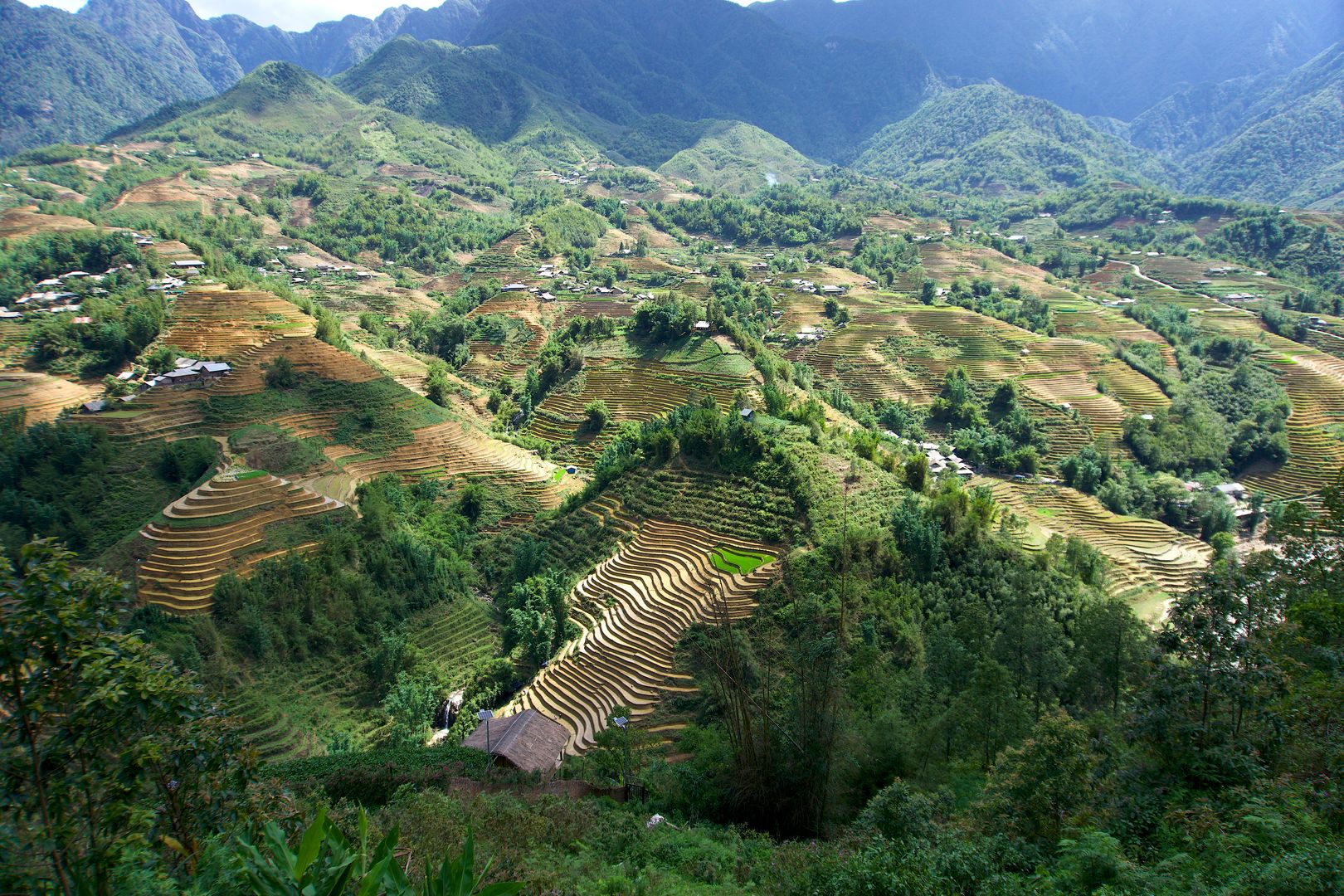
September and October: the rice harvest season, with fields turning gold and amber. This is the most photographed period and the most visited — book accommodation 4–6 weeks ahead. May and early June: the water-filling season, when terraces are flooded and reflective in clear weather. Both periods can have cloud and mist, which is either atmospheric or frustrating depending on your expectations.
December through February: cold (0–8°C), occasional frost at altitude, and rare snowfall that brings Vietnamese tourists in large numbers. The cloud tends to lift in winter mornings, giving better mountain views, but trekking conditions are cold and wet paths are harder to navigate. July and August are warm but very wet — the Hoàng Liên Sơn range intercepts monsoon clouds and receives 350–500mm in August. The terraces are green and lush; the paths are muddy and some trails flood.
Fansipan: Indochina's Highest Peak
Fansipan (3,143m), the highest peak in Vietnam, Laos, and Cambodia, sits above Sapa and has been accessible since 2016 via a cable car from the base of the mountain. The cable car costs ₫750,000 return (€29) and takes 20 minutes; a staircase of 600 steps completes the final climb to the summit. The view — on a clear day, north into China, south toward Hanoi — is genuinely good. Cloud covers the summit a majority of days; check the Fansipan webcam before committing.
The trekking route to the summit (the original approach, now less used) takes 2–3 days with a local guide and involves camping or a trail guesthouse at 2,800m. Permits and a registered guide are required. The route is technical in places; the cable car is the realistic option for most visitors.
Where to Stay in Sapa
Sapa town has a wide range of accommodation, from budget guesthouses (₫250,000–400,000/€9–15 per night) to cloud-view boutique hotels (₫1,500,000–3,000,000/€57–115). The town is built on a hillside and most hotels advertise valley views — the better views are from the higher streets and the northwest-facing rooms. In cloud, views disappear entirely regardless of altitude; this is more common than brochures suggest.
Homestays in the villages (Cat Cat, Lao Chai, Ta Van) are available directly or through agencies in town. Spending at least one night in a village gives a very different experience from the town — meals with the family, evenings without significant lighting, and waking to a valley rather than a tourist strip.