Seoul was the capital of the Joseon dynasty for 500 years and the capital of the Republic of Korea since its founding in 1948. The Joseon palaces — Gyeongbokgung, Changdeokgung, Changgyeonggung — occupy the northern sections of the city against the Bugaksan and Inwangsan mountain ridges. The colonial Japanese destruction of the late 19th and early 20th centuries, the near-total destruction of the Korean War (1950–1953), and the rapid postwar development that followed left Seoul with less of its pre-modern built fabric than cities like Kyoto or Beijing. What remains is genuinely significant; what replaced it is a modern city of exceptional density and energy.
Gyeongbokgung Palace and Bukchon
Gyeongbokgung, built in 1395 as the main Joseon palace, was burned by Japanese forces in 1592, rebuilt in 1867, and partially demolished again under Japanese colonial rule in the early 20th century. The current complex is a partial reconstruction covering approximately 40% of the original site. The Gwanghwamun Gate, the Geunjeongjeon Throne Hall, and the Gyeonghoeru Pavilion (a colonnaded hall on a lotus pond) are the main structures. The changing of the Royal Guard ceremony (10am and 2pm daily, except Tuesdays) is a costumed recreation with some theatrical value; entry to the palace grounds is KRW 3,000 (free with traditional hanbok rental — several rental shops operate immediately outside the main gate).
Bukchon Hanok Village, a 15-minute walk east of Gyeongbokgung, is a preserved neighbourhood of 600+ hanok (traditional Korean wooden tile-roof houses) on the hillside between the two main palaces. The streets are narrow and steep; the architecture is intact; residents still live here and have posted signs asking for quiet and for photography to be limited. The early morning (before 9am) is the time to walk Bukchon — the tour groups arrive from 9:30am and the narrowest alleyways become gridlocked by midday. Bukchon's most photographed viewpoint, looking south over the rooftops toward Namsan Tower, is on Gahoe-dong alley.
Insadong, Jongno, and the Temple Quarter
Insadong, immediately south of Bukchon, is Seoul's traditional-culture street — teahouses, craft shops, galleries, and restaurants in 19th-century buildings and modern facsimiles. The main street (Insadong-gil) is car-free on Sundays; the side alleys (Ssamziegil courtyard, Nakwon Arcade) are worth more time than the main drag. Jogyesa Temple, two blocks west of Insadong, is the main temple of Korean Buddhism in Seoul — an active urban monastery with a 600-year-old zelkova tree in the courtyard and, during the Lotus Lantern Festival (May), a lantern installation covering every surface of the temple grounds.
Changdeokgung Palace and its Secret Garden (Huwon, KRW 8,000) is the best-preserved of the Joseon palaces — the garden design, integrating ponds, pavilions, and naturalistic forest planting, represents Korean aesthetic principles more clearly than the formal Chinese-influenced layouts of the other palaces. Tours are guided and timed (book ahead in spring and autumn when the garden has waiting times); the garden closes in winter.
Hongdae, Sinchon, and the University Districts
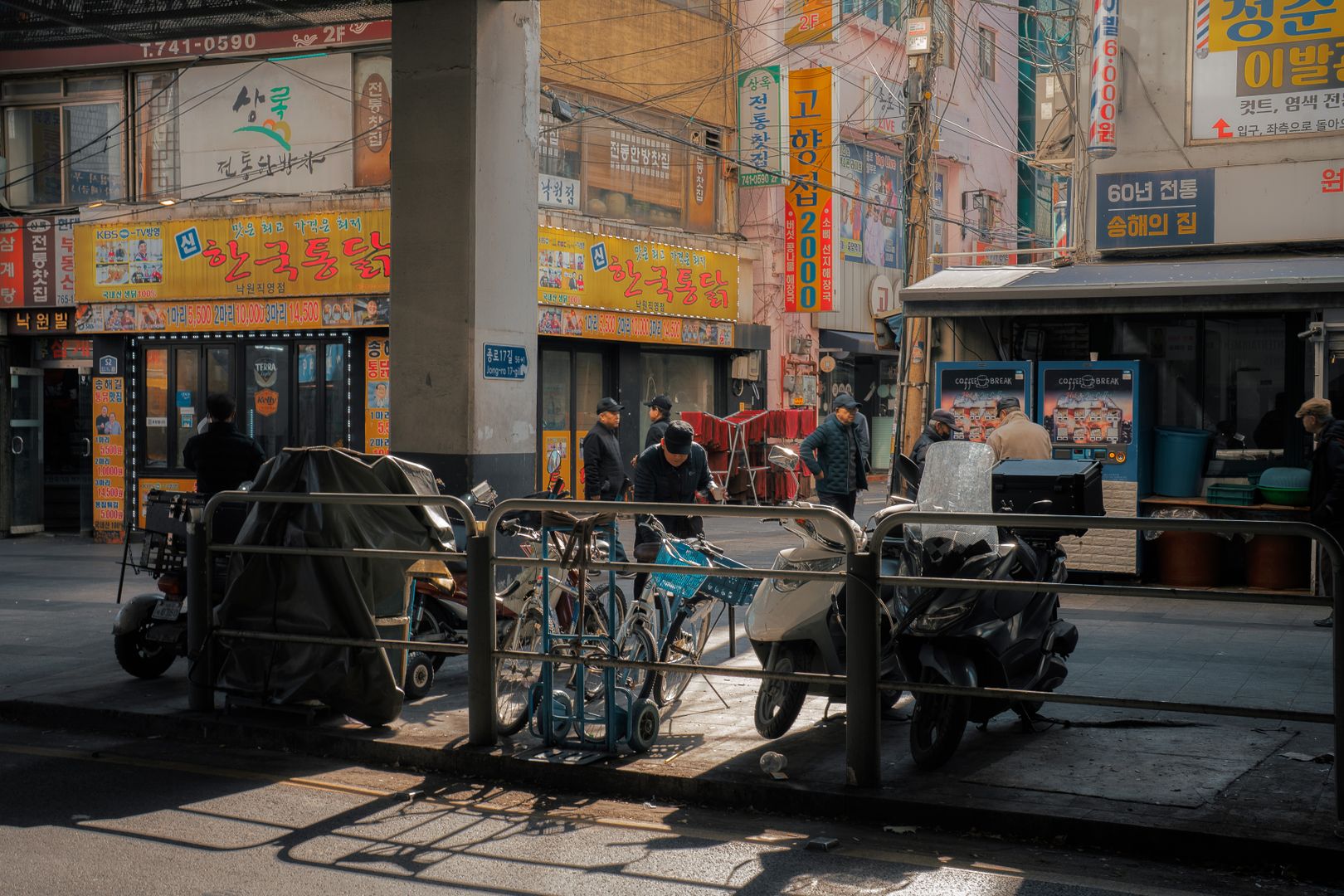
Hongdae (Hongik University neighbourhood) has been Seoul's independent music and art district since the 1990s — street art, independent clothing stores, small clubs, live music venues, and a Saturday free market running March–November. The street-level energy peaks from early evening; the club scene (Cakeshop, Contra, FF) runs from midnight. Sinchon, adjacent, has the larger university campus concentration and a more student-market character. Yeonnam-dong, west of Hongdae, is the neighbourhood that has emerged most strongly in the past decade — Japanese-style narrow streets, independent coffee shops, bookstores, and restaurants that predate the Instagrammification of the area.
Gangnam and the Han River
Gangnam — the area south of the Han River — became synonymous internationally with wealth after the 2012 song, which is an accurate shorthand: the Apgujeong and Cheongdam-dong neighbourhoods contain the highest concentration of luxury brands in Korea. The Coex underground mall (connected to the metro) is enormous and contains an impressive library installation (Starfield Library) worth a detour. Han River parks run along both banks for 40km; the culture of buying convenience store chicken and beer and sitting by the river on summer evenings is a genuine urban ritual. Yeouido (parliament island, middle of the Han) has the largest Han riverside park and the best cherry blossom in Seoul in early April.
Korean Food in Seoul
Samgyeopsal (thick-cut pork belly grilled on a table grill, wrapped in lettuce with garlic, ssamjang paste, and kimchi) is the dish most associated with Korean social eating. The cooking is done at the table; the combination of components varies by personal preference; a full meal for two with soju costs KRW 30,000–50,000. Tteokbokki — chewy rice cakes in a fermented chilli sauce, available at street stalls for KRW 3,000–5,000 — is the snack food that appears at every major street market and convenience store. Bibimbap, kimchi jjigae, Korean fried chicken, and cold buckwheat noodles (naengmyeon, particularly in summer) complete the essential list.
Gwangjang Market (Jongno) is Seoul's oldest traditional market and the best place to eat jeon (savoury pancakes) and bindaetteok (mung bean pancakes) at the street stall section — extremely busy, extremely good, cash only. Mangwon Market (Mapo-gu, near Hongdae) is a local neighbourhood market less visited by tourists, with a strong produce section and several good noodle shops.
Day Trips: DMZ and Suwon
The DMZ (Demilitarized Zone), 55km north of Seoul, is the 4km-wide buffer zone along the 38th parallel separating South and North Korea. Civilian access to the JSA (Joint Security Area at Panmunjom, where the armistice was signed in 1953) resumed for South Korean and foreign tourists in 2023 after a COVID closure; tours through USO or licensed operators cost USD 55–90, include the blue UN conference buildings straddling the border, and require advance booking. The Dora Observatory, Dorasan Station (the last railway station before the North Korean border), and the Third Infiltration Tunnel (one of four tunnels dug northward from North Korea under the DMZ) are accessible on day tours that don't require JSA access. The overall experience is more sobering than spectacular — the physical landscape is unremarkable; the historical weight is not.
Suwon (30 minutes by subway from central Seoul, KRW 1,850) has the best-preserved Joseon fortress walls in Korea — Hwaseong Fortress (UNESCO, 5.7km circumference, built 1796, entry KRW 1,000) and the Korean Folk Village outside the city (a preserved 19th-century village with demonstrations of traditional crafts and folk performances, KRW 30,000). Both are manageable in a full day.
Getting Around Seoul
The Seoul Metro has 23 lines and 700+ stations. A T-money card (purchased at any convenience store, KRW 2,500 + initial load) covers metro, bus, and most inter-city bus connections with a transfer discount. Single metro fares run KRW 1,250–1,750 depending on distance. Taxis are metered and honest; a short city trip runs KRW 4,000–8,000. KakaoTaxi (app) works for calling taxis in Korean without language difficulty.
Practical Costs
A hostel dorm in Seoul runs KRW 15,000–25,000 (USD 11–18); a mid-range hotel KRW 80,000–150,000 (USD 58–108). Street food and market meals: KRW 4,000–10,000. Restaurant dinner: KRW 20,000–50,000 per person for Korean BBQ including drinks. Museum entries: KRW 1,000–15,000. The city is modestly priced by Japanese or European standards and significantly cheaper than Tokyo for equivalent comfort.