
The Sukhothai Kingdom existed from roughly 1238 to 1438, when it was absorbed into the Ayutthaya Kingdom. At its height under King Ramkhamhaeng in the 13th century, it controlled much of what is now central and northern Thailand, parts of Laos, and the Malay Peninsula. The Thai alphabet was codified here; early Thai Buddhism and art styles developed here; the country's first hydraulic engineering works — a system of reservoirs and canals feeding a walled city — are still partially visible. The historical park was designated a UNESCO World Heritage Site in 1991.
Getting to Sukhothai
Sukhothai is in the lower north, about 440km from Bangkok. There is no direct train — the nearest station is Phitsanulok, 58km east. From Bangkok's Chatuchak Mo Chit terminal or Victory Monument, air-conditioned buses run directly to Sukhothai (5.5–7 hours, 250–320 baht). From Chiang Mai there are direct buses via a company called Greyhound Bus or Win Tour (5 hours, 200–280 baht). Flying into Sukhothai Airport (which serves Bangkok Suvarnabhumi via Bangkok Airways) is the fastest option but considerably more expensive (2,500–4,500 baht including airport bus) — worth considering if you are combining Sukhothai with Chiang Mai and want to save a day.
Sukhothai Town and the Historical Park are 12km apart; a songthaew runs between them on request for 40–60 baht per person, or 300–400 baht for a private charter.
The Historical Park
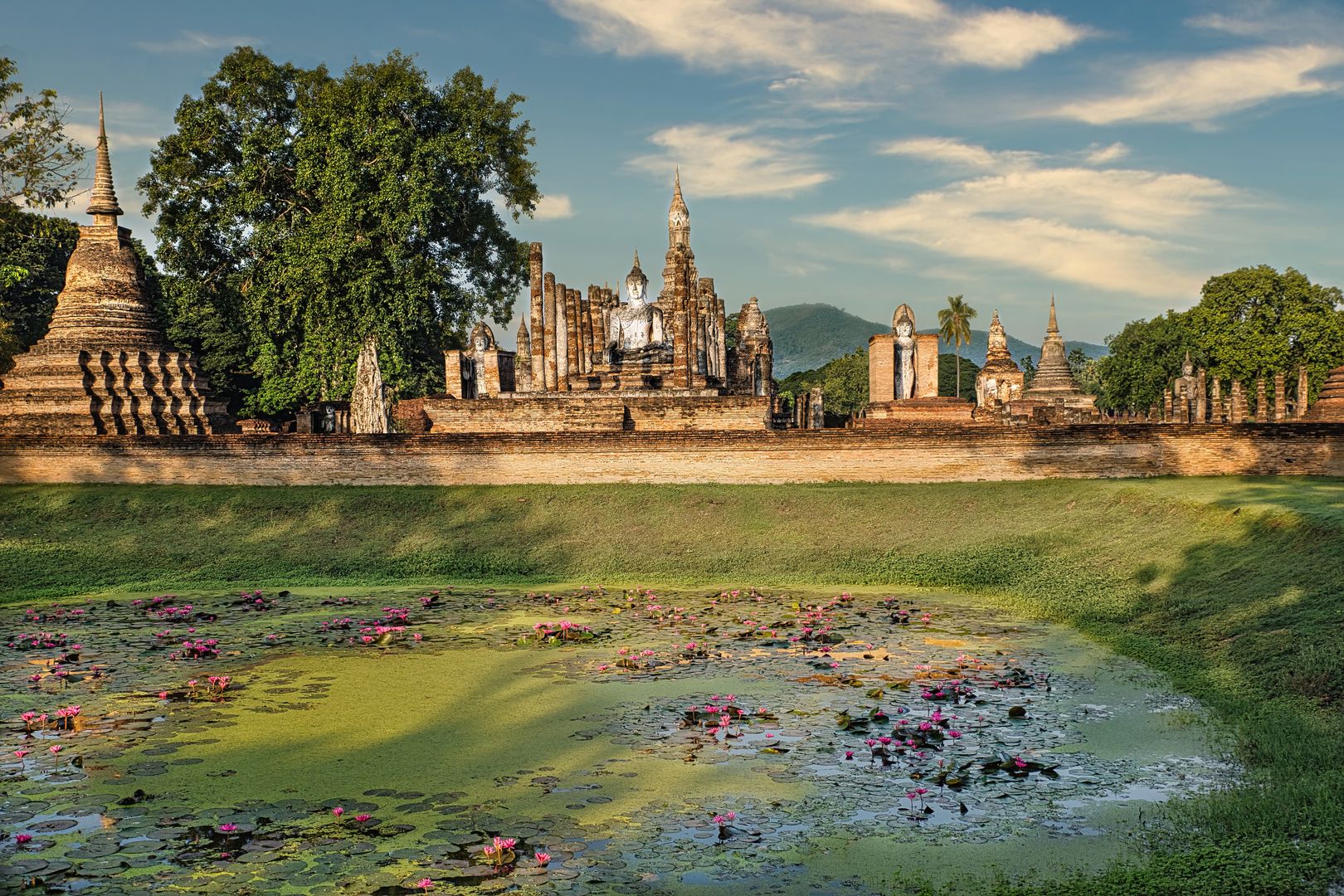
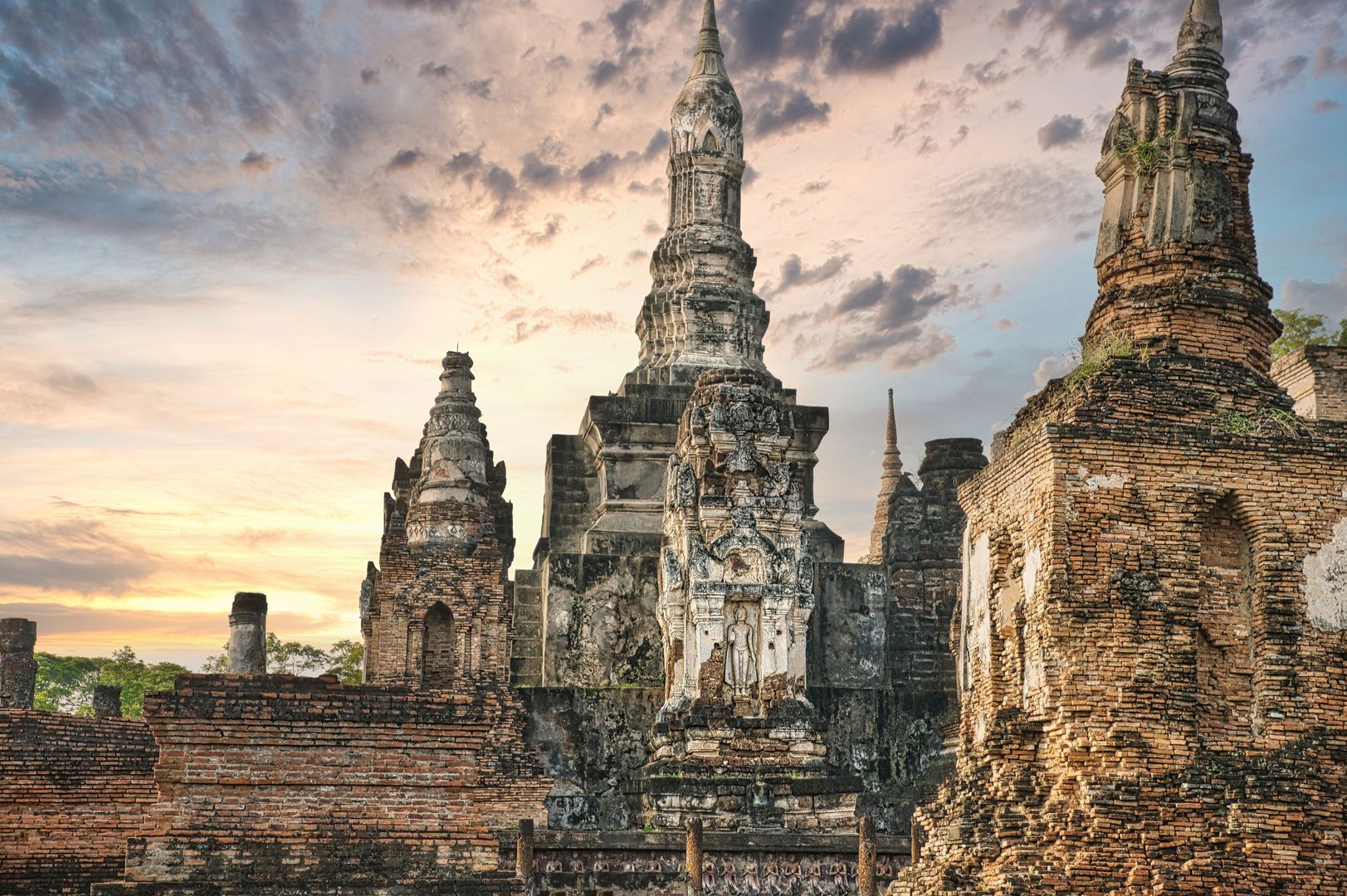
The park is divided into five zones. The Central Zone (entry 100 baht) contains the most important monuments and is where most visitors focus. Wat Mahathat — the royal temple at the centre of the ancient city — is the most photographed: a large lotus-bud stupa surrounded by subsidiary chedis, columns, and a pond filled with lotus plants. The reflection at dawn, when the gate has just opened and almost no one is there, is genuinely worth the early alarm.
Other Central Zone highlights: Wat Sri Sawai, three Khmer-style prangs predating the Thai kingdom; Wat Sa Si, a small island temple accessible by a footbridge, with an ordination hall and a colonnaded walkway; and Wat Trapang Thong, connected to the park's main pond by a footbridge. The city walls and moats of the outer fortifications are partially intact and visible on the park's perimeter.
The North Zone (100 baht, 2km from centre) has Wat Sri Chum — a large mondop (square hall) enclosing a 15m-tall seated Buddha image visible through a narrow entrance slot. The effect is dramatic: the head of the image fills almost the entire opening. A hidden staircase inside the wall leads to the roof; the stairway is usually closed but the image from outside is the draw. The South Zone, East Zone, and West Zone are smaller, less visited, and worth including on a longer visit — the West Zone's Wat Saphan Hin, on a hilltop 12m above the plain, has clear views across the entire historical park.
Cycling the Park

Bicycles rent for 30–50 baht per day from stalls at the Central Zone entrance. This is the standard and most sensible way to visit — the Central Zone is about 3km across, the paths between monuments are flat and shaded, and a bicycle means you can stop anywhere rather than following a tour group route. Electric bikes are also available for 100 baht and are useful for the outer zones. The entrance road from the main gate to Wat Mahathat is 1.5km; plan 3–4 hours for the Central Zone on a bicycle, plus another hour or two if adding the North Zone.
Si Satchanalai Historical Park
55km north of Sukhothai, Si Satchanalai is a separate UNESCO-listed site (100 baht) — another ruined city from the same kingdom, less restored, more overgrown, and almost always quieter than the main park. The kilns at Chaliang (where celadons and other ceramics were produced for export across Southeast Asia) are worth combining with the temple ruins. A full day covering both parks requires either a hired car or motorbike; the road north is pleasant through forested hills.
Loi Krathong in Sukhothai
Sukhothai hosts one of the largest Loi Krathong celebrations in Thailand — a festival on the full moon of the 12th lunar month (November) where floats with candles are released onto water. The historical park at Sukhothai has both the lotus ponds and the historical credibility (the festival is believed to have originated here in the Sukhothai period). The celebration runs for about a week, with nightly sound-and-light shows at the park and a large fairground. Accommodation books up months in advance for the central nights; anyone planning to visit during Loi Krathong should reserve early.
Where to Stay and Eat
Most accommodation is in New Sukhothai (the modern town), 12km from the park. A good mid-range option is staying in the park area itself — several guesthouses and small hotels are positioned within walking distance of the Central Zone entrance, which makes the dawn timing much easier. Prices in the park area are slightly higher: 600–1,200 baht for a fan or air-conditioned room.
The night market in New Sukhothai on Ramkhamhaeng Road has reliable Thai standards at 50–100 baht per dish. The park area has a few tourist-oriented restaurants at the entrance — acceptable but not exciting. For the best rice noodle soups (Sukhothai is known for a particular style of rice noodle — thicker, served with ground pork, green beans, and dried shrimp in a clear broth), go into town.
FAQ
How long do you need in Sukhothai?
Two full days is comfortable: one day for the Central and North Zones with an early start, one day for a trip to Si Satchanalai. One full day is enough for the Central Zone alone if that is all the itinerary allows.
Is Sukhothai better than Ayutthaya?
Different rather than better. Ayutthaya is larger, more varied architecturally, and easier to reach from Bangkok. Sukhothai is smaller, more cohesive, and significantly less crowded. The cycling experience at Sukhothai has no equivalent at Ayutthaya, where tuk-tuk drivers position themselves at every entrance.
What is the best time to visit Sukhothai?
November–February is optimal: dry, not too hot, clear skies for photography. March–May is hotter (up to 40°C); June–October is the rainy season with green landscapes and fewer visitors. Rain does not close the park, and the ruins in light rain with no crowds can be preferable to a clear day with tour groups.