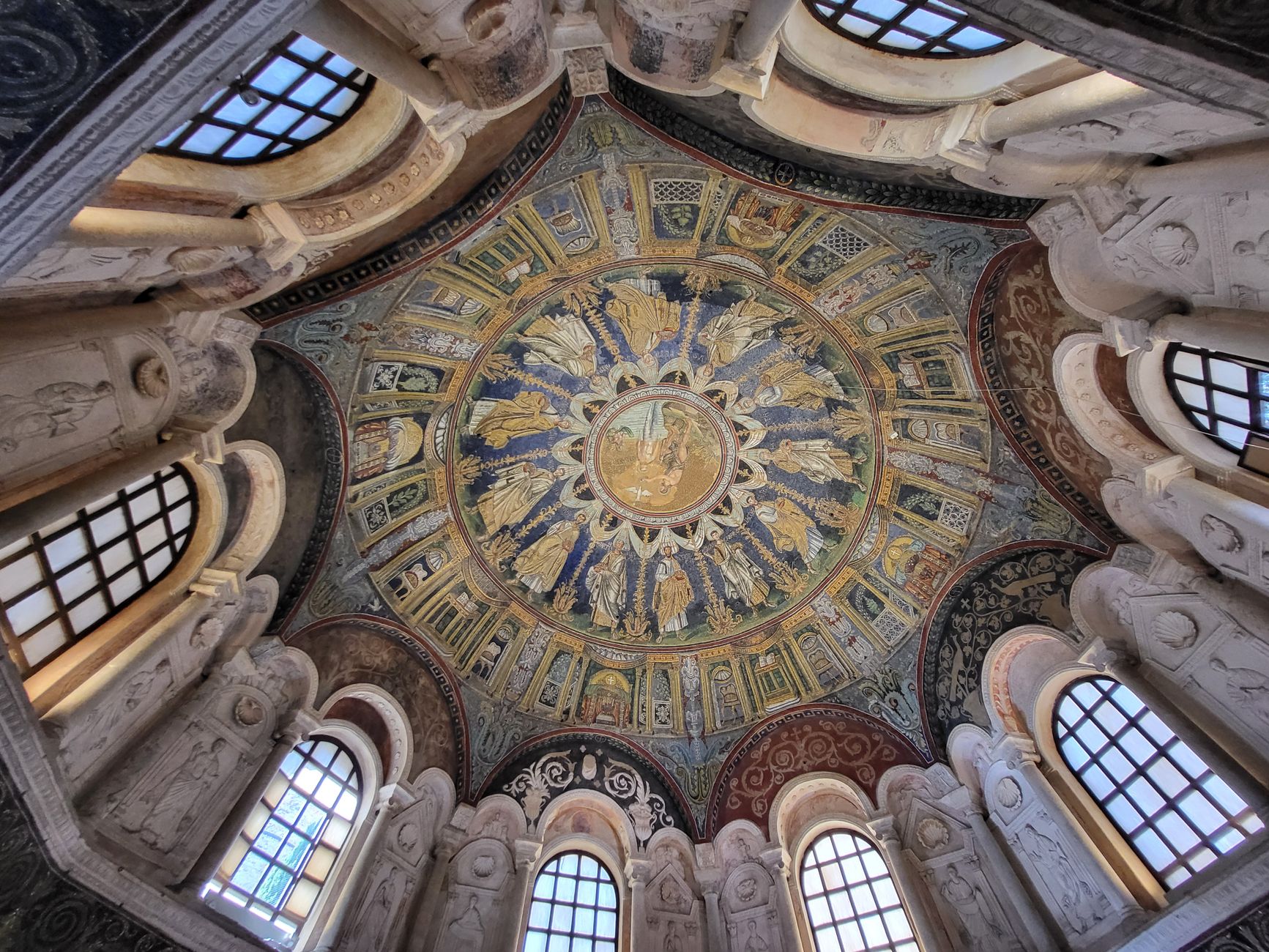

Sicily's position in the middle of the Mediterranean made it contested territory for every significant civilisation from ancient Greece onwards. The Greeks built temples in Agrigento and Syracuse in the 5th century BC; the Arabs introduced citrus, sugar cane, and the culinary traditions that became Sicilian cuisine in the 9th–11th centuries; the Normans built Palermo's extraordinary Arab-Norman churches in the 12th century; the Spanish Baroque rebuilt the east coast cities after the 1693 earthquake. The resulting architecture — Greek columns embedded in cathedral walls, Arab-influenced domed churches, Baroque piazzas — is layered in a way that most European cities can't approximate. The food follows the same logic.
Palermo: The Capital
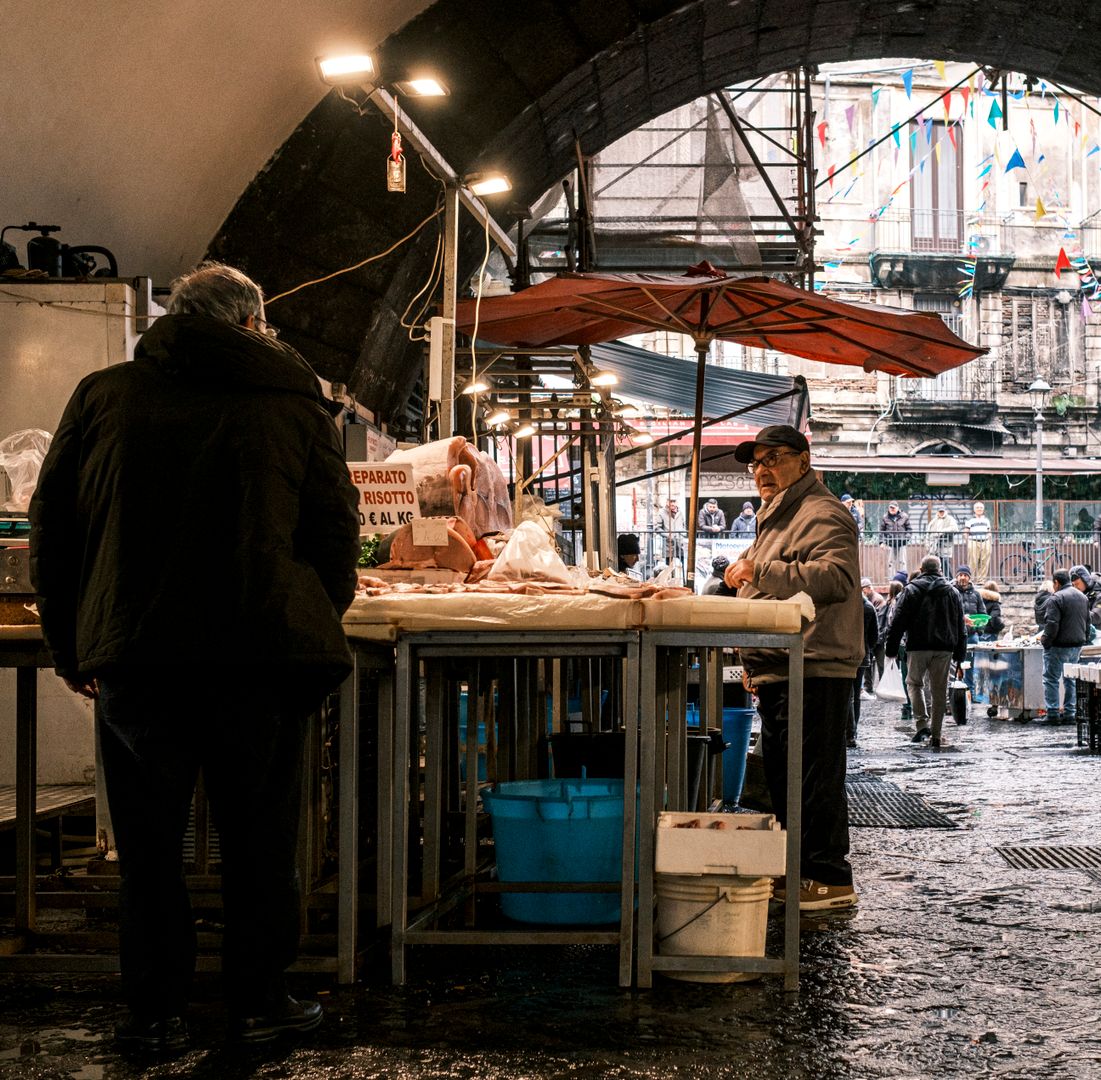
Palermo is the most complex and energetic Sicilian city — a working capital of 650,000 people with an unresolved relationship between its monumental historic centre and the postwar construction that surrounds it. The Ballarò and Capo markets, operating since the Arab period, are the urban anchors: produce, fish, and street food in narrow alleys, with the same social function they've had for a thousand years. The Vucciria market (Kalsa neighbourhood) has declined from its historic scale but remains atmospheric in the evenings.
The Cappella Palatina, inside the Norman Palace (Palazzo dei Normanni, €12 combined), contains the finest 12th-century Byzantine mosaics in Europe — gold-ground images covering every surface of a small royal chapel commissioned by Roger II in 1132. The Arab-Norman cathedral (Cattedrale di Palermo, free to enter, €3 for the rooftop) is architecturally eclectic in the most literal sense: the exterior shows successive modifications over eight centuries. The Martorana church (Santa Maria dell'Ammiraglio, €2) on Piazza Bellini has 12th-century mosaics comparable to the Cappella Palatina at a fraction of the visitor volume.
The Catacombe dei Cappuccini (€3, Piazza Cappuccini) hold 8,000 mummified bodies displayed in wall niches — monks, merchants, soldiers, and children, interred and displayed from the 16th century through 1920. The collection is one of the most extensive and well-preserved examples of this practice in the world. Whether you find this fascinating or deeply uncomfortable says something about your relationship with mortality; it is unquestionably unlike anything else you will see in Italy.
Valley of the Temples, Agrigento
The Valle dei Templi (Valley of the Temples, €10–15 depending on seasonal inclusions) outside Agrigento holds seven 5th-century BC Greek temples on a ridge above the modern city — one of the most extensive and best-preserved ancient Greek sites outside Greece itself. The Tempio della Concordia is the most complete (nearly entire walls and colonnade standing), the Tempio di Ercole the most ruined, the Tempio di Giunone the most dramatically positioned above the valley slope.
The site is large enough to absorb its visitors without feeling overcrowded outside the busiest summer weeks. The almond trees between the temples bloom in late February — the Sagra del Mandorlo in Fiore festival fills the valley with temporary theatre and folk performances at the same time. Visiting at dawn (the site opens early, before the tourist buses from Palermo and Catania) is the practical approach in July and August; the light and the absence of crowds compensate for the early start. The modern city of Agrigento, 3km north, has no particular reason to visit beyond logistics; accommodation near the temples or in the neighbouring town of Villaggio Mosè is preferable.
Mount Etna
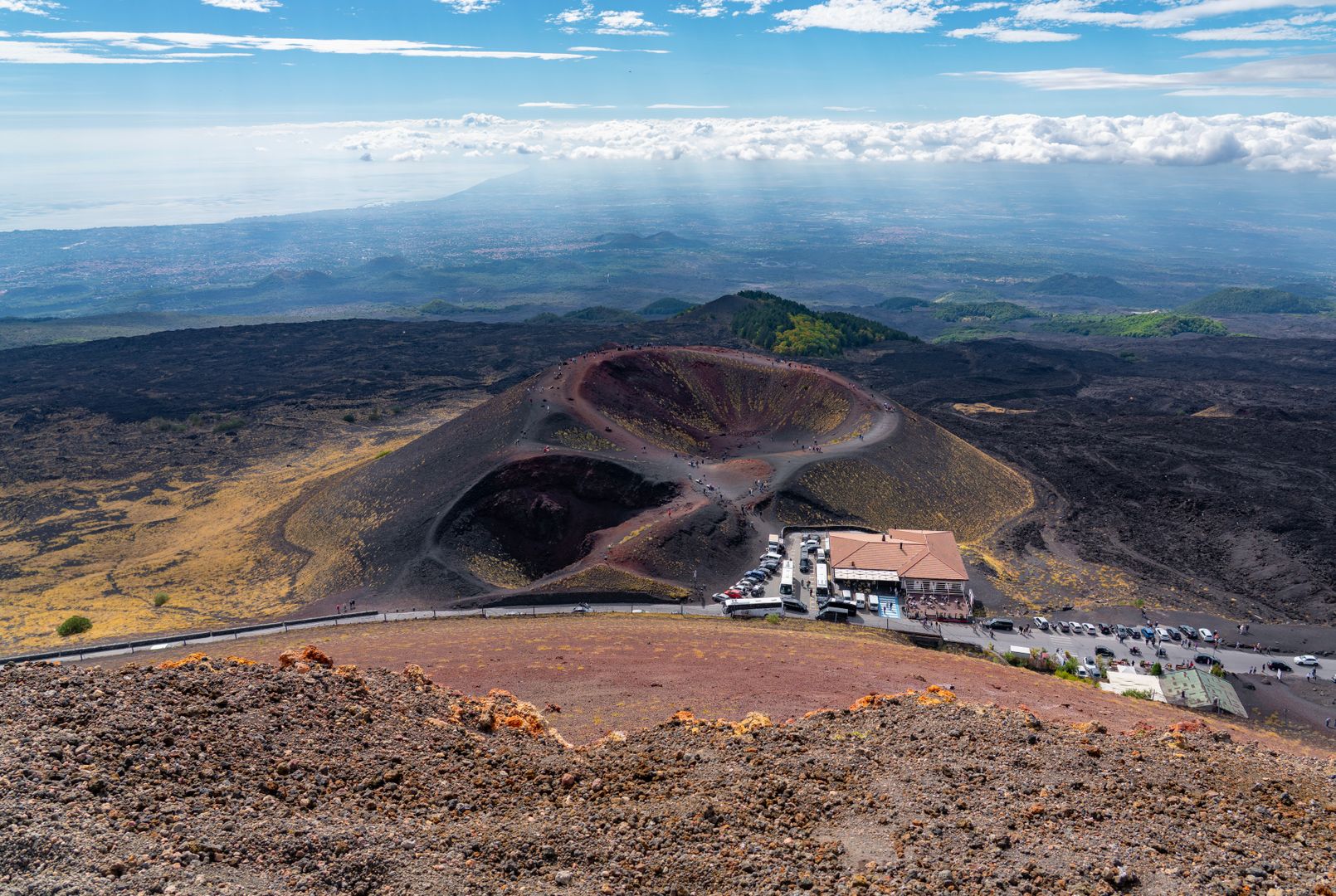
Etna is Europe's largest active volcano (3,326m) and the most continuously active volcano in the world. It erupts in some form almost every year — lava flows from the summit craters are common (the 2021 and 2023 eruptions were significant), pyroclastic activity less frequent. The Sicilian Civil Protection agency monitors activity continuously; access to the upper slopes is adjusted based on current eruption status and is shown on the INGV website.
The cable car (Funivia dell'Etna) and 4x4 shuttle from the Rifugio Sapienza (1,900m, accessible by car from Catania via Nicolosi) operate on the south side and reach approximately 2,800m (€30 cable car, €30 additional for the 4x4 to the authorised limit). Guided tours to the summit area (€75–90 from the cable car base) operate when conditions allow. The Silvestri craters, two extinct craters at 1,900m near Rifugio Sapienza, are accessible on foot without a guide, without equipment, and free; they give a clear view of the volcanic landscape without the cost and logistics of the higher ascent.
The north face of Etna (accessed via Piano Provenzana) is less visited and lower in tourist infrastructure; snow often persists here into June. The Etna wine region on the volcano's slopes produces increasingly respected wines (Nerello Mascalese for reds, Carricante for whites) — Benanti, Cornelissen, and Terre Nere are producers worth seeking out, with tastings by appointment at the wineries.
Taormina
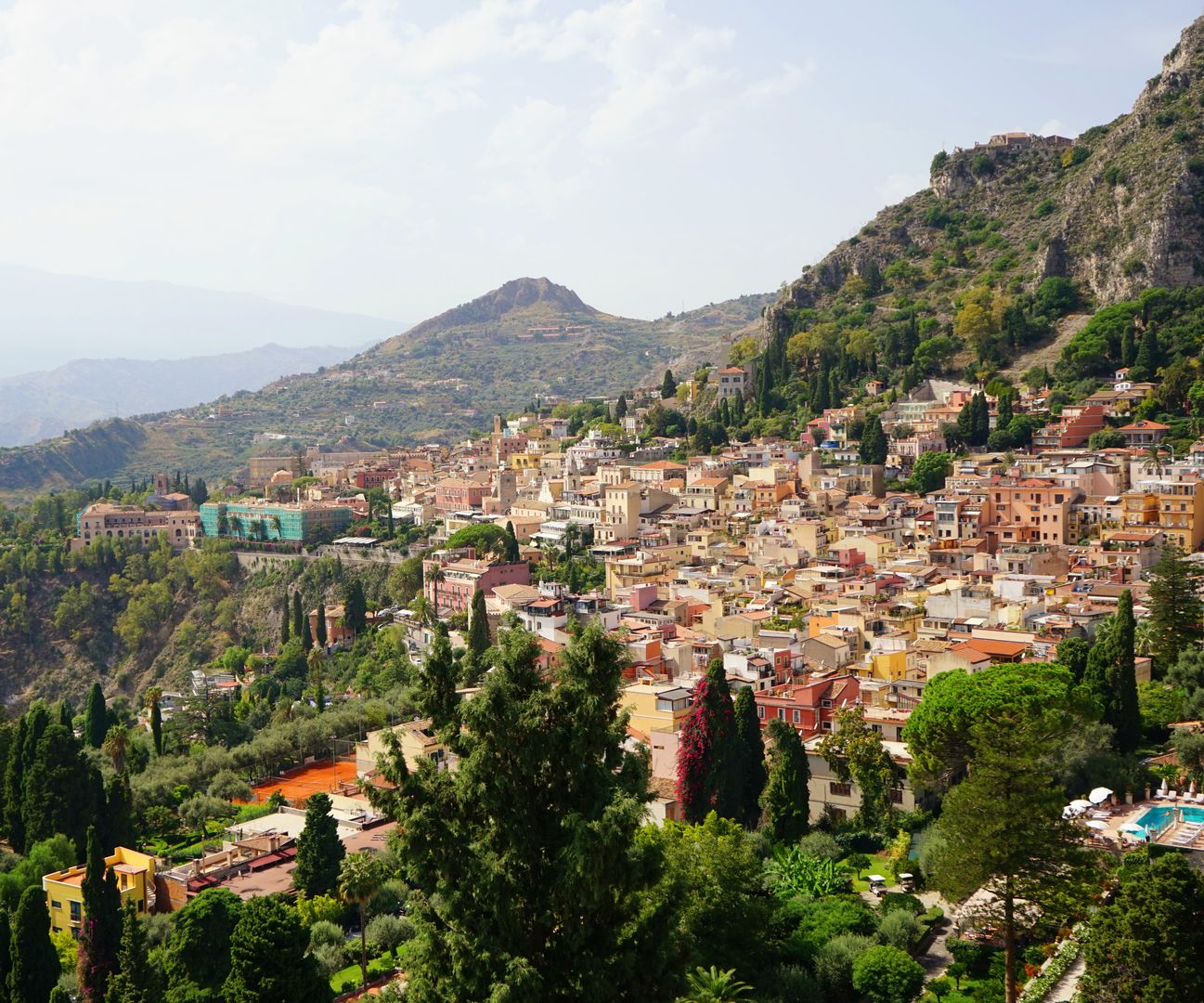
Taormina is the most visited town in Sicily — a clifftop settlement at 200m with a 3rd-century BC Greek theatre that frames Etna behind its stage. The view from the theatre (€10) is the reason people come: the volcano rising behind the ancient stone, the sea below. It's legitimately impressive and legitimately crowded from June through September.
Via Teatro Greco is the main pedestrian street — mostly tourist shops, aperitivo bars, and restaurants priced at a premium for the location. The best restaurants are on the side streets below the corso. Isola Bella, the small nature reserve below the cliff accessible by cable car (€3 one way), has a beach and clear water; the beach is a nature reserve and the stones are not for moving. July and August: Taormina Arte festival occupies the Greek theatre for concerts and film screenings (€40–120), which is the reason the accommodation books out completely. Shoulder season: the same views, accessible hotels at €100–180 rather than €250–450.
Syracuse and Ortygia
Syracuse was, in the 5th century BC, one of the largest cities in the western world — larger than Athens, a rival to Carthage. Ortygia, the island forming the old city, shows that history in strata: the Cattedrale di Siracusa is a 7th-century Norman church built directly around a 5th-century BC Greek temple (the original Doric columns are visible in the nave walls — the wall was simply cut between them). The Fonte Aretusa, a freshwater spring surrounded by papyrus plants on the Ortygia waterfront, has been the island's water source since antiquity.
The Parco Archeologico della Neapolis (€13), on the mainland north of Ortygia, holds the Greek Theatre (well-preserved, capacity 15,000, classical performances in May–June, €40–60), the Latomie (ancient stone quarries that Athenian prisoners of war were imprisoned in after 413 BC), and the Ear of Dionysius — a 23m-high cave with remarkable acoustic properties. Ortygia itself is the better place to stay: small hotels in 14th–18th century palazzi run €90–160 per night, the restaurants focus on local fish and pasta (€15–28 for a main), and the evening life is entirely Sicilian rather than tourist-oriented.
Sicilian Food
Arancini (fried risotto balls, filled with ragù or mozzarella and peas, coated in breadcrumbs) are the street food that most directly represents the Arab-influenced culinary tradition. Palermo claims the invention; Catania disputes this and insists its version (conical rather than round) is the original. The debate is unresolvable and beside the point — both are excellent, particularly fresh and hot from the fryer at €2–3 each.
Pasta alla Norma (tubes of pasta with fried aubergine, tomato, basil, and ricotta salata — a hard, aged ricotta) is the classic Catanese pasta dish, named in tribute to Bellini's opera. Caponata — sweet-sour aubergine relish with capers, olives, and pine nuts — comes from the Arab sweet-sour (agrodolce) tradition and appears as a side dish across the island. Swordfish and red tuna are the eastern coastline specialities, particularly around the Messina Strait and around Favignana island off Trapani (the historical centre of bluefin tuna fishing). Granita con brioche — fruit or almond sorbet served with a soft brioche bun — is the Sicilian breakfast; coffee granita in particular is better than it has any right to be.
Cannoli are sold fresh-filled (shell filled to order with sweetened ricotta) or pre-filled (soggy). Pre-filled cannoli in tourist shops are a different product; order from a pasticceria where they fill to order, eat immediately.
Getting Around Sicily
A car is near-essential for the Valley of the Temples, Etna, and anywhere outside the three main cities. Trains between Palermo and Catania (3h30, €13–20) and between Catania and Syracuse (1h, €7–10) are functional but slow by continental European standards. Flixbus and other intercity buses are generally faster than trains between the major cities. Ferries from Naples (Grimaldi, Tirrenia, €50–90 for a car + passenger, 10–11 hours overnight) are practical for arriving with a vehicle already on the island, eliminating the car hire cost and the ferry from the Italian mainland.
Practical Costs
Sicily is significantly cheaper than northern Italy. A mid-range hotel in Palermo runs €70–140; in Taormina, €150–300 in high season. Restaurant dinners average €15–25 for a main course in most of Sicily; Taormina charges €20–35. Street food (arancini, panelle, sfincione) is €2–5 per item. Petrol runs similar to the Italian mainland (€1.80–1.95/litre). A four-day circuit covering Palermo, Agrigento, Syracuse, and Etna is manageable with a car; budget €400–600 per person including accommodation, food, and entrance fees.