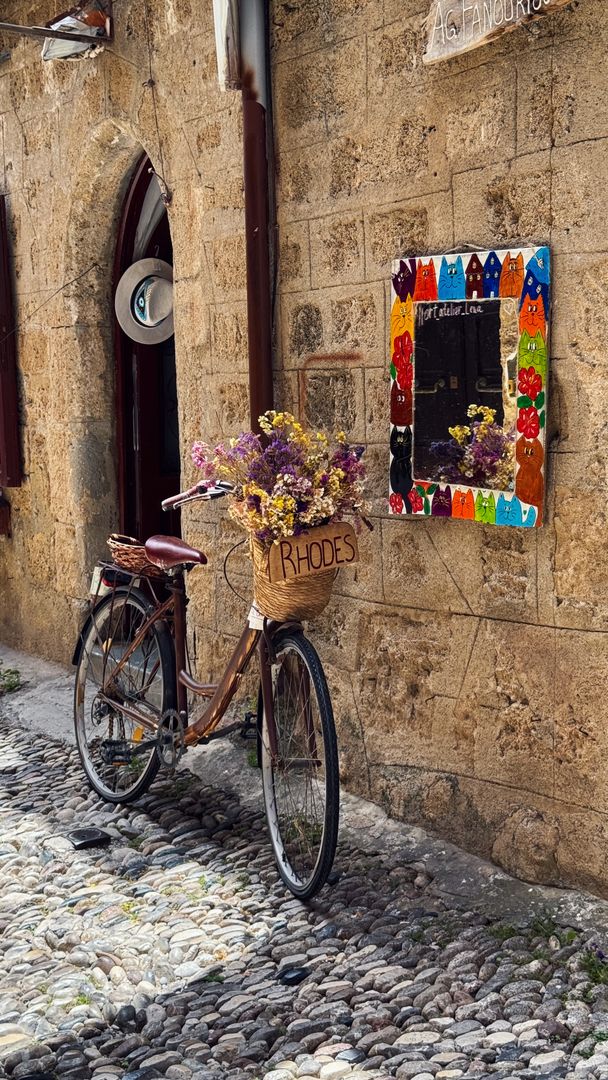

Rhodes is the largest of the Dodecanese islands and home to the most intact medieval city in Europe. The Knights Hospitaller built the Old Town's walls and streets starting in 1309, and those same 4km of stone ramparts and cobblestone alleys function as a living neighbourhood today — restaurants operate in 700-year-old buildings, families live above street-level shops, the city never became a museum. This distinguishes Rhodes fundamentally from Santorini or Mykonos, where historic cores have been hollowed out and rebuilt as tourist infrastructure. Add three genuinely excellent beaches within 50km, an extended warm season, and compact geography that allows real exploration without a car, and you have the most complete island experience in the southern Aegean.
The Medieval Old Town: what actually survives
The Old Town occupies roughly 200,000 square metres inside walls that remain almost entirely intact. Walk the top of the walls at 10am, before the heat builds to painful levels — the circuit takes two hours and offers the clearest view of the street layout and the modern city beyond. The walls themselves are 6–12 metres thick and were designed to withstand Ottoman siege artillery; the southeast corner, nearest the port, absorbed the heaviest bombardment.
The Street of the Knights (Ippoton) is the most completely preserved medieval street in Europe. Built in 1480 by the Hospitaller Order, it runs 600 metres uphill toward the Palace of the Grand Master. Each building was assigned to a different national "tongue" of the Order — the English, French, Italian, Aragonese, Provence, German, and Auvergne sections each had their own headquarters. Carved crests above doorways still identify which nation occupied which palazzo. The street is genuinely eerie in early morning, when restaurant shutters are still closed and the stone looks exactly as it did five centuries ago. By noon it fills with tour groups following red umbrellas.
The Palace of the Grand Master stands at the top of the street. It was heavily damaged in 1944 and completely rebuilt by the Italians (Rhodes was under Italian occupation from 1912 to 1943, which is why you'll see Mussolini-era architecture throughout the island). The interior — mosaics, grand halls, courtyards — is visually impressive, but the authenticity question matters less than the views from the upper loggia across the old town and modern port. Entry costs €8 and takes one hour. Don't pay for a guide; a printed plan from the ticket office is sufficient.
The crucial fact most guides skip: the living economy inside the walls is uneven. Restaurants within 50 metres of Sokratous Gate (the main entrance) are overwhelmingly mediocre and priced for tourists unfamiliar with Greek village meal costs. The better option is to walk into the interior alleyways — particularly around Agia Ekaterini Square and the Jewish Quarter, south and east of the main thoroughfare — where Greeks still eat lunch, prices drop 20–30%, and the atmosphere shifts from performance to actual daily life. A proper taverna meal (grilled fish, salad, wine) costs €18–24 in the interior; the same restaurant steps away from the gate charges €32.
Plan a minimum of five hours for the old town if you want to walk the walls, spend time in the interior alleyways, see the palace interior, and eat without rushing. Do not attempt it in mid-afternoon heat in July or August; the stone radiates at temperatures that make quick walking uncomfortable.
Lindos: acropolis and village
Lindos sits 50km south of Rhodes Town, built on a hillside above a bay that has been inhabited since the Mycenaean period. The Doric acropolis crowns the promontory — built in the 4th century BC and later fortified by the Knights Hospitaller. The village itself is whitewashed and arranged in tight terraces, more visually Cycladic than the rest of Rhodes (which tends toward sandstone and tile rather than bright white).
The acropolis views are among the best in the Dodecanese: the bay opens below, the village spreads to the south, and on clear days you can see Turkey's coast to the east. Entry costs €12 and includes access to both the main temple ruins and the fortified walls. Allow 90 minutes for the site and surrounding views. Do not arrive between noon and 3pm; the exposed hilltop offers zero shade and the heat becomes dangerous. The path climbs steeply; this is not a casual walk.
The beach directly below the village is good — fine pale sand, transparent water — but absorbed most of its capacity by 10am in summer. St Paul's Bay, accessible via a coastal path south from the village (15 minutes), is smaller, more scenic, and less crowded. The path is paved but steep downhill on the return.
The village itself has deteriorated slightly; it's increasingly a day-trip destination for package holiday tourists rather than a genuine place to stay. If you're tempted by the whitewash and light, stay one night, but the infrastructure (restaurants, shops) is tourist-focused and prices reflect that. Most visitors handle Lindos as a day trip from Rhodes Town.
Getting there: KTEL Rhodes operates a direct bus from Rhodes Town (1.5 hours, €6 return). Taxis cost approximately €60 return with a two-hour wait. The bus is reliable; buy a return ticket at the station the morning you plan to leave. Rental scooters and cars can reach Lindos, but parking is chaotic once you arrive. The bus saves the complication.
The beaches: which one, when

Rhodes has 220km of coastline and dozens of accessible beaches. Three stand out for their specific character.
Tsambika (30km south of Rhodes Town) is frequently cited as the best beach on the island. The sand is fine and pale, the water is genuinely turquoise, and the beach is long enough (2km) to absorb summer crowds without feeling packed. The northern end is family-oriented with water sports operators; the southern end is quieter. A small taverna operates at the access point. Open water swimmers should note: there's a strong rip current at the northern end during high wind. The beach faces east, so the sun sets over the land; you get full daylight until 8pm or later, depending on season.
Anthony Quinn Bay (15km south) is a small rocky cove named after the actor who purchased the adjoining property in the 1980s. The water is deep and exceptionally clear; this is where people go to snorkel or freedive. The setting feels more atmospheric than Tsambika — backed by pine forest rather than developed coastline — but it's small; once it reaches capacity (roughly 200 people), arrivals are turned away. No facilities. Best visited early (before 10am) in high season.
Prasonisi (90km south, near the tip of the island) is where the Aegean meets the Mediterranean. Two beaches sit back-to-back on a narrow sandy isthmus, exposed to different wind patterns: one side typically calm and clear, the other choppy and suited for kitesurfing. It's more of a destination than a casual beach — the drive takes 90 minutes from Rhodes Town — but if you're interested in kiteboarding or want to see genuinely dramatic coastal geography, it's the only place on the island worth the time investment.
Faliraki (15km south) is a broad, well-serviced package holiday beach. Fine sand, calm water, dozens of restaurants and bars. It suits families with young children and people who want basic beach comfort. It's not wrong; it's just interchangeable with dozens of other Mediterranean resort beaches.
Getting around Rhodes
Rhodes Town itself is compact and walkable — most of the Old Town and the harbour front can be covered on foot in a single day.
By bus: KTEL Rhodes operates reliable connections to Lindos (1.5 hours, €6 return) and the west-coast resort towns (Kamiros Scala, Ialyssos, Kalithea). The south coast beyond Lindos is poorly served; buses to Tsambika and beyond run only two or three times daily and are aimed at workers rather than tourists. Timetables are posted at the main station; the system is transparent but requires planning.
By scooter: A 50cc scooter rents for €25–35 per day and is practical for the north of the island and day trips to Lindos or Tsambika. The roads north and west are well-maintained. Parking is never an issue. Many travelers find this the ideal compromise between independence and simplicity. Petrol costs roughly €8 per tank; you'll use half a tank for a round trip to Lindos.
By car: €40–60 per day. Essential if you want to reach Prasonisi, the Valley of the Butterflies (Petaloudes), or the ancient site at Kameiros on a single day. The road network is good; main routes are modern and clearly signed. Parking in Rhodes Town is organized and costs €2–3 for the day. Rental companies cluster near the airport and harbour.
By taxi: Available but expensive for longer distances. A taxi from Rhodes Town to Lindos costs roughly €60; to Tsambika, €40–45. Negotiate price before departure.
Beyond the beaches: interior attractions
Valley of the Butterflies (Petaloudes) — located 25km south of Rhodes Town, accessible only by car or organized tour — is a surreal experience in mid-summer. The valley fills with Jersey tiger moths (not butterflies, technically, though they're often misidentified) that cling to every vertical surface: tree trunks, rocks, visitor clothing if you stand still. The display is densest from mid-July through August, begins to thin in September, and is essentially absent by November. The atmosphere is genuinely strange — thousands of insects creating an ambient hum, the air thick with movement. Entry costs €5. It's not a hike; a paved path climbs gently for 1km to the picnic area and returns. Allow one hour.
Kameiros — an archaeological site on the west coast, 34km from Rhodes Town — preserves the ruins of an ancient Doric city built around the 6th century BC. It's less visited than the Acropolis at Lindos and substantially more atmospheric because of it. The site descends a hillside toward the sea, and you can walk it without crowds. Pottery, column fragments, and defensive walls are still visible. Entry costs €8 and is included in a combined ticket with Lindos and the Old Town palace (€22 for all three sites). Kameiros requires a car or scooter; bus connections are minimal.
When to visit: Rhodes' extended season

Rhodes sits far enough east that it retains warmth and sunshine longer than other Dodecanese islands. The season genuinely runs from April through November.
May and June are optimal: water temperature reaches 21–23°C, daytime highs are 28–30°C, crowds are moderate, and businesses operate without the July-August intensity. The islands are green; wildflowers remain visible in interior areas.
July and August are hottest (32–34°C) and most crowded. The beaches reach genuine capacity; the Old Town becomes genuinely uncomfortable mid-afternoon. Accommodation is difficult to find on short notice, and prices spike 30–50%. The water is perfectly warm (25–26°C). If you must visit in summer, prioritize early morning (5am–10am) for the Old Town and beaches.
September and October are exceptional months. The water remains warm (23–25°C), crowds drop sharply after mid-September, temperatures settle at 26–28°C, and accommodation reverts to reasonable prices. Most businesses operate through October, though some begin to close in November. This is when Rhodes genuinely shines; the extended season is its chief advantage over Santorini, Mykonos, or Crete, where autumn tourism drops off more dramatically.
November through March sees declining temperatures (daytime highs drop to 15–18°C by December), reduced sun, and selective business closures. It's not impossible — the Old Town functions year-round — but the beach season is over and the weather is unreliable.
Rhodes versus Crete: which island to choose
Rhodes and Crete both occupy prominent positions in Greek island rankings, but they suit different trip types.
Crete is larger (8,336 km² to Rhodes' 1,408 km²), more geographically varied, and less reliant on a single draw. It has gorges, mountains, beaches, archaeology, and interior villages that function as real communities rather than tourist nodes. It requires a car for any meaningful exploration. Most visitors need five to seven days to feel they've adequately covered the island; the southern coast alone could absorb three days.
Rhodes is more compact and historically focused. The Old Town is unquestionably its primary draw; everything else is supplementary. But supplementary is good: a day at Lindos, a beach day, a morning at Kameiros, and you've experienced what the island offers. Four to five days is sufficient without a car. The extended warm season (May through October, not just June through August) makes it accessible for longer.
For a first-time Greek islands visitor on a 4–6 day trip, Rhodes is often the better call. You can arrive without planning, rent a scooter on day two if you want to, and spend half your time in a place that genuinely is irreplaceable. Crete requires more structure and benefits from a car and a longer stay. Rhodes is simpler and, paradoxically, more distinctive because of it.
Who Rhodes suits, and the best single day
Rhodes suits travelers interested in medieval history who also want beach time, people skeptical of "postcard island" culture who need proof that such places exist, older travelers who want combination of comfort and something genuinely substantial to see, and couples looking for a destination that works equally well for walking through stone streets or lying on sand.
The ideal single day on Rhodes: wake early, walk the top of the Old Town walls at 8am (cooler, empty), eat a proper Greek breakfast in an interior alleyway restaurant (€8–12), spend midday sheltering in the Palace of the Grand Master interior, then drive south on a scooter at 4pm to Tsambika for the late-afternoon light and the easiest part of the beach day — after families have left but before sunset. Eat fresh grilled fish at the beach taverna, watch the sun set over the Aegean from the northern end of the beach, and drive back through inland villages as the light fades. That day explains why people return to Rhodes.
The thing that surprises first-timers about the Old Town: you can actually live in it, or nearly live in it. People argue about politics in cafés at 11am. Kids walk to school. The rhythm is not hospitality-based; tourism is one layer atop a genuinely functioning neighbourhood. This is rare in Southern Europe.
Frequently Asked Questions
How many days do I need on Rhodes?
Three days is the practical minimum: one full day in the Old Town, one beach day (Lindos or Tsambika), one day for either Kameiros or recovery. Four to five days allows genuine time without rushing and room for a scooter rental to explore smaller coves. Six or more days means you're comfortable with repeated beach visits or interior exploration.
Is the Old Town overwhelming for solo travelers?
No. The Old Town functions perfectly as a solo destination — restaurants welcome single diners, the walking is self-paced, and the streets are safe throughout the day and evening. The main downside is that you're navigating crowds that skew toward tour groups, so timing matters more. Arriving before 9am or after 6pm avoids the majority of package tourism.
Can I visit Rhodes without renting a car?
Yes, completely. KTEL buses reach all the major beaches and Lindos. You'll miss Prasonisi and Kameiros, and the Butterflies valley is reachable only via organized tour from town. For a first visit focused on the Old Town and primary beaches, car rental is optional. For a second visit or if you want maximum flexibility, rent a scooter (€25–35/day) instead of a full car.
What's the difference between visiting in May versus October?
May is visually greener, water is slightly cooler (21°C vs 24°C), and crowds are moderate. October has warmer water, fewer crowds, and slightly hotter days, but some businesses begin closing in late October. Both are excellent. May feels more "spring trip"; October feels more "extended summer." Neither has meaningful disadvantages.
Should I base myself in Rhodes Town or split between town and Lindos?
Base yourself in Rhodes Town. It's the only genuinely walkable settlement on the island, has the best restaurant diversity, and serves as an excellent hub for day trips. Lindos is worth a day trip but has limited accommodation appeal and is increasingly tourist-focused. You'll spend idle time in Lindos; you won't in Rhodes Town.
Is Rhodes worth visiting if I've already been to Crete?
Yes, for a different reason. If you've done Crete's combination of archaeology, gorges, beaches, and mountain villages, Rhodes offers a chance to slow down and focus on a single historical site — the medieval city — without requiring a car or multi-day logistics. It's the change of pace Crete travelers often need next.


